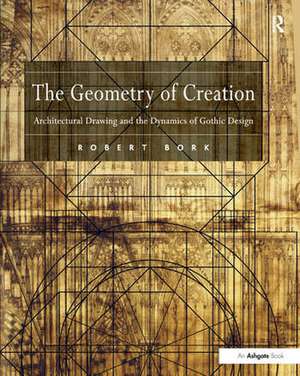
The Geometry of Creation: Architectural Drawing and the Dynamics of Gothic Design
Autor Robert Borken Limba Engleză Paperback – 23 sep 2016
Considerăm că The Geometry of Creation reprezintă o incursiune fascinantă în mintea constructorilor medievali, pornind de la analiza detaliată a desenelor de turnuri germanice, unde precizia compasului dictează o complexitate structurală fără precedent. Departe de a fi simple schițe, aceste „planuri” timpurii păstrează amprenta fizică a creatorilor lor: înțepături de compas și linii de construcție fine, vizibile doar sub o examinare atentă, care dezvăluie o metodologie de lucru bazată pe o geometrie riguroasă, nealterată de erorile execuției pe șantier.
Putem afirma că volumul propune o experiență vizuală inedită, integrând grafica computerizată pentru a reconstrui, pas cu pas, procesul creativ. Această abordare permite cititorului să vadă cum forme abstracte se transformă în structuri monumentale prin operațiuni geometrice fundamentale. Structura cărții, organizată cronologic și regional — de la originile desenului arhitectural în Renania până la „provocarea italiană” — oferă o perspectivă panoramică asupra modului în care designul gotic a evoluat pe parcursul secolelor.
Ca și Ad Quadratum, lucrarea pune în valoare aplicarea geometriei practice în arhitectura medievală, dar cu un accent pe dinamica procesului de proiectare și pe modul în care desenul a devenit un instrument esențial de inovație. În contextul operei lui Robert Bork, volumul se distanțează de abordările istoriografice din American Gothic: Reflections on Gothic Architectural Scholarship in America, 1925–2025, concentrându-se mai degrabă pe „arheologia” tehnică a designului. Este o lucrare care demonstrează că declinul goticului în fața Renașterii nu a fost cauzat de limitări tehnice, ci de o schimbare a preferințelor estetice ale principilor umaniști, care au ales claritatea clasicismului în detrimentul complexității matematice gotice.
Preț: 474.57 lei
Preț vechi: 515.84 lei
-8%
Carte disponibilă
Livrare economică 25 mai-08 iunie
Livrare express 08-14 mai pentru 57.96 lei
Specificații
ISBN-10: 1138247677
Pagini: 488
Dimensiuni: 219 x 276 x 33 mm
Greutate: 1.12 kg
Ediția:1
Editura: Taylor & Francis
Colecția Routledge
Locul publicării:Oxford, United Kingdom
V-ar putea interesa
-
 -14%Preț: 125.77 lei146.92 lei
 -
 101 Things I Learned in Architecture SchoolMatthew Frederick-17%Preț: 99.29 lei118.95 lei
 -
 FormulationsAndrew Witt-20%Preț: 207.47 lei258.30 lei
 -
 Experiencing ArchitectureSteen Eiler Rasmussen-20%Preț: 247.85 lei310.53 lei
 -
 The Ten Books on ArchitectureVitruvius-38%Preț: 88.61 lei143.38 lei
 -
 The Gothic CathedralChristopher Wilson-16%Preț: 119.65 lei143.12 lei
 -
 The Classical Language of ArchitectureJohn Summerson-20%Preț: 82.70 lei103.22 lei
 -
 3D Thinking in Design and ArchitectureRoger Burrows-34%Preț: 216.21 lei329.54 lei
 -
 Sacred GeometryRobert Lawlor-18%Preț: 74.78 lei91.31 lei
 -
 Notes on the Synthesis of FormChristopher AlexanderPreț: 219.06 lei
 -
 Drawing GeometryJon AllenPreț: 89.64 lei
 -
 Funicular Structures: The Art of Building EfficientlyDamon BolhassaniPreț: 352.85 leiRecomandat
 -
 Drawing Architecture and the UrbanSam JacobyPreț: 345.98 lei
 -
 Geometry of DesignKimberly Elam-13%Preț: 114.07 lei130.76 lei
 -
 Heaven on EarthEmma J. Wells-28%Preț: 75.36 lei104.02 lei
 -
 Brunelleschi and the Moment of the RenaissanceMarvin TrachtenbergPreț: 344.67 lei
 -
 Drawing ArchitectureHelen ThomasPreț: 331.59 lei
 -
 Drawing for Product DesignersKevin Henry-31%Preț: 153.44 lei222.24 lei
 -
 The Cosmos in StoneTom BreePreț: 214.34 lei
 -
 Sacred GeometryMiranda LundyPreț: 44.77 lei
De ce să citești această carte
Recomandăm această carte arhitecților, istoricilor de artă și pasionaților de geometrie care doresc să înțeleagă „codul sursă” al catedralelor europene. Cititorul câștigă o înțelegere profundă a modului în care instrumente simple au generat structuri de o complexitate uluitoare. Este o resursă rară care transformă analiza tehnică într-o poveste despre creativitate, demonstrând cum grafica modernă poate ilumina secretele de design vechi de secole.
Despre autor
Robert Bork este un distins istoric al arhitecturii, cunoscut pentru cercetările sale meticuloase asupra perioadei gotice. Prin lucrări precum New Approaches to Medieval Architecture sau coordonarea volumelor din seria AVISTA, Bork s-a impus ca o autoritate în studiul tehnologiei și științei medievale. Expertiza sa îmbină rigoarea analizei geometrice cu o înțelegere profundă a contextului cultural, reușind să aducă la viață metodele de lucru ale maeștrilor constructori de mult uitați. Interesul său vast, care acoperă de la prelucrarea metalelor în De Re Metallica până la istoria bursei de studii arhitecturale, oferă cărților sale o profunzime academică remarcabilă.