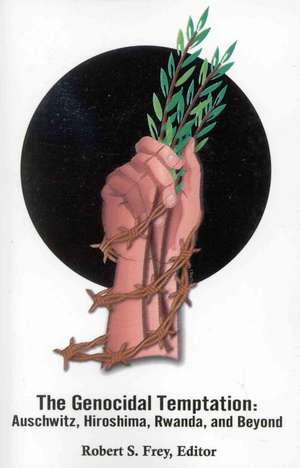
The Genocidal Temptation: Auschwitz, Hiroshima, Rwanda, and Beyond: University Press of America
Editat de Robert S. Frey Contribuţii de Harald Runblom, Darrell J. Fasching, Eric Markusen, Samuel Totten, Henry R. Huttenbach, Steven Leonard Jacobs, Dovilé Budryté, Peter V. Ronayne, Hans Askenasy, Warren K. A. Thompson, Steven Carter, William A. Rottschaefer, David R. Blumenthal, Alan Milchman, Alan Rosenberg, Konrad Paul Liessmannen Limba Engleză Paperback – 10 feb 2004
Din seria University Press of America
- 35%
 Preț: 376.42 lei
 - 27%
 Preț: 255.50 lei
 - 33%
 Preț: 388.94 lei
 - 27%
 Preț: 277.28 lei
 - 29%
 Preț: 343.67 lei
 - 33%
 Preț: 356.32 lei
 - 28%
 Preț: 238.63 lei
 - 27%
 Preț: 352.54 lei
 - 27%
 Preț: 276.97 lei
 - 33%
 Preț: 485.31 lei
 - 27%
 Preț: 252.84 lei
 - 27%
 Preț: 273.68 lei
 - 39%
 Preț: 527.38 lei
 - 26%
 Preț: 279.74 lei
 - 23%
 Preț: 314.30 lei
 - 27%
 Preț: 252.91 lei
 - 36%
 Preț: 369.19 lei
 - 28%
 Preț: 251.94 lei
 - 34%
 Preț: 443.80 lei
 - 26%
 Preț: 286.36 lei
 - 34%
 Preț: 351.50 lei
 - 35%
 Preț: 374.40 lei
 - 33%
 Preț: 491.96 lei
 - 27%
 Preț: 266.67 lei
 - 33%
 Preț: 481.51 lei
 - 27%
 Preț: 253.44 lei
 - 27%
 Preț: 273.68 lei
 - 34%
 Preț: 348.03 lei
 - 26%
 Preț: 285.87 lei
 - 29%
 Preț: 345.60 lei
 - 27%
 Preț: 256.41 lei
 - 27%
 Preț: 258.17 lei
 - 23%
 Preț: 322.16 lei
 - 34%
 Preț: 506.57 lei
 - 32%
 Preț: 390.38 lei
 - 25%
 Preț: 306.96 lei
 - 33%
 Preț: 390.66 lei
 - 34%
 Preț: 442.53 lei
 - 32%
 Preț: 363.17 lei
 - 27%
 Preț: 276.77 lei
 - 34%
 Preț: 536.65 lei
 - 27%
 Preț: 255.93 lei
 - 25%
 Preț: 364.66 lei
 - 32%
 Preț: 458.54 lei
 - 34%
 Preț: 474.70 lei
 - 37%
 Preț: 730.79 lei
 - 26%
 Preț: 357.73 lei
 - 39%
 Preț: 531.33 lei
 - 23%
 Preț: 322.03 lei
Preț: 345.61 lei
Preț vechi: 530.66 lei
-35%
Puncte Express: 518
Carte tipărită la comandă
Livrare economică 18 noiembrie-02 decembrie
Livrare prin curier în România Termenul estimat este afișat lângă disponibilitate.
Transport gratuit de la 400.00 lei Plată online sau ramburs, în funcție de opțiunile comenzii.
Retur gratuit în 14 zile Comandă securizată și suport în română.
Specificații
ISBN-13: 9780761827436
ISBN-10: 0761827439
Pagini: 288
Dimensiuni: 148 x 216 x 22 mm
Greutate: 0.37 kg
Editura: Bloomsbury Publishing
Colecția University Press of America
Seria University Press of America
Locul publicării:New York, United States
ISBN-10: 0761827439
Pagini: 288
Dimensiuni: 148 x 216 x 22 mm
Greutate: 0.37 kg
Editura: Bloomsbury Publishing
Colecția University Press of America
Seria University Press of America
Locul publicării:New York, United States
Cuprins
Chapter 1 Foreword
Chapter 2 Preface
Chapter 3 Ethics After Auschwitz and Hiroshima
Chapter 4 Reflections on the Holocaust and Hiroshima
Chapter 5 To Deem nor Not to Deem "It" Genocide: A Double-Edged Sword
Chapter 6 More Than Genocide: Rwanda Revisited (Before and After 1994)
Chapter 7 Afraid to Call Genocide Genocide? Reflections on Rwanda and Beyond
Chapter 8 "We Call It Genocide": Soviet Deportations and Repression in the Memory of Lithuanians
Chapter 9 The United States and the "G-Word": Genocide and Denial Before and Beyond Rwanda
Chapter 10 Are We All Nazis?: Man's Inhumanity to Man and Goldhagen's Holocaustbabble
Chapter 11 The Holocaust and the MBA: A Suggestion
Chapter 12 Romancing the Apocalypse, or: Why We Stopped Worrying and Learned to Love the Bomb
Chapter 13 Naturalizing Moral Agency: A Critical Review of Some Recent Works on the Biological and Psychological Bases of Human Morality
Chapter 14 Despair and Hope in Post-Shoah Jewish Life
Chapter 15 Auschwitz and Hiroshima
Chapter 16 Hiroshima and the "Auschwitz Principle": Günther Anders' Theory of Industrial Killing
Chapter 17 Hiroshima, Mon Amour?
Chapter 18 The Power of Individual Decision Making in Generating Hope in the Twentieth- First Century: Neutralizing Genocidal Tendencies
Chapter 19 Auschwitz and Hiroshima: Icons of Our Century
Chapter 20 About the Contributors
Chapter 21 Subject and Name Index
Chapter 2 Preface
Chapter 3 Ethics After Auschwitz and Hiroshima
Chapter 4 Reflections on the Holocaust and Hiroshima
Chapter 5 To Deem nor Not to Deem "It" Genocide: A Double-Edged Sword
Chapter 6 More Than Genocide: Rwanda Revisited (Before and After 1994)
Chapter 7 Afraid to Call Genocide Genocide? Reflections on Rwanda and Beyond
Chapter 8 "We Call It Genocide": Soviet Deportations and Repression in the Memory of Lithuanians
Chapter 9 The United States and the "G-Word": Genocide and Denial Before and Beyond Rwanda
Chapter 10 Are We All Nazis?: Man's Inhumanity to Man and Goldhagen's Holocaustbabble
Chapter 11 The Holocaust and the MBA: A Suggestion
Chapter 12 Romancing the Apocalypse, or: Why We Stopped Worrying and Learned to Love the Bomb
Chapter 13 Naturalizing Moral Agency: A Critical Review of Some Recent Works on the Biological and Psychological Bases of Human Morality
Chapter 14 Despair and Hope in Post-Shoah Jewish Life
Chapter 15 Auschwitz and Hiroshima
Chapter 16 Hiroshima and the "Auschwitz Principle": Günther Anders' Theory of Industrial Killing
Chapter 17 Hiroshima, Mon Amour?
Chapter 18 The Power of Individual Decision Making in Generating Hope in the Twentieth- First Century: Neutralizing Genocidal Tendencies
Chapter 19 Auschwitz and Hiroshima: Icons of Our Century
Chapter 20 About the Contributors
Chapter 21 Subject and Name Index
Recenzii
By drawing on diverse disciplines and theories, Robert Frey's collection of essays makes an important contribution to Holocaust and Genocide history. Scholars will find particularly interesting the contributions on neutralizing genocidal tendencies and those dealing with trauma and memory in the wake of the Holocaust. The essays on Hiroshima, too, will spark a needed discussion about what constitutes genocide and the dangers of comparative victimization.
With genocide, an inescapable part of what Hannah Arendt called the 'terrible century' just past, raising serious questions is more important than presuming definitive answers. What I most appreciate about this book, dedicated to the exploration of genocide through various disciplinary perspectives and particular instances, is precisely the way in which the authors challengingly pose such questions. Fresh and sometimes irreverent in their approaches, the contributors place mass killing inescapably on our collective agenda. That is why I recommend this book with real enthusiasm.
This unique collection of essays by renowned scholars from many disciplines offers current reflections upon major incidents of genocides that have plagued us in the 20th century. One of the disturbing theses of this volume is the prediction that the 'genocidal temptation' might increase in the future in proportion to our ever-expanding technological and bureaucratic power unless we find ways and means to control this terrifying menace.
Robert Frey makes a significant contribution by compiling the reflections of key scholars who have thought long and hard about the Holocaust and other genocides. While warning that the temptations of genocide have not diminished with the twenty-first century's arrival they also help to show how those temptations may best be resisted. In these provocative pages, anguish and hope mix and mingle urgently.
A rich discussion of why genocide happens and what can be done to prevent it. ...Through definitional preciseness, concerned with avoiding a definitional process that dehumanizes conflict, and the adept marshalling of theological arguments, Frey's collection poses important and haunting questions. His multidisciplinary approach is a provocative introduction for the student interested in the topic of genocide and willing to grapple with it complexities.
Far more than just another collection of 'lest we forget' essays, this volume of original, current perspectives on the Holocaust and other genocides of the 20th and 21st centuries breaks important new ground by focusing on 'genocidal temptations' of the present and future as well as the past. By including the work of established scholars in philosophy and theology along with history and psychology, the editor has successfully organized an innovative, comprehensive analysis of the seductive rationalizations leading to massive outbreaks of human destruction. It could well be an essential life preserver as we face the threatening uncertainties of the new millennium.
With genocide, an inescapable part of what Hannah Arendt called the 'terrible century' just past, raising serious questions is more important than presuming definitive answers. What I most appreciate about this book, dedicated to the exploration of genocide through various disciplinary perspectives and particular instances, is precisely the way in which the authors challengingly pose such questions. Fresh and sometimes irreverent in their approaches, the contributors place mass killing inescapably on our collective agenda. That is why I recommend this book with real enthusiasm.
This unique collection of essays by renowned scholars from many disciplines offers current reflections upon major incidents of genocides that have plagued us in the 20th century. One of the disturbing theses of this volume is the prediction that the 'genocidal temptation' might increase in the future in proportion to our ever-expanding technological and bureaucratic power unless we find ways and means to control this terrifying menace.
Robert Frey makes a significant contribution by compiling the reflections of key scholars who have thought long and hard about the Holocaust and other genocides. While warning that the temptations of genocide have not diminished with the twenty-first century's arrival they also help to show how those temptations may best be resisted. In these provocative pages, anguish and hope mix and mingle urgently.
A rich discussion of why genocide happens and what can be done to prevent it. ...Through definitional preciseness, concerned with avoiding a definitional process that dehumanizes conflict, and the adept marshalling of theological arguments, Frey's collection poses important and haunting questions. His multidisciplinary approach is a provocative introduction for the student interested in the topic of genocide and willing to grapple with it complexities.
Far more than just another collection of 'lest we forget' essays, this volume of original, current perspectives on the Holocaust and other genocides of the 20th and 21st centuries breaks important new ground by focusing on 'genocidal temptations' of the present and future as well as the past. By including the work of established scholars in philosophy and theology along with history and psychology, the editor has successfully organized an innovative, comprehensive analysis of the seductive rationalizations leading to massive outbreaks of human destruction. It could well be an essential life preserver as we face the threatening uncertainties of the new millennium.