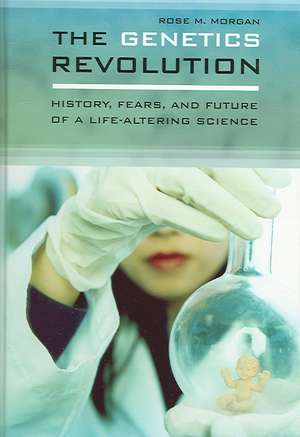
The Genetics Revolution: History, Fears, and Future of a Life-Altering Science
Autor Rose Morganen Limba Engleză Hardback – 30 noi 2005
The Genetics Revolution examines the scientific, social, and political impacts of the genetics on everyday life-in the past, in the present, and in the future. Each specific topic is contained within its own chapter for ease in accessing specific information. This is an ideal resource for students, teachers, and others preparing research papers. In addition, it integrates science and social science topics in a way that supports topics in the school curricula. The book contains documented, current information that both supports and challenges current thinking about genetics.
Preț: 249.03 lei
Preț vechi: 439.38 lei
-43%
Puncte Express: 374
Carte tipărită la comandă
Livrare economică 30 noiembrie-14 decembrie
Livrare prin curier în România Termenul estimat este afișat lângă disponibilitate.
Transport gratuit de la 400.00 lei Plată online sau ramburs, în funcție de opțiunile comenzii.
Retur gratuit în 14 zile Comandă securizată și suport în română.
Specificații
ISBN-13: 9780313336720
ISBN-10: 0313336725
Pagini: 232
Dimensiuni: 178 x 254 x 20 mm
Greutate: 0.65 kg
Editura: Bloomsbury Publishing
Colecția Greenwood
Locul publicării:New York, United States
ISBN-10: 0313336725
Pagini: 232
Dimensiuni: 178 x 254 x 20 mm
Greutate: 0.65 kg
Editura: Bloomsbury Publishing
Colecția Greenwood
Locul publicării:New York, United States
V-ar putea interesa
-
 Nursing Ethics: A Principle-Based ApproachSteven Edwards-20%Preț: 270.91 lei340.63 lei
 -
 Nursing EthicsA. Armstrong-5%Preț: 352.40 lei370.95 lei
 -
 -27%Preț: 243.28 lei335.15 lei
 -
 -27%Preț: 269.69 lei370.27 lei
 -
 Ethics of AutismDeborah R BarnbaumPreț: 171.22 lei
 -
 The Spirit Catches You and You Fall DownAnne FadimanPreț: 108.48 lei
 -
 Mental Health Ethics: The Human ContextPhil Barker-5%Preț: 389.08 lei409.56 lei
 -
 -5%Preț: 411.08 lei432.71 lei
 -
 Medical Ethics for DummiesJane Runzheimer-5%Preț: 119.17 lei125.44 lei
 -
 Due ConsiderationArthur L. Caplan-5%Preț: 410.49 lei432.09 lei
 -
 The Sorting SocietyLoane Skene-5%Preț: 513.87 lei540.93 lei
 -
 Public health ethics and practiceStephen Peckham-5%Preț: 246.09 lei259.04 lei
 -
 Values-Based Health & Social CareJill Mccarthy-5%Preț: 358.81 lei377.69 lei
 -
 -22%Preț: 192.30 lei246.19 lei
Cuprins
Preface
On the Brink of Altering Life
Recombining DNA Molecules
Splicing Life: Technological Revolution or Pandora's Box?
The Book of Life: The Human Genome Project
Beauty and the Beast
Laboratory Babies: New Biology, New Morality
The Warnock Report
Fighting to Save a Gene Pool
The Human Genome Diversity Project
The HGDP Debate
Threading an Ethical Needle
Stem Cell Research
A Major Decision
To Clone or Not to Clone: That is the Question
Reproductive Cloning
Cloning a Human
End Notes
Bibliography
On the Brink of Altering Life
Recombining DNA Molecules
Splicing Life: Technological Revolution or Pandora's Box?
The Book of Life: The Human Genome Project
Beauty and the Beast
Laboratory Babies: New Biology, New Morality
The Warnock Report
Fighting to Save a Gene Pool
The Human Genome Diversity Project
The HGDP Debate
Threading an Ethical Needle
Stem Cell Research
A Major Decision
To Clone or Not to Clone: That is the Question
Reproductive Cloning
Cloning a Human
End Notes
Bibliography
Recenzii
Over the past 35 years, the field of genetics has been inundated with new discoveries, capturing worldwide attention. In The Genetics Revolution, Morgan addresses the intriguing research on recombinant DNA technology, in vitro fertilization, the human genome diversity project, stem cell research, and cloning. The book is divided into five sections: On the Brink of Altering Life, Beauty and the Beast, Fighting to Save a Gene Pool, Threading an Ethical Needle, and To Clone or Not to Clone: That Is the Question. The author describes hallmark genetic discoveries to frame each research topic in a historical perspective without belaboring the genetic experimental protocols. In addition, the book presents the merits of all the research areas and their potential benefit to society. Finally, it considers ethical, moral, legal, and political issues. Recommended. Upper-division undergraduates and above.
The one topic that will probably be most useful for high school students is the recounting of the problems involved with the Human Genome Diversity Project. It is a topic in which the available information is sparse, but one that primarily involves sociology and anthropology aid is meaningful without an understanding of DNA sequencing.
To consider the future of genetic research, Morgan clarifies its history and examines five major research areas: the Human Genome Project and genetic engineering; in vitro fertilization and the technology of reproduction; the Human Genome Diversity Project; embryonic stem-cell research; and cloning. She also examines the scientific, social and political impacts of genetics on everyday life.
The one topic that will probably be most useful for high school students is the recounting of the problems involved with the Human Genome Diversity Project. It is a topic in which the available information is sparse, but one that primarily involves sociology and anthropology aid is meaningful without an understanding of DNA sequencing.
To consider the future of genetic research, Morgan clarifies its history and examines five major research areas: the Human Genome Project and genetic engineering; in vitro fertilization and the technology of reproduction; the Human Genome Diversity Project; embryonic stem-cell research; and cloning. She also examines the scientific, social and political impacts of genetics on everyday life.