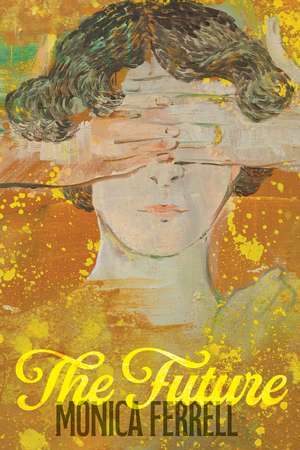
The Future
Autor Monica Ferrellen Limba Engleză Paperback – 15 mar 2026
At once irreverent yet elegant, sophisticated yet conversational, these poems capture what it means to get by day to day in a 21st century destabilized by ecological collapse, political havoc, and the incursion of technology into our most private and intimate spaces. “Every day I wake up,” Ferrell writes, “and ask, is it today? The volcano?” Restless in their imaginative scope, these poems leap across the world, from the enduring statues at Angkor Wat and Hampi to Alpine meadows contaminated with plastic to a supermarket in Vermont. Without papering over any of the difficulties we face today, Ferrell nonetheless expands our capacity to wonder, especially about the experience of motherhood, how the future keeps finding a way of breaking through.
This book manifests as that impossible, unimaginable collision that annihilates the world as we thought it was and sees it emerge as pure energy. Ferrell includes us in “the bequest of this battered planet, this sweetly belabored thing,” from one generation to the next, reminding us of the genesis contained inside obliteration: “one November night I too once opened my eyes to the bright.”
Preț: 99.01 lei
Puncte Express: 149
Carte disponibilă
Livrare economică 04-18 noiembrie
Livrare prin curier în România Termenul estimat este afișat lângă disponibilitate.
Transport gratuit de la 400.00 lei Plată online sau ramburs, în funcție de opțiunile comenzii.
Retur gratuit în 14 zile Comandă securizată și suport în română.
Specificații
ISBN-13: 9781961897823
ISBN-10: 1961897822
Pagini: 112
Dimensiuni: 152 x 229 x 10 mm
Greutate: 0.23 kg
Editura: FOUR WAY BOOKS
Colecția Four Way Books
ISBN-10: 1961897822
Pagini: 112
Dimensiuni: 152 x 229 x 10 mm
Greutate: 0.23 kg
Editura: FOUR WAY BOOKS
Colecția Four Way Books
Recenzii
This book depicts the unfathomable contours of time better than any other I know. Ontogeny recapitulates phylogeny, we’re told—and in poem after poem, Monica Ferrell brilliantly shows how each life contains in miniature the whole history of humankind, from the origin of our species to the civilizational extinction we live in fear of. Along the way, upwellings of love and awe—for our children, our lovers, and the great works of art that have shaped us—testify to an absurd, primal urge to stick around. The Future is a masterful and ambitious collection by one of our shrewdest poets.
—Maggie Millner
I’m startled by the breadth of this book, by its scope and its scale. In Monica Ferrell’s sweeping vision, ancient eons pass through quotidian modernity and out again into the farthest reaches of space and time, from the halls of the Neanderthals to the Macy’s Thanksgiving Day parade to the unwritten ice ages of a future human epoch. Ferrell’s language is ingenious in its juxtapositions of phrase, image, and subject, taking turns at once radical and revelatory. Here, we learn, “The future has a past with lichens and moss, / Nutcrackers, rusted cannons, and beer; / The past is a place where the moon dips / Her face and tries her hardest not to sneer.” I am thrilled by the pasts, the presents, and the expansive futures written into these poems, and I am grateful for them.
—Jaswinder Bolina
“Every word of writing is a form of goodbye,” writes Monica Ferrell in her virtuosic third book of poems, The Future. With erudition and dazzling mischief, Ferrell reckons with nothing less than history and bids farewell to the history of great men and great art and great omissions. This book isn’t merely critique or interrogation but a lyric reinvention of the past, wherein domesticity and cosmopolitanism join forces to reveal the weirdness of history and the weirdness of being human. If the brain is “a place for dreaming,” so, too, is this book. By wrangling with our timeworn past and present, Monica Ferrell dreams for us the future, making a radiant music out of the boisterous collision of ideas. The Future is visionary and masterful, and it is the future we’ve all been hoping for.
—Jennifer Chang
—Maggie Millner
I’m startled by the breadth of this book, by its scope and its scale. In Monica Ferrell’s sweeping vision, ancient eons pass through quotidian modernity and out again into the farthest reaches of space and time, from the halls of the Neanderthals to the Macy’s Thanksgiving Day parade to the unwritten ice ages of a future human epoch. Ferrell’s language is ingenious in its juxtapositions of phrase, image, and subject, taking turns at once radical and revelatory. Here, we learn, “The future has a past with lichens and moss, / Nutcrackers, rusted cannons, and beer; / The past is a place where the moon dips / Her face and tries her hardest not to sneer.” I am thrilled by the pasts, the presents, and the expansive futures written into these poems, and I am grateful for them.
—Jaswinder Bolina
“Every word of writing is a form of goodbye,” writes Monica Ferrell in her virtuosic third book of poems, The Future. With erudition and dazzling mischief, Ferrell reckons with nothing less than history and bids farewell to the history of great men and great art and great omissions. This book isn’t merely critique or interrogation but a lyric reinvention of the past, wherein domesticity and cosmopolitanism join forces to reveal the weirdness of history and the weirdness of being human. If the brain is “a place for dreaming,” so, too, is this book. By wrangling with our timeworn past and present, Monica Ferrell dreams for us the future, making a radiant music out of the boisterous collision of ideas. The Future is visionary and masterful, and it is the future we’ve all been hoping for.
—Jennifer Chang
Notă biografică
Monica Ferrell is the author of a novel and three books of poetry, including You Darling Thing (2018), a finalist for the Kingsley Tufts Poetry Award and the Believer Book Award in Poetry, and Beasts for the Chase (2008), winner of the Kathryn A. Morton Prize and finalist for the Asian American Writers Workshop Prize in Poetry. Born in New Delhi, she lives in Vermont.
Extras
Cosmos
I sign my name on the contract anew
Every morning that I walk to school.
Pulling a little kid in each fist,
I pay the future for those bodies we borrowed.
I prepare for my replacement
By filling their mouths with the whole jar of marbles:
English words and mincing syntax,
Dates, the names of revolutionary men.
Soon they will become the is and I a was.
At best, I will be a late-Roman shield
Thrown in a bog, engraved with illegible prayers,
Or a murk-dirtied corpse like a burnt candle,
Pollen-dusted rings moving concentrically
Away from me. Look at those two
Crossing the street, radiant with new day,
More beautiful than I have ever been.
Listen: I’m not sad. As long as I can,
I will work my little flute, which is to say
This body with all of its stops
Making a sort of music.
I sign my name on the contract anew
Every morning that I walk to school.
Pulling a little kid in each fist,
I pay the future for those bodies we borrowed.
I prepare for my replacement
By filling their mouths with the whole jar of marbles:
English words and mincing syntax,
Dates, the names of revolutionary men.
Soon they will become the is and I a was.
At best, I will be a late-Roman shield
Thrown in a bog, engraved with illegible prayers,
Or a murk-dirtied corpse like a burnt candle,
Pollen-dusted rings moving concentrically
Away from me. Look at those two
Crossing the street, radiant with new day,
More beautiful than I have ever been.
Listen: I’m not sad. As long as I can,
I will work my little flute, which is to say
This body with all of its stops
Making a sort of music.