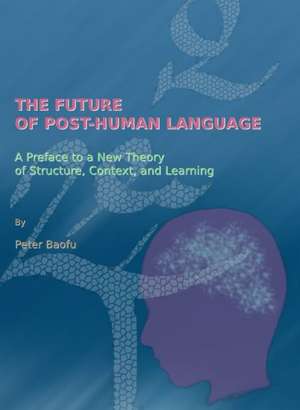
The Future of Post-Human Language: A Preface to a New Theory of Structure, Context, and Learning
Autor Peter PH. D . Baofuen Limba Engleză Hardback – 30 sep 2009
Descoperim aici o lucrare de o ambiție teoretică remarcabilă, care plasează studiul lingvisticii la intersecția dintre psihologia cognitivă, sociologie și filozofia post-umanistă. Autorul Peter PH. D . Baofu nu se limitează la o analiză filologică, ci investighează modul în care limitele limbajului definesc sau restricționează orizontul gândirii și al acțiunii umane. Notăm cu interes modul în care textul chestionează dihotomia clasică dintre structurile universale înnăscute și învățarea pur contextuală, propunând în schimb o viziune sistemică asupra viitorului comunicării.
Remarcăm o structură densă, argumentată pe parcursul a 389 de pagini, care extinde cadrul propus de Posthumanist Applied Linguistics cu date noi din perspectiva evoluției post-umane. În timp ce Alastair Pennycook se concentrează pe dimensiunea politică și ecologică a lingvisticii aplicate, Peter PH. D . Baofu avansează spre o teorie a structurii care include nu doar vorbirea, ci și mecanismele profunde ale învățării trans-lingvistice. Stilul este unul academic, precis, orientat către deconstruirea „închisorii limbajului” și explorarea modului în care tehnologia și evoluția socială vor redefini capacitatea noastră de a procesa realitatea.
Lucrarea funcționează ca un „prefață” la o nouă paradigmă, integrând natural concepte din neuroștiințe și antropologie. Față de abordările holistice precum cele din The Theory of Language Holography, volumul de față menține un ton analitic riguros, fiind relevant pentru curriculumul de studii avansate în științele comunicării și filozofia minții. Este o resursă esențială pentru cei care urmăresc tranziția de la umanismul clasic la noile forme de existență intelectuală asistată.
Preț: 446.20 lei
Carte disponibilă
Livrare economică 18 mai-01 iunie
Livrare express 02-08 mai pentru 43.64 lei
Specificații
ISBN-10: 1443813141
Pagini: 389
Dimensiuni: 150 x 206 x 33 mm
Greutate: 0.68 kg
Editura: Cambridge Scholars Publishing
V-ar putea interesa
-
 Preț: 80.02 lei
 -
 Correct Your French BlundersVéronique MazetPreț: 177.14 lei
 -
 Side-By-Side French and English Grammar, 3rd EditionC. Frederick Farrell-18%Preț: 109.73 lei133.43 lei
 -
 Side-By-Side Spanish and English Grammar, 3rd EditionEdith Farrell-13%Preț: 137.62 lei157.63 lei
 -
 German Stories/Deutsche Erzahlungen – A Bilingual En Face AnthologyHarry SteinhauerPreț: 233.60 lei
 -
 A Modern Persian Prose ReaderH. KamshadPreț: 326.36 lei
 -
 Media ArabicElisabeth Kendall-13%Preț: 94.46 lei108.07 lei
 -
 -15%Preț: 37.14 lei43.72 lei
 -
 Living Italian: 6th EditionMaria Valgimigli-28%Preț: 84.02 lei116.26 lei
 -
 Edexcel GCSE Spanish Foundation Student BookANNELI MCLACHLANPreț: 335.63 lei
De ce să citești această carte
Recomandăm această carte cercetătorilor și studenților la masterat sau doctorat în lingvistică, filozofie și științe cognitive. Cititorul câștigă o perspectivă critică asupra limitărilor teoriilor actuale de învățare și descoperă un cadru teoretic nou care integrează viitorul post-uman în studiul limbajului. Este un exercițiu intelectual dens care provoacă limitele înțelegerii tradiționale despre comunicare și cunoaștere.
Despre autor
Peter PH. D . Baofu este un teoretician prolific, cunoscut pentru dezvoltarea unor cadre conceptuale vaste în domeniul viitorologiei și al studiilor post-umane. Opera sa este marcată de o abordare multidisciplinară, publicând numeroase volume care analizează viitorul creativității, al științei și al comportamentului uman sub egida Cambridge Scholars Publishing. Autorul deține un doctorat care îi susține rigoarea academică, fiind recunoscut pentru capacitatea de a sintetiza date din istorie, psihologie și filozofie pentru a proiecta traiectoriile de evoluție ale civilizației umane în era tehnologică.