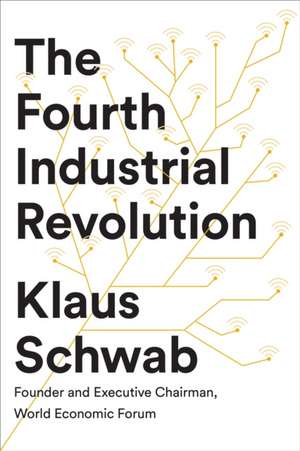
The Fourth Industrial Revolution
Autor Klaus Schwaben Limba Engleză Paperback – 5 ian 2017
Până în anul 2025, datele Forumului Economic Mondial indică faptul că vom asista la utilizarea comercială a unor nanomateriale de 200 de ori mai rezistente decât oțelul, dar de un milion de ori mai subțiri decât firul de păr uman. Suntem de părere că această statistică nu este doar un indicator al progresului tehnic, ci semnalul unei transformări structurale profunde. În The Fourth Industrial Revolution, Klaus Schwab demonstrează că nu ne confruntăm doar cu o simplă digitalizare, ci cu o fuziune fără precedent a sferelor fizice, digitale și biologice care va redefini însăși natura experienței umane. Putem afirma că această lucrare funcționează ca un manual strategic pentru înțelegerea mecanismelor care accelerează schimbarea în economie și guvernanță. Ca și Joseph N. Pelton în Preparing for the Next Cyber Revolution, autorul distilează experiență reală în principii acționabile, avertizând însă că viteza acestei a patra unde transformatoare nu are corespondent în istorie. Spre deosebire de analizele tehnice înguste, Klaus Schwab abordează sistemic impactul asupra pieței muncii și a identității individuale. Reținem că această perspectivă completează viziunea sa din Stakeholder Capitalism, unde analiza inegalitățile economice, oferind aici fundamentul tehnologic care cauzează sau, dimpotrivă, poate rezolva aceste disparități. Spre deosebire de Understanding Industry 4.0, care se concentrează pe evoluția profesiilor, The Fourth Industrial Revolution oferă o viziune de ansamblu asupra modului în care liderii pot modela viitorul prin design bazat pe valori. Textul este dens în informații factuale, menținând un ton pragmatic și autoritar, esențial pentru decidenții care doresc să navigheze într-un peisaj dominat de inteligență artificială, biotehnologie și sisteme autonome.
Preț: 61.01 lei
Preț vechi: 107.24 lei
-43%
Carte disponibilă
Livrare economică 19-25 noiembrie
Livrare express 30 octombrie-05 noiembrie pentru 32.11 lei
Specificații
ISBN-10: 0241300754
Pagini: 192
Dimensiuni: 233 x 152 x 16 mm
Greutate: 0.25 kg
Editura: Penguin Books
Colecția Portfolio
Locul publicării:London, United Kingdom
V-ar putea interesa
-
 XCLASSICS-LEAVES OF GRASS PBWalt WhitmanPreț: 28.98 lei
 -
 The GlobalistJohn WalshPreț: 110.53 lei
 -
 Snakes in SuitsPaul BabiakPreț: 146.20 lei
 -
 Thinking, Fast and SlowDaniel Kahneman-27%Preț: 90.79 lei123.57 leiRecomandat
 -
 -18%Preț: 89.17 lei108.72 lei
 -
 Leaves of GrassWalt WhitmanPreț: 29.30 lei
 -
 My View of the WorldErwin SchrodingerPreț: 104.92 lei
 -
 A Culture of GrowthJoel MokyrPreț: 162.55 lei
 -
 Higgs ForceNicholas MeePreț: 96.49 lei
 -
 Preț: 153.14 lei
 -
 Abundance: The Future Is Better Than You ThinkPeter H. Diamandis-17%Preț: 78.43 lei94.91 lei
 -
 The Industries of the FutureAlec Ross-8%Preț: 66.51 lei72.32 lei
 -
 The Fourth Industrial RevolutionKevin ChenPreț: 160.17 lei
 -
 Manufacturing Happy CitizensEdgar CabanasPreț: 132.88 lei
 -
 The Singularity is NearerRay KurzweilPreț: 94.17 lei
 -
 Drawing on the Right Side of the BrainBetty EdwardsPreț: 147.61 lei
 -
 Cosmic Consciousness - A Study in the Evolution of the Human MindRichard Maurice BuckePreț: 169.12 lei
 -
 Megatech: Technology in 2050Daniel Franklin-20%Preț: 54.29 lei68.25 lei
 -
 -17%Preț: 66.57 lei80.42 lei
 -
 -16%Preț: 106.04 lei126.10 lei
 -
 Preț: 184.35 lei
 -
 -19%Preț: 111.19 lei137.01 lei
De ce să citești această carte
Recomandăm această carte liderilor și profesioniștilor care doresc să înțeleagă forțele tehnologice ce vor dicta deceniul următor. Cititorul va obține o hartă clară a schimbărilor din industrie și administrație, învățând cum să anticipeze impactul nanomaterialelor sau al mașinilor autonome. Este o resursă esențială pentru a trece de la simpla adaptare la modelarea proactivă a viitorului economic și social.
Despre autor
Klaus Schwab este un distins inginer și economist german, recunoscut la nivel global în calitate de fondator și președinte executiv al Forumului Economic Mondial. Cu o carieră dedicată analizei dinamicii economice globale, Schwab a publicat lucrări fundamentale precum Stakeholder Capitalism și Covid-19: La Grande Réinitialisation. Expertiza sa în intersecția dintre tehnologie și politicile publice îl poziționează ca una dintre cele mai influente voci în definirea conceptului de Industrie 4.0, promovând constant necesitatea unei guvernanțe bazate pe etică și incluziune.
Notă biografică
Professor Klaus Schwab is founder and executive chairman of the World Economic Forum, the International Organization for Public-Private Cooperation. In 1998, he created the Schwab Foundation for Social Entrepreneurship, which seeks to identify, recognize and disseminate initiatives in social entrepreneurship that have the potential to be replicated on a global scale. An engineer and economist by training, Professor Klaus Schwab holds doctorates in Economics (summa cum laude) from the University of Fribourg; in Engineering from the Swiss Federal Institute of Technology; and a Masters of Public Administration from the Kennedy School of Government at Harvard University. He has received numerous international and national honours.
Recenzii
It's no secret that technologies are reshaping the world's economies and societies. To manage the risks and spread the benefits, we have to act now, and in the interest of stakeholders everywhere
Sheds light on what's at stake for society and how leaders can play a part in shaping the course of history. Klaus makes a powerful call in the book: "We have to shake things up before technological inertia determines our future for us." Act now
The technologies of the Fourth Industrial Revolution are extraordinary. Leadership has to be equally extraordinary to manage the complexities of systemic change
This book is essential for gaining a perspective on some of the critical challenges that rapid technological change poses to us all: ensuring the wellbeing of societies, understanding the evolving role of governments, and rethinking how the global economy will work in the 21st century
The World Economic Forum shows us that improving the state of the world will mean seriously thinking about, and empowering, all of those whose lives are transformed by technologies
Prosperity with technology means defending the rights of women on the frontline of change, defending the dignity of work for all workers and improving working conditions around the world. A Fourth Industrial Revolution that can do that would benefit us all
The Fourth Industrial Revolution is being felt profoundly around the world. Chapter by chapter, special insights from some of the best minds from the World Economic Forum's community show just where leadership focus is needed
Descriere scurtă
We are on the brink of the Fourth Industrial Revolution. And this one will be unlike any other in human history.
Characterized by new technologies fusing the physical, digital and biological worlds, the Fourth Industrial Revolution will impact all disciplines, economies and industries - and it will do so at an unprecedented rate. World Economic Forum data predicts that by 2025 we will see: commercial use of nanomaterials 200 times stronger than steel and a million times thinner than human hair; the first transplant of a 3D-printed liver; 10% of all cars on US roads being driverless; and much more besides.
InThe Fourth Industrial Revolution, Schwab outlines the key technologies driving this revolution, discusses the major impacts on governments, businesses, civil society and individuals, and offers bold ideas for what can be done to shape a better future for all.