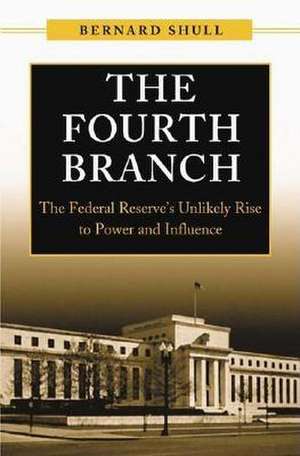
The Fourth Branch: The Federal Reserve's Unlikely Rise to Power and Influence
Autor Bernard Shullen Limba Engleză Hardback – 30 iul 2005
In many ways, the story of the Fed is the classic American epic: turning adversity into opportunity, responding to threat by innovating and adapting. Even today, under attack by liberals and conservatives alike-in the wake of the stock market bubble, economic recession, and rampant job loss-the Fed is poised to remain strong long after the tenure of legendary Chairman Alan Greenspan. Setting the current profile of the Fed against its evolutionary context, The Fourth Branch sheds new light on the Fed's character and its impact on our economic, political, and cultural history.
Preț: 473.98 lei
Preț vechi: 675.27 lei
-30%
Puncte Express: 711
Carte tipărită la comandă
Livrare economică 28 noiembrie-12 decembrie
Livrare prin curier în România Termenul estimat este afișat lângă disponibilitate.
Transport gratuit pentru acest produs Plată online sau ramburs, în funcție de opțiunile comenzii.
Retur gratuit în 14 zile Comandă securizată și suport în română.
Specificații
ISBN-13: 9781567206241
ISBN-10: 1567206247
Pagini: 272
Dimensiuni: 156 x 235 x 28 mm
Greutate: 0.58 kg
Ediția:New.
Editura: Bloomsbury Publishing
Colecția Praeger
Locul publicării:New York, United States
ISBN-10: 1567206247
Pagini: 272
Dimensiuni: 156 x 235 x 28 mm
Greutate: 0.58 kg
Ediția:New.
Editura: Bloomsbury Publishing
Colecția Praeger
Locul publicării:New York, United States
V-ar putea interesa
-
 -19%Preț: 92.36 lei113.66 lei
 -
 Option TradingEuan Sinclair-8%Preț: 386.15 lei419.72 lei
 -
 Top Hedge FundRittereiserPreț: 361.77 lei
 -
 The Little Book of Big DividendsCharles B CarlsonPreț: 149.07 lei
 -
 The Conscious InvestorJohn PricePreț: 293.26 lei
 -
 Trading with Ichimoku CloudsManesh Patel-8%Preț: 432.69 lei470.32 lei
 -
 Preț: 191.04 lei
 -
 Preț: 128.89 lei
 -
 The Universal Principles of SuPenfoldPreț: 371.18 lei
 -
 Investments WorkbookMichael McMillanPreț: 293.78 lei
 -
 More Money Than God: Hedge Funds and the Making of the New EliteSebastian Mallaby-25%Preț: 91.82 lei123.20 lei
 -
 Payback TimePhil Town-25%Preț: 64.11 lei85.93 lei
Cuprins
Preface
Introduction
The Federal Reserve's Legacy
A Shock to the System: 1919-1921
Collapse and Revival: 1929-1935
Stagflation and the Monetary Experiment of 1979-1982
The Federal Reserve's Ascent
Final Remarks
Notes
Bibliography
Index
Introduction
The Federal Reserve's Legacy
A Shock to the System: 1919-1921
Collapse and Revival: 1929-1935
Stagflation and the Monetary Experiment of 1979-1982
The Federal Reserve's Ascent
Final Remarks
Notes
Bibliography
Index
Recenzii
Shull provides a good overview of the history of the Federal Reserve, emphasizing its role in three economic crises: the inflation and sudden deflation of 1919-21, the Great Depression, and the stagflation period of 1973-82. In each of these events, the Federal Reserve played an undistinguished role, and was often fingered as a major cause of the problem. Despite its failures, in the wake of each crisis the Federal Reserve emerged with enhanced powers. The author credits the success of the Federal Reserve in expanding its power to its willingness to change course when conditions require it. One could just as well conclude from the evidence presented in this work that the Federal Reserve has been rewarded because it has proven itself willing and able to serve the financial community. Shull, whose career includes working for the board of governors of the Federal Reserve and the Office of the Comptroller of the Currency as well as teaching, brings both archival material and the established literature into play. His book is well written and for the most part avoids technical analysis, making it accessible to undergraduate students. Recommended. Public and academic library collections, lower-division undergraduate and up.
Dr. Shull examines how, despite convincing evidence that misguided Federal Reserve policy exacerbated a number of major economic crises, the institution has consistently emerged from each crisis more powerful and influential than before. By focusing on three critical periods of economic stress (the inflation and deflation following World War I, the stock market crash of 1929 and subsequent Depression, and the volatility of the 1970s and 1980s), Dr. Shull argues that the key to the Federal Reserve's unexpected success has been awareness of its immense value in national emergencies and its capacity to adapt to the changing economic conditions and political realities of the past century.
Dr. Shull examines how, despite convincing evidence that misguided Federal Reserve policy exacerbated a number of major economic crises, the institution has consistently emerged from each crisis more powerful and influential than before. By focusing on three critical periods of economic stress (the inflation and deflation following World War I, the stock market crash of 1929 and subsequent Depression, and the volatility of the 1970s and 1980s), Dr. Shull argues that the key to the Federal Reserve's unexpected success has been awareness of its immense value in national emergencies and its capacity to adapt to the changing economic conditions and political realities of the past century.