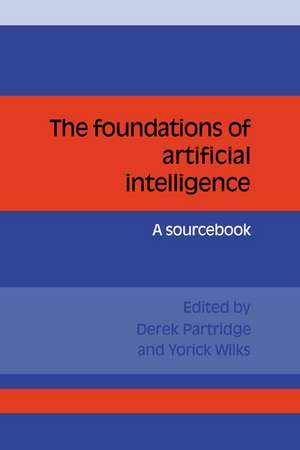
The Foundations of Artificial Intelligence
Editat de Derek Partridge, Yorick Wilksen Limba Engleză Paperback – 30 noi 2005
Preț: 459.91 lei
Puncte Express: 690
Carte tipărită la comandă
Livrare economică 06-20 noiembrie
Livrare prin curier în România Termenul estimat este afișat lângă disponibilitate.
Transport gratuit pentru acest produs Plată online sau ramburs, în funcție de opțiunile comenzii.
Retur gratuit în 14 zile Comandă securizată și suport în română.
Specificații
ISBN-13: 9780521359443
ISBN-10: 0521359449
Pagini: 516
Dimensiuni: 156 x 234 x 28 mm
Greutate: 0.78 kg
Ediția:New.
Editura: Cambridge University Press
Locul publicării:Cambridge, United Kingdom
ISBN-10: 0521359449
Pagini: 516
Dimensiuni: 156 x 234 x 28 mm
Greutate: 0.78 kg
Ediția:New.
Editura: Cambridge University Press
Locul publicării:Cambridge, United Kingdom
V-ar putea interesa
-
 -20%Preț: 89.95 lei112.23 lei
 -
 Machine TranslationYorick Wilks-20%Preț: 823.48 lei1029.35 lei
 -
 The Quest for Artificial IntelligenceNils J. Nilsson-20%Preț: 287.92 lei359.91 lei
 -
 Computational Logic and Human ThinkingRobert Kowalski-20%Preț: 330.76 lei413.44 lei
 -
 Density Ratio Estimation in Machine LearningMasashi Sugiyama-20%Preț: 899.94 lei1124.93 lei
 -
 Text-to-Speech SynthesisPaul Taylor-14%Preț: 756.47 lei879.61 lei
 -
 Multiagent SystemsYoav Shoham-20%Preț: 476.99 lei596.24 lei
 -
 Artificial Believers: The Ascription of BeliefAfzal Ballim-18%Preț: 1120.74 lei1366.77 lei
 -
 Computer VisionSimon J. D. Prince-20%Preț: 574.23 lei717.78 lei
 -
 Machine LearningPeter Flach-20%Preț: 386.84 lei483.55 lei
 -
 Multi-Agent Machine LearningSchwartz-20%Preț: 653.53 lei816.92 lei
 -
 Wavelet Neural NetworksAntonis K Alexandridis-20%Preț: 613.26 lei766.58 lei
 -
 Practical Introduction to CompDawson-Howe-20%Preț: 501.15 lei626.44 lei
 -
 Machine Learning: An Algorithmic Perspective, Second EditionStephen Marsland-20%Preț: 614.34 lei767.93 lei
 -
 Artificial Intelligence and Software EngineeringDerek Partridge-18%Preț: 1311.86 lei1599.83 lei
 -
 -9%Preț: 987.33 lei1084.98 lei
 -
 The Seductive ComputerDerek Partridge-20%Preț: 255.52 lei319.40 lei
 -
 Believable BotsPhilip Hingston-20%Preț: 656.24 lei820.30 lei
 -
 WHAT MAKES YOU CLEVERPartridge Derek-15%Preț: 492.85 lei579.83 lei
Cuprins
List of contributors; Preface; Acknowledgements; Part I. Introduction: 1. What is AI anyway? Roger C. Schank; 2. What kind of information processing is intelligence? B. Chandrasekaran; Part II. The Formal Foundations of AI: 3. Non-monotonic reasoning versus logic programming: a new perspective Teodor C. Przymusinski; 4. Prolegomena to a theory of mechanized formal reasoning Richard W. Weyhrauch; Part III. Levels of Theory: 5. AI: a personal view David Marr; 6. Has AI helped psychology? Margaret A. Boden; 7. What's in an AI program? Derek Partridge; Part IV. Programs and Theories: 8. One smal head: models and theories Yorick Wilks; 9. The nature of AI principles Alan Bundy and Stellan Ohlsson; 10. What's in an AI program? Derek Partridge; Part V. The Role of Representations: 11. Thinking machines: can there be? are we? Terry Winograd; 12. Evolution, error, and intentionality Daniel C. Dennett; Part VI. The Role of Programs in AI: 13. What kind of fields is AI? Alan Bundy; 14. Programs in the search for intelligent machines: the mistaken foundations of AI Eric Dietrich; Part VII. Rational Reconstruction as an AI Methodology: 15. The novelties of AI: theories, rograms and rational reconstructions J. A. Campbell; 16. AM: a case study in AI methodology G. D. Ritchie and F. K. Hanna; Part VIII. Is AI Special in Regard to its Methodology?: 17. Is there anything special about AI? Roger M. Needham; 18. What sort of a thing is an AI experiment? Karen Sparck Jones; 19. We need better standards for AI research John McCarthy; Part IX. Does Connectionism Provide a New Paradigm for AI? 20. Why there still has to be a language of thought Jerry A. Fodor; 21. Connectionism and the foundations of AI Paul Smolensky; 22. Some comments on Smolensky and Fodor Yorick Wilks; 23. Representation and high-speed computation in neural networks Paul M. Churchland; Part X. The Role of Correctness in AI: 24. Does AI have a methodology different from software engineering? Derek Partridge and Yorick Wilks; 25. AI, computer science and education Ranan Banerji; Part XI. Limitations on Current AI Technology: 26. The challenge of open systems Carl Hewitt; 27. Towards a reconciliation of phenomenology and AI Stuart E. Dreyfus and Hubert L. Druyfus; 28. The superarticulacy phenomenon in the context of software manufacture Donald Michie; Part XII. Annotated Bibliography on the Foundations of AI Imre Balogh and Brian M. Slator; Index of names.
Recenzii
"A nontechnical treatment of AI, recommended for general readers." Choice
"...a valuable resource and a model for future publications." William Hunt, Canadian Artificial Intelligence
"...any reader who wants to stop at the question as to what AI really is will find this collection of papers a valuable sourcebook." G.A.W. Vreeswijk, Mathematical Reviews
"...a valuable resource and a model for future publications." William Hunt, Canadian Artificial Intelligence
"...any reader who wants to stop at the question as to what AI really is will find this collection of papers a valuable sourcebook." G.A.W. Vreeswijk, Mathematical Reviews
Descriere
This outstanding collection is designed to address the fundamental issues and principles underlying the task of Artificial Intelligence.