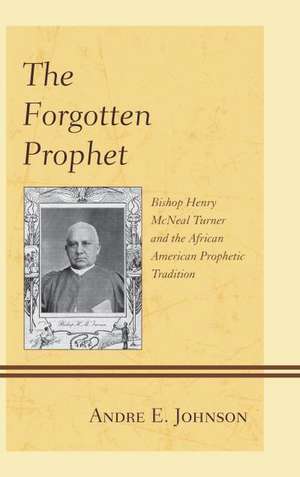
The Forgotten Prophet: Bishop Henry McNeal Turner and the African American Prophetic Tradition
Autor Andre E. Johnsonen Limba Engleză Paperback – 3 iun 2014
Preț: 340.48 lei
Preț vechi: 481.35 lei
-29%
Puncte Express: 511
Carte tipărită la comandă
Livrare economică 17 noiembrie-01 decembrie
Livrare prin curier în România Termenul estimat este afișat lângă disponibilitate.
Transport gratuit de la 400.00 lei Plată online sau ramburs, în funcție de opțiunile comenzii.
Retur gratuit în 14 zile Comandă securizată și suport în română.
Specificații
ISBN-13: 9780739197677
ISBN-10: 0739197673
Pagini: 127
Dimensiuni: 155 x 230 x 11 mm
Greutate: 0.2 kg
Editura: Bloomsbury Publishing
Colecția Lexington Books
Locul publicării:New York, United States
ISBN-10: 0739197673
Pagini: 127
Dimensiuni: 155 x 230 x 11 mm
Greutate: 0.2 kg
Editura: Bloomsbury Publishing
Colecția Lexington Books
Locul publicării:New York, United States
V-ar putea interesa
-
 After You BelieveN T WrightPreț: 109.10 lei
 -
 Reflective CaringBob WhortonPreț: 85.68 lei
 -
 Developing Healthy ChurchesROBERT WARRENPreț: 123.22 lei
 -
 The Shaping of Things to ComeAlan HirschPreț: 127.88 lei
 -
 The Theological Turn in Youth MinistryAndrew RootPreț: 142.48 lei
 -
 Preț: 56.28 lei
 -
 Disability & the GospelMichael S BeatesPreț: 96.67 lei
 -
 Speaking of DyingFred CraddockPreț: 166.32 lei
 -
 IgodsCraig DetweilerPreț: 139.44 lei
Cuprins
Chapter 1. "Let By-Gones be By-Gones": Emancipation and Turner's Celebratory Prophecy
Chapter 2. "Hurling Thunderbolts" and "Fighting the Devil with Fire": Turner's Prophetic Disputation
Chapter 3. "To Seek Other Quarters": Turner's Mission-Oriented Prophecy
Chapter 4. "No Future for the Negro": Turner's Pessimistic Prophecy
Conclusion
Chapter 2. "Hurling Thunderbolts" and "Fighting the Devil with Fire": Turner's Prophetic Disputation
Chapter 3. "To Seek Other Quarters": Turner's Mission-Oriented Prophecy
Chapter 4. "No Future for the Negro": Turner's Pessimistic Prophecy
Conclusion
Recenzii
Johnson's analysis of this forgotten prophet's rhetoric offers fresh insights to scholars interested in the ways in which minority groups adopt radical, dissident, and prophetic stances in discourse. . . .The lasting significance of Johnson's work in The Forgotten Prophet is three-fold. First, he builds on and expands previous rhetorical scholarship on the prophetic tradition and enables future scholars to examine a wider field of texts from a prophetic standpoint. Second, the historical component of this analysis recovers lesser known ideas from the Reconstruction Era for a new generation to consider. . . .Finally, Turner's rhetoric is a powerful example of what it means to be prophetic: to fight in love for sacred values in defense of those who have no voice.
Andre Johnson's study of the speeches of Henry McNeal Turner, from his optimistic Emancipation Day Address in 1866, to sober reflections on the fiftieth anniversary of the proclamation in 1913, is an important step in recovering the story of African-Americans in the South during Reconstruction. Framing Turner's powerful words as examples of prophetic rhetoric, Johnson shows how even Turner's most pessimistic comments spoke to a wide audience eager for freedom yet demoralized by prejudice, discrimination, and violence. Although Turner's answer to the nation's racism-emigration-did not become a major movement in his lifetime, Johnson's study of Turner's prophetic voice enlarges our understanding of this neglected, but important figure in American history.
Andre Johnson's study of the speeches of Henry McNeal Turner, from his optimistic Emancipation Day Address in 1866, to sober reflections on the fiftieth anniversary of the proclamation in 1913, is an important step in recovering the story of African-Americans in the South during Reconstruction. Framing Turner's powerful words as examples of prophetic rhetoric, Johnson shows how even Turner's most pessimistic comments spoke to a wide audience eager for freedom yet demoralized by prejudice, discrimination, and violence. Although Turner's answer to the nation's racism-emigration-did not become a major movement in his lifetime, Johnson's study of Turner's prophetic voice enlarges our understanding of this neglected, but important figure in American history.