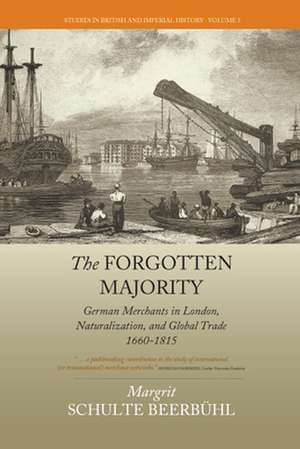
The Forgotten Majority: Studies in British and Imperial History, cartea 3
Autor Margrit Schulte Beerbühlen Limba Engleză Hardback – oct 2014



Preț: 764.15 lei
Preț vechi: 992.40 lei
-23%
Puncte Express: 1146
Carte tipărită la comandă
Livrare economică 07-21 decembrie
Livrare prin curier în România Termenul estimat este afișat lângă disponibilitate.
Transport gratuit pentru acest produs Plată online sau ramburs, în funcție de opțiunile comenzii.
Retur gratuit în 14 zile Comandă securizată și suport în română.
Specificații
ISBN-13: 9781782384472
ISBN-10: 1782384472
Pagini: 326
Dimensiuni: 157 x 235 x 22 mm
Greutate: 0.62 kg
Editura: BERGHAHN BOOKS
Colecția Studies in British and Imperial History
Seria Studies in British and Imperial History
ISBN-10: 1782384472
Pagini: 326
Dimensiuni: 157 x 235 x 22 mm
Greutate: 0.62 kg
Editura: BERGHAHN BOOKS
Colecția Studies in British and Imperial History
Seria Studies in British and Imperial History
V-ar putea interesa
-
 Britain ADFrancis PryorPreț: 93.30 lei
 -
 A Monarchy TransformedMark Kishlansky-18%Preț: 65.98 lei80.10 lei
 -
 Devolution in the United KingdomVernon Bogdanor-20%Preț: 123.70 lei155.49 lei
 -
 Codebreakers: The Inside Story of Bletchley ParkF. H. Hinsley-20%Preț: 102.63 lei127.82 lei
 -
 A History of Roman BritainPeter Salway-17%Preț: 132.99 lei160.78 lei
 -
 Anglo-Saxon EnglandFrank M. Stenton-21%Preț: 155.36 lei196.57 lei
 -
 The Later Tudors: England 1547-1603Penry Williams-21%Preț: 417.64 lei531.41 lei
 -
 -30%Preț: 566.98 lei805.39 lei
 -
 -27%Preț: 402.86 lei555.64 lei
 -
 -27%Preț: 467.74 lei642.80 lei
 -
 The Kings & Queens of EnglandNicholas Best-27%Preț: 46.81 lei64.14 lei
 -
 Raj: The Making and Unmaking of British IndiaLawrence James-23%Preț: 96.94 lei125.65 lei
 -
 Bletchley Park PeopleMarion HillPreț: 110.89 lei
 -
 Stephen and MatildaJim BradburyPreț: 94.31 lei
 -
 Enemy Coast AheadGuy GibsonPreț: 56.81 lei
 -
 IrishJohn Burrowes-19%Preț: 69.28 lei85.95 lei
Notă biografică
Margrit Schulte Beerbuhl is Professor of Modern History of the University of Dusseldorf. Her publications include Spinning the Commercial Web (Frankfurt 2004, ed. with Jorg Voegele), Migration and Transfer from Germany to Britain (Munchen 2007, ed. with Stefan Manz et al.), and Transnational Networks: German Migrants in the British Empire, 1670-1914 (Leiden 2012, ed. with Stefan Manz et al.).
Cuprins
List of Illustrations
List of Tables
Preface
Acknowledgments
Abbreviations
Introduction
Sources and Outline
Chapter 1. Naturalizing Newcomers for Prosperity (1660-1818)
Historical Sources
Bibliography
Index
List of Tables
Preface
Acknowledgments
Abbreviations
Introduction
Sources and Outline
Chapter 1. Naturalizing Newcomers for Prosperity (1660-1818)
- Early Modern English Naturalization Law
- Naturalized Subjects: Their Numbers and Native Lands
- The Occupations of German Immigrants who became English Subjects
- Reorganizing Anglo-German Trade during the 1600s
- London's German Merchants after 1660
- Lack of Trust and Understanding: Challenges for Both Sides
- German Merchant Trade in London
- Trading Regions and Commodities
- Late-Seventeenth-Century German Trade Networks
- German Merchants and London Trade Companies
- Fighting Regulated Companies
- Politics and Commerce
- London's German Trade Houses
- Starting out in London: The Way to Independence
- Trade Houses and Partners
- Chain Migration, Successors, and Transnational Alliances
- A German Perspective on the Development of Bilateral Trade
- The Rise and Organization of Early "Merchant Empires"
- Connecting Colonial Empires
- Early Merchant Empires - flexible and vulnerable
- British Trade with Russia and the Levant
- Naturalized Merchants in the Levant Company
- Naturalized Merchants in the Russia Company
- The Russia Company's Struggle with Naturalization Practices
- Naturalized Citizens and the Russia Company's Office in St. Petersburg
- The Bank of Scotland's Right to Naturalize
- Insurance and Trade at London's German Trade Houses
- London's Early Insurance Business
- Networking Europe with the Americas and Asia
- The Bankruptcy Trend and the Naturalized Subjects' Bankruptcies
- Waves of Bankruptcy during the Coalition Wars
- The Size of Failed Trade Houses during the Era of the Coalition Wars
- Muilman & Nantes
- Theophilus Blanckenhagen
- Persent & Bodecker
- Oom, Hoolboom, Knoblock & Co. and Hippius & Co.
- Estates of the Failed
- Certificate of Conformity and Brokering Commodities: Starting all over
- Commodity Brokers and the Freedom of the City
Historical Sources
Bibliography
Index