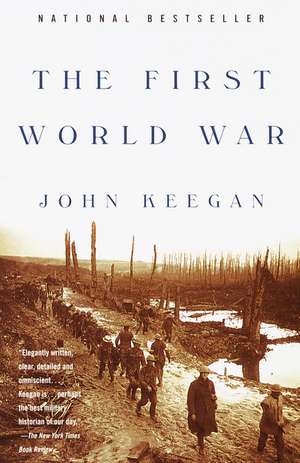
The First World War: Knopf Doubleday Publishing Group
Autor John Keeganen Limba Engleză Paperback – 16 mai 2000
Analiza modului în care o civilizație aflată la apogeul realizărilor sale a putut declanșa un conflict atât de devastator constituie tema centrală a acestei lucrări monumentale. Notăm cu interes felul în care John Keegan investighează nu doar fronturile de luptă, ci și negocierile din culise ale capetelor încoronate din Europa, evidențiind cum o dispută bilaterală a escaladat într-un cataclism continental din cauza unui eșec surprinzător de comunicare. Structura narativă îmbină rigoarea academică a analizei militare cu o sensibilitate profundă față de experiența umană, oferind detalii despre figuri precum Haig sau Hindenburg, dar și despre milioanele de combatanți anonimi. Descoperim aici o examinare metodică a bătăliilor legendare de la Verdun, Somme și Gallipoli, unde autorul pune un accent deosebit pe rolul geografiei și al tehnologiei în desfășurarea ostilităților. Ediția de față, publicată de Vintage Publishing, este îmbogățită cu 15 hărți în text și 24 de pagini de documente fotografice, elemente esențiale pentru înțelegerea logisticii unui război care a redesenat harta lumii prin colapsul imperiilor Austro-Ungar, Rus și Otoman. The First World War completează perspectiva oferită de The Oxford Illustrated History of the First World War de Hew Strachan, adăugând o analiză strategică și tactică mai densă, specifică stilului lui Keegan, față de abordarea enciclopedică a volumului de la Oxford. Putem afirma că acest volum reprezintă încununarea carierei autorului, integrându-se organic în bibliografia sa marcată de studii fundamentale despre psihologia luptei. Dacă în The Face of Battle Keegan se concentra pe experiența directă a individului în punctul de maxim pericol, în acest titlu el extinde cadrul, oferind o viziune panoramică ce explică tranziția violentă de la era victoriană la modernitatea secolului XX.
Din seria Knopf Doubleday Publishing Group
-
 Preț: 118.24 lei
 -
 Preț: 90.14 lei
 -
 Preț: 109.06 lei
 -
 Preț: 78.00 lei
 -
 Preț: 109.77 lei
 -
 Preț: 54.38 lei
 -
 Preț: 91.02 lei
 -
 Preț: 83.66 lei
 -
 Preț: 144.98 lei
 -
 Preț: 113.78 lei
 -
 Preț: 109.06 lei
 -
 Preț: 105.04 lei
 -
 Preț: 103.02 lei
 -
 Preț: 82.18 lei
 -
 Preț: 87.99 lei
 -
 Preț: 92.59 lei
 -
 Preț: 89.12 lei
 -
 Preț: 104.40 lei
 -
 Preț: 96.98 lei
 -
 Preț: 163.09 lei
 -
 Preț: 119.07 lei
 -
 Preț: 92.54 lei
 -
 Preț: 100.26 lei
 -
 Preț: 106.26 lei
 -
 Preț: 100.24 lei
 -
 Preț: 90.99 lei
 -
 Preț: 113.53 lei
 -
 Preț: 92.72 lei
 -
 Preț: 108.77 lei
 -
 Preț: 98.65 lei
 -
 Preț: 129.38 lei
 -
 Preț: 99.28 lei
 -
 Preț: 89.83 lei
 -
 Preț: 115.76 lei
 -
 Preț: 106.47 lei
 -
 Preț: 73.98 lei
 -
 Preț: 86.45 lei
 -
 Preț: 104.05 lei
 -
 Preț: 113.97 lei
 -
 Preț: 109.06 lei
 -
 Preț: 97.19 lei
 -
 Preț: 96.09 lei
 -
 Preț: 88.00 lei
 -
 Preț: 113.32 lei
 -
 Preț: 104.35 lei
 -
 Preț: 118.53 lei
 -
 Preț: 104.21 lei
 -
 Preț: 112.27 lei
 -
 Preț: 106.89 lei
 -
 Preț: 151.29 lei
Preț: 135.55 lei
Carte disponibilă
Livrare economică 28 octombrie-11 noiembrie
Specificații
ISBN-10: 0375700455
Pagini: 530
Ilustrații: 24 PP PHOTOS AND 17 MAPS
Dimensiuni: 201 x 131 x 33 mm
Greutate: 0.49 kg
Ediția:Vintage Books.
Editura: Random House
Colecția Knopf Doubleday Publishing Group
Seria Knopf Doubleday Publishing Group
Locul publicării:New York, NY
V-ar putea interesa
-
 Beyond Band of BrothersDick Winters-20%Preț: 84.70 lei105.78 lei
 -
 Britons: Forging the Nation 1707-1837Linda ColleyPreț: 160.18 lei
 -
 Gabriel Garcia MarquezMichael WoodPreț: 276.75 lei
 -
 PyramidsTerry Pratchett-11%Preț: 64.02 lei71.88 lei
 -
 The American Civil WarJohn Keegan-19%Preț: 87.53 lei108.01 lei
 -
 Intelligence In WarJohn Keegan-19%Preț: 86.54 lei106.65 lei
 -
 The Second World WarJohn Keegan-18%Preț: 189.39 lei232.05 lei
 -
 Woodbine WillieBob HolmanPreț: 77.98 lei
 -
 Animals in the First World WarNeil R. Storey-32%Preț: 41.34 lei60.51 lei
 -
 Remembering TommyPeter DoylePreț: 156.42 lei
 -
 A Volunteer Nurse on the Western FrontOlive DentPreț: 115.42 lei
 -
 Preț: 216.19 leiNou
 -
 The World Crisis Volume I: 1911-1914Sir Sir Winston S. Churchill-24%Preț: 190.91 lei251.08 lei
 -
 The Verdun RegimentJohnathan BrackenPreț: 190.53 lei
 -
 Public Schools and the Great WarAnthony SeldonPreț: 109.38 lei
 -
 -29%Preț: 64.00 lei90.21 lei
 -
 -21%Preț: 142.42 lei179.38 lei
 -
 Battle At SeaJohn KeeganPreț: 95.00 lei
 -
 The Mask of CommandJohn Keegan-20%Preț: 96.13 lei119.58 lei
 -
 The Count of Monte CristoAlexandre DumasPreț: 42.95 lei
 -
 Essential ScaliaAntonin Scalia-21%Preț: 173.66 lei218.85 lei
 -
 O să râzi, totul e chimie!: Telefoane, cafea, emoții – cum le explică pe toate chimiaDr. Mai Thi Nguyen-KimPreț: 49.00 lei
De ce să citești această carte
Această lucrare este esențială pentru cei care doresc să înțeleagă rădăcinile lumii moderne și mecanismele eșecului diplomatic. Cititorul câștigă o perspectivă clară asupra modului în care tehnologia și geografia au dictat cursul istoriei. Este o recomandare certă pentru studenții la istorie și relații internaționale, oferind un echilibru rar între analiza strategică de nivel înalt și cronica suferinței umane de pe front.
Despre autor
Sir John Keegan (1934–2012) a fost unul dintre cei mai distinși istorici militari britanici, activând ca lector la Academia Militară Regală Sandhurst și ca jurnalist pentru Daily Telegraph. Opera sa vastă acoperă evoluția conflictelor din preistorie până în secolul XXI, explorând dimensiuni diverse, de la informații militare și tactici navale până la psihologia soldatului. Prin lucrări precum A History of Warfare sau The Mask of Command, Keegan a redefinit istoriografia militară, punând sub semnul întrebării concepțiile tradiționale despre eroism și strategie în context politic.
Notă biografică
Extras
The First World War was a tragic and unnecessary conflict. Unnecessary because the train of events that led to its outbreak might have been broken at any point during the five weeks of crisis that preceded the first clash of arms, had prudence or common goodwill found a voice; tragic because the consequences of the first clash ended the lives of ten million human beings, tortured the emotional lives of millions more, destroyed the benevolent and optimistic culture of the European continent and left, when the guns at last fell silent four years later, a legacy of political rancour and racial hatred so intense that no explanation of the causes of the Second World War can stand without reference to those roots. The Second World War, five times more destructive of human life and incalculably more costly in material terms, was the direct outcome of the First. On 18 September 1922, Adolf Hitler, the demobilised front fighter, threw down a challenge to defeated Germany that he would realise seventeen years later: "It cannot be that two million Germans should have fallen in vain . . . No, we do not pardon, we demand--vengeance!"
The monuments to the vengeance he took stand throughout the continent he devastated, in the reconstructed centres of his own German cities, flattened by the strategic bombing campaign that he provoked, and of those--Leningrad, Stalingrad, Warsaw, Rotterdam, London--that he himself laid waste. The derelict fortifications of the Atlantic Wall, built in the vain hope of holding his enemies at bay, are monuments to his desire for vengeance; so, too, are the decaying hutments of Auschwitz and the remnants of the obliterated extermination camps at Sobibor, Belzec and Treblinka. A child's shoe in the Polish dust, a scrap of rusting barbed wire, a residue of pulverised bone near the spot where the gas chambers worked, these are as much relics of the First as of the Second World War. They have their antecedents in the scraps of barbed wire that litter the fields where the trenches ran, filling the French air with the smell of rust on a damp morning, in the mildewed military leather a visitor finds under a hedgerow, in the verdigrised brass of a badge or button, corroded clips of ammunition and pockmarked shards of shell. They have their antecedents also in the anonymous remains still upturned today by farmers ploughing the bloodsoaked soil of the Somme--"I stop work at once. I have a great respect for your English dead"--just as the barely viewable film of bodies being heaped into the mass graves at Belsen in 1945 has its antecedents in the blurred footage of French soldiers stacking the cordwood of their dead comrades after the Second Battle of Champagne in 1915. The First World War inaugurated the manufacture of mass death that the Second brought to a pitiless consummation.
There are more ceremonial monuments. Few French and British communities lack a memorial to the dead of the Second World War. There is one in my West Country village, a list of names carved at the foot of the funerary crucifix that stands at the crossroads. It is, however, an addition and an afterthought. The cross itself was raised to commemorate the young men who did not return from the First World War and their number is twice that of those killed in the Second. From a population of two hundred in 1914, W. Gray, A. Lapham, W. Newton, A. Norris, C. Penn, L. Penn and W. J. White, perhaps one in four of the village's men of military age, did not come back from the front. Theirs are names found in the church registers that go back to the sixteenth century. They survive in the village today. It is not difficult to see from the evidence that the Great War brought heartbreak on a scale never known since the settlement was established by the Anglo-Saxons before the Norman Conquest and, thankfully, has not been known since. The memorial cross is, the church apart, the only public monument the village possesses. It has its counterpart in every neighbouring village, in the county's towns, where the names multiply many times, and in the cathedral of the diocese at Salisbury. It has its counterpart, too, in every cathedral in France, in each of which will be seen a tablet bearing the inscription, "To the Glory of God and in memory of one million men of the British Empire who died in the Great War and of whom the greater number rest in France."
Nearby, certainly, will stand a memorial to the locality's own dead, itself replicated in every surrounding town and village. France lost nearly two million in the Great War, two out of every nine men who marched away. They are often symbolised by the statue of a poilu, defiant in horizon blue, levelling a bayonet eastward at the German frontier. The list of names on the plinth is heartrendingly long, all the more heartrending because repetition of the same name testifies to more than one death, often several, in the same family. There are similar lists to be seen graven in stone in the towns and cities of most combatant nations of the Great War. Particularly poignant, I find, is the restrained classicism of the memorial to the cavalry division of the Veneto that stands beside the cathedral of Murano in the lagoon of Venice, bearing row after row of names of young men from the lowlands of the River Po who died in the harsh uplands of the Julian Alps. I am touched by the same emotion in the churches of Vienna where severe stone tablets recall the sacrifice of historic Habsburg regiments now almost forgotten to history.
The Germans, who cannot decently mourn their four million dead of the Second World War, compromised as the Wehrmacht was by the atrocities of the Nazi state, found a materially, if not morally equivalent difficulty in arranging an appropriately symbolic expression of grief for their fallen of the First, since so many lay on foreign soil. The battlefields of the east were closed to them by the Bolshevik revolution, those of the west made at best grudgingly accessible for the retrieval and reburial of bodies. The French and the Belgians found little room in their hearts or in the national soil for the creation of German war cemeteries.
Descriere scurtă
Probing the mystery of how a civilization at the height of its achievement could have propelled itself into such a ruinous conflict, Keegan takes us behind the scenes of the negotiations among Europe's crowned heads (all of them related to one another by blood) and ministers, and their doomed efforts to defuse the crisis. He reveals how, by an astonishing failure of diplomacy and communication, a bilateral dispute grew to engulf an entire continent.
But the heart of Keegan's superb narrative is, of course, his analysis of the military conflict. With unequalled authority and insight, he recreates the nightmarish engagements whose names have become legend--Verdun, the Somme and Gallipoli among them--and sheds new light on the strategies and tactics employed, particularly the contributions of geography and technology. No less central to Keegan's account is the human aspect. He acquaints us with the thoughts of the intriguing personalities who oversaw the tragically unnecessary catastrophe--from heads of state like Russia's hapless tsar, Nicholas II, to renowned warmakers such as Haig, Hindenburg and Joffre. But Keegan reserves his most affecting personal sympathy for those whose individual efforts history has not recorded--"the anonymous millions, indistinguishably drab, undifferentially deprived of any scrap of the glories that by tradition made the life of the man-at-arms tolerable."
By the end of the war, three great empires--the Austro-Hungarian, the Russian and the Ottoman--had collapsed. But as Keegan shows, the devastation ex-tended over the entirety of Europe, and still profoundly informs the politics and culture of the continent today. His brilliant, panoramic account of this vast and terrible conflict is destined to take its place among the classics of world history.
With 24 pages of photographs, 2 endpaper maps, and 15 maps in text
Recenzii
"The best one-volume account there is." -Civilization
"Elegantly written, clear, detailed, and omniscient.... Keegan is ...perhaps the best military historian of our day." -The New York Times Book Review
"Undoubtedly the world's most accessible and popular military historian." -Los Angeles Times Book Review
"Magisterial.... A miracle of concision." -The Weekly Standard
"An epic tale.... Makes us keenly aware of how battles are fought, won, and lost." -Fortune