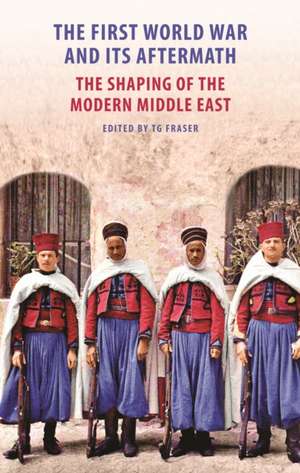
The First World War and Its Aftermath: The Shaping of the Modern Middle East
Editat de T. G. Fraseren Limba Engleză Paperback – 17 mar 2025
Suntem de părere că volumul The First World War and Its Aftermath oferă o perspectivă riguroasă asupra mecanismelor care au dus la fragmentarea Orientului Mijlociu modern, pornind de la studii de caz punctuale ce depășesc simpla narativă militară. Analizele se deschid cu examinarea naționalismului egiptean și a percepției străinilor între 1914 și 1923, continuând cu investigații asupra serviciilor de informații britanice și a impactului foametei în Siria și Liban. Această abordare practică și multisectorială permite cititorului să înțeleagă cum deciziile luate la Conferința de Pace de la Paris au ignorat realitățile sociale complexe, precum drepturile femeilor în Irak sau aspirațiile trans-sectare din Liban.
Volumul extinde cadrul propus de Making the Modern Middle East cu date noi din arhivele serviciilor de informații și studii aprofundate despre evoluția islamismului radical. În contextul operei editorului, lucrarea completează cercetările din Chaim Weizmann: The Zionist Dream, oferind contextul regional mai larg în care s-au desfășurat negocierile pentru viitorul Palestinei. Structura cărții este una progresivă: debutează cu transformările politice generale, trece prin experiențe naționale specifice (Egipt, Irak, Liban) și culminează cu o analiză critică a legitimității guvernanței în perioada post-otomană. Prin utilizarea hărților și a tabelelor statistice, autorii demonstrează cum „pokerul politic” al secolului XX a trasat linii arbitrare în nisip, separând comunități și punând bazele conflictelor contemporane, inclusiv ascensiunea grupărilor extremiste moderne.
Preț: 193.48 lei
Carte disponibilă
Livrare economică 09-23 noiembrie
Livrare express 23-29 octombrie pentru 24.88 lei
Specificații
ISBN-10: 1914983262
Pagini: 350
Ilustrații: 2 maps, 2 halftones, 5 tables
Dimensiuni: 133 x 216 x 28 mm
Greutate: 0.31 kg
Editura: Gingko
Colecția Gingko
De ce să citești această carte
Recomandăm această carte cercetătorilor și studenților la istorie sau relații internaționale care doresc să înțeleagă rădăcinile instabilității actuale din Orientul Mijlociu. Cititorul câștigă o viziune nuanțată asupra modului în care prăbușirea unui imperiu de secole a lăsat loc unor state artificiale. Este o resursă esențială pentru a decodifica tranziția de la pan-arabism la islamismul modern, oferind instrumente de analiză factuală în locul generalizărilor geopolitice.
Despre autor
T. G. Fraser este profesor emerit la Universitatea din Ulster și un specialist recunoscut în istoria conflictelor moderne. Expertiza sa se concentrează pe punctele de inflexiune istorică, fiind autorul unor lucrări de referință precum Ireland in Conflict 1922-1998 și Chaim Weizmann: The Zionist Dream. În acest volum, Fraser își folosește experiența vastă pentru a coordona o echipă de experți, integrând istoria Orientului Mijlociu în contextul mai larg al transformărilor globale de după 1914. Lucrările sale sunt apreciate pentru rigoarea documentară și capacitatea de a explica originile tensiunilor contemporane prin prisma deciziilor politice din secolul trecut.
Descriere scurtă
In addition to recounting the crucial international politics that drew fierce lines in the sands of the Middle East—a story of intrigue between the British, Russians, Ottomans, North Africans, Americans, and others—the contributors engage topics ranging from the war’s effects on women, the experience of the Kurds, sectarianism, the evolution of Islamism, and the importance of prominent intellectuals like Ziya Gökalp and Michel ‘Aflaq. They examine the dissolution of the Ottoman Empire, the exploitation of notions of Islamic unity and pan-Arabism, the influences of Woodrow Wilson and American ideals on Middle East leaders, and likewise the influence of Vladimir Lenin’s vision of a communist utopia. Altogether, they tell a story of promises made and promises broken, of the struggle between self-determination and international recognition, of centuries-old empires laying in ruin, and of the political poker of the twentieth century that carved up the region, separating communities into the artificial states we know today.
Notă biografică
Cuprins
T.G. Fraser
1. The rise of Egyptian nationalism and the perception of foreigners in Egypt 1914–1923
Amany Soliman
2. The antecedents and implications of the so-called Anglo-Sanussi War 1915–1917
Jason Pack
3. British intelligence and Arab nationalism: the origins of the modern Middle East
Steven Wagner
4. The First World War and its legacy for women in Iraq
Noga Efrati
5. From anti-imperial dissent to national consent: the First World War and the formation of a trans-sectarian national consciousness in Lebanon
Mark Farha
6. Historicising hunger: the famine in wartime Lebanon and Syria
Najwa al-Qattan
7. The patriarch, the amir and the patriots: civilisation and selfdetermination at the Paris Peace Conference
Andrew Arsan
8. A thoroughly modern Caliphate: could legitimate governance for the Middle East in the aftermath of the First World War have been found by looking within?
Louise Pyne-Jones
9. From the Archduke to the Caliph: the Islamist evolution that led to ‘The Islamic State’
Aaron Y. Zelin
10. Some reflections on whether the Mandates were a slow burning fuse for toxic sectarianism in Arab countries
John McHugo
11. Oil, state and society in Iran in the aftermath of the First World War
Kaveh Ehsani
12. The new Arab intellectuals of the post-First World War period: the case of Taha Husayn
Bruno Ronfard
13. A tale of two nationalists: parallelisms in the writings of Ziya Gökalp and Michel Aflaq
Michael Erdman
14. Women, war and the foundations of the Turkish Republic: the vision of New Womanhood in Halide Edib Adıvar’s The Shirt of Flame (1922)
Sevinç Elaman-Garner
15. The limits of soft power: why Kurdish nationalism failed in the French Mandate of Syria
Laila McQuade and Nabil Al-Tikriti
16. The other jihad: Enver Pasha, Bolsheviks, and politics of anticolonial Muslim nationalism during the Baku Congress 1920
Alp Yenen
17. A point of order: a battle for autonomy in the First Legislative Council of Transjordan
Harrison Guthorn
18. Drawing the line: Calouste Gulbenkian and the Red Line Agreement of 1928
Jonathan Conlin
Acknowledgements
Contributors
Index