
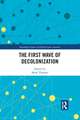
The First Wave of Decolonization: Routledge Studies in Global Latin America
Editat de Mark Thurneren Limba Engleză Hardback – 24 mai 2019
| Toate formatele și edițiile | Preț | Express |
|---|---|---|
| Paperback (1) | 378.94 lei 6-8 săpt. | |
| Taylor & Francis – 30 iun 2021 | 378.94 lei 6-8 săpt. | |
| Hardback (1) | 1010.87 lei 6-8 săpt. | |
| Taylor & Francis – 24 mai 2019 | 1010.87 lei 6-8 săpt. |


Preț: 1010.87 lei
Preț vechi: 1232.77 lei
-18%
Puncte Express: 1516
Preț estimativ în valută:
178.71€ • 211.93$ • 155.02£
178.71€ • 211.93$ • 155.02£
Carte tipărită la comandă
Livrare economică 11-25 martie
Specificații
ISBN-13: 9780367258702
ISBN-10: 0367258706
Pagini: 162
Ilustrații: 4 Halftones, black and white; 4 Illustrations, black and white
Dimensiuni: 152 x 229 x 14 mm
Greutate: 0.37 kg
Ediția:1
Editura: Taylor & Francis
Colecția Routledge
Seria Routledge Studies in Global Latin America
Locul publicării:Oxford, United Kingdom
ISBN-10: 0367258706
Pagini: 162
Ilustrații: 4 Halftones, black and white; 4 Illustrations, black and white
Dimensiuni: 152 x 229 x 14 mm
Greutate: 0.37 kg
Ediția:1
Editura: Taylor & Francis
Colecția Routledge
Seria Routledge Studies in Global Latin America
Locul publicării:Oxford, United Kingdom
Public țintă
Postgraduate and UndergraduateCuprins
Foreword. Introduction 1. A Brief Conceptual History of "Colonia" 2. Decolonizing Customs 3. Inventing Columbia/Colombia 4. Race and Revolution in Colombia, Haiti, and the United States 5. Decolonizing Europe 6. Second Slavery and Decolonization in Brazil 7. The Lost Italian Connection
Notă biografică
Mark Thurner is Professor of Latin American Studies at the Institute of Latin American Studies, School of Advanced Study, University of London.
Descriere
This volume is the first to describe and analyze the scope and meanings of the global phenomenon of decolonization during the late 18th and early 19th centuries. It vastly expands the horizons of decolonization, conventionally understood to be a post-war development emanating from Europe.