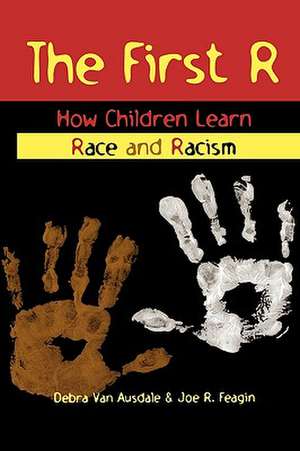
The First R: How Children Learn Race and Racism
Autor Joe R. Feagin, Debra Van Ausdaleen Limba Engleză Paperback – 11 dec 2001
Parents and teachers will find this remarkable study reveals that the answer to how children learn about race might be more startling than could be imagined.
Preț: 124.59 lei
Preț vechi: 148.23 lei
-16%
Puncte Express: 187
Carte tipărită la comandă
Livrare economică 08-22 decembrie
Livrare prin curier în România Termenul estimat este afișat lângă disponibilitate.
Transport gratuit de la 400.00 lei Plată online sau ramburs, în funcție de opțiunile comenzii.
Retur gratuit în 14 zile Comandă securizată și suport în română.
Specificații
ISBN-13: 9780847688623
ISBN-10: 0847688623
Pagini: 240
Dimensiuni: 148 x 228 x 18 mm
Greutate: 0.37 kg
Ediția:0240
Editura: Bloomsbury Publishing
Colecția Rowman & Littlefield
Locul publicării:New York, United States
ISBN-10: 0847688623
Pagini: 240
Dimensiuni: 148 x 228 x 18 mm
Greutate: 0.37 kg
Ediția:0240
Editura: Bloomsbury Publishing
Colecția Rowman & Littlefield
Locul publicării:New York, United States
V-ar putea interesa
-
 Why Are All the Black Kids Sitting Together in the Cafeteria?Beverly Daniel Tatum-17%Preț: 78.20 lei94.31 lei
 -
 Race and EducationKalwant BhopalPreț: 78.52 lei
 -
 A Kids Book About Systemic RacismJordan Thierry-17%Preț: 79.28 lei95.44 lei
 -
 A Kids Book About White PrivilegeBen Sand-17%Preț: 79.48 lei95.56 lei
 -
 A Little Book About RacismJelani Memory-19%Preț: 40.85 lei50.29 lei
 -
 A Little Book About BiasCourtney Ahn-17%Preț: 42.28 lei51.13 lei
 -
 Talking to Children About RaceLoretta AndrewsPreț: 97.08 lei
 -
 Wish We Knew What to Say: Talking with Children About RaceDr Pragya Agarwal-25%Preț: 59.86 lei79.62 lei
 -
 Everything I Learned about Racism I Learned in SchoolTiffany JewellPreț: 124.80 lei
 -
 Our Skin: A First Conversation About RaceJessica RalliPreț: 68.83 lei
 -
 What If All the Kids Are White?Louise Derman-SparksPreț: 253.73 lei
 -
 Anti-Racism in Early Childhood EducationKerry-Ann EscaygPreț: 340.24 lei
 -
 Anti-racism in Early Childhood Education: Theory and PracticeVictoria Bamsey-22%Preț: 183.63 lei234.07 lei
 -
 -25%Preț: 91.42 lei122.43 lei
 -
 What is racism?Katie DaynesPreț: 80.00 lei
 -
 Raising White KidsJennifer HarveyPreț: 110.40 lei
 -
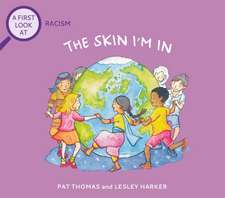 A First Look At: Racism: The Skin I'm InPat ThomasPreț: 65.91 lei
 -
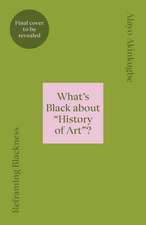 Reframing BlacknessAlayo AkinkugbePreț: 229.22 lei
Cuprins
Chapter 1 Preface
Chapter 2 Young Children Learning Racial and Ethnic Matters
Chapter 3 Using Racial-Ethnic Distinctions to Define Self
Chapter 4 Play Groups and Racial Matters
Chapter 5 Using Racial-Ethnic Concepts to Define Other People
Chapter 6 How Adults View Children
Chapter 7 Conclusion: What and How Do Children Learn about Racial and Ethnic Matters?
Chapter 8 A Postscript: What Can Be Done?
Chapter 2 Young Children Learning Racial and Ethnic Matters
Chapter 3 Using Racial-Ethnic Distinctions to Define Self
Chapter 4 Play Groups and Racial Matters
Chapter 5 Using Racial-Ethnic Concepts to Define Other People
Chapter 6 How Adults View Children
Chapter 7 Conclusion: What and How Do Children Learn about Racial and Ethnic Matters?
Chapter 8 A Postscript: What Can Be Done?
Recenzii
A wonderfully vivid account of how children learn about the 'first R'-race-even before they start school. The authors show how children as young as three have entered into and are experimenting with the tangled ideologies of race of the adult world.
A landmark study that should change our understanding of the social genesis and maintenance of racism and the dynamics of hegemony. It is a must-read for anyone, especially parents and teachers interested in how these dynamics come into being, and it should be required reading in all school systems and universities.
A sensitive and politically sophisticated work of on-site observation and engaging scholarship which ought to shake our nation from its equanimity. The lessons we were given long ago by Dr. Kenneth Clark and, nearly a hundred years ago, by W.E.B. Du Bois have yet to be internalized. Perhaps, as the authors of this valuable and stirring work suggest, it is our children who will prove to be our wisest teachers.
Vivid and provocative.
Van Ausdale and Feagin challenge conventional theories of child development that are 'adultcentric' and removed, based mostly on attitude testing and behavioral checklists. The authors spent a year at a racially diverse day care center, observing children from three to six years old. The authors suggest that racially hostile and discriminatory behavior among children needs far more study and attention than it has had to date.
Van Ausdale sought honesty from the children by never playing the role of 'sanctioning' adult, so that children learned to act more freely in front of her than they did in the presence of teachers. . . . The implication [of the author's work] is that racism will be much harder to root out than once believed, which makes the active teaching of tolerance all the more important.
Early education professionals and interested parents will find it an important addition to their collections.
The primary value of the book lies in its numerous interactional vignettes. This is an empirically rich book.
This is a scrupulously researched book.
A groundbreaking study of children's behavior, attitudes, and assumptions around race.
Van Ausdale wrote about her findings with co-author Joe Feagin in their book The First R. What she saw in her research goes against what we want to believe. Those passionate about ending racism can believe Van Ausdale's findings.
Dr. Debra Van Ausdale, co-author of The First R, gives stirring accounts of kids and race in her study of three child-care centers.
While researching her book The First R, sociologist Debra Van Ausdale found that very young children form strong opinions about race.
In The First R, Debra Van Ausdale and Joe R. Feagin do the study of race a great service by centering analysis on the activity of very young children. The book reminds readers of a crucial fact: all Americans, even the tiniest ones, build our racial orders together.
The First R is an extremely rich ethnographic study of children's racial understandings and constructions of meaning. Its fascinating glimpse into the world of children making meaning about race effectively refutes common views of children's relationship to race.
Despite the weight of the issues it addresses, this book is anything but heavy going. From the very first page, much of it is engaging. I highly recommend it.
Psychologists, teachers, parents and researchers in the field of child development should make this book essential reading.
A landmark study that should change our understanding of the social genesis and maintenance of racism and the dynamics of hegemony. It is a must-read for anyone, especially parents and teachers interested in how these dynamics come into being, and it should be required reading in all school systems and universities.
A sensitive and politically sophisticated work of on-site observation and engaging scholarship which ought to shake our nation from its equanimity. The lessons we were given long ago by Dr. Kenneth Clark and, nearly a hundred years ago, by W.E.B. Du Bois have yet to be internalized. Perhaps, as the authors of this valuable and stirring work suggest, it is our children who will prove to be our wisest teachers.
Vivid and provocative.
Van Ausdale and Feagin challenge conventional theories of child development that are 'adultcentric' and removed, based mostly on attitude testing and behavioral checklists. The authors spent a year at a racially diverse day care center, observing children from three to six years old. The authors suggest that racially hostile and discriminatory behavior among children needs far more study and attention than it has had to date.
Van Ausdale sought honesty from the children by never playing the role of 'sanctioning' adult, so that children learned to act more freely in front of her than they did in the presence of teachers. . . . The implication [of the author's work] is that racism will be much harder to root out than once believed, which makes the active teaching of tolerance all the more important.
Early education professionals and interested parents will find it an important addition to their collections.
The primary value of the book lies in its numerous interactional vignettes. This is an empirically rich book.
This is a scrupulously researched book.
A groundbreaking study of children's behavior, attitudes, and assumptions around race.
Van Ausdale wrote about her findings with co-author Joe Feagin in their book The First R. What she saw in her research goes against what we want to believe. Those passionate about ending racism can believe Van Ausdale's findings.
Dr. Debra Van Ausdale, co-author of The First R, gives stirring accounts of kids and race in her study of three child-care centers.
While researching her book The First R, sociologist Debra Van Ausdale found that very young children form strong opinions about race.
In The First R, Debra Van Ausdale and Joe R. Feagin do the study of race a great service by centering analysis on the activity of very young children. The book reminds readers of a crucial fact: all Americans, even the tiniest ones, build our racial orders together.
The First R is an extremely rich ethnographic study of children's racial understandings and constructions of meaning. Its fascinating glimpse into the world of children making meaning about race effectively refutes common views of children's relationship to race.
Despite the weight of the issues it addresses, this book is anything but heavy going. From the very first page, much of it is engaging. I highly recommend it.
Psychologists, teachers, parents and researchers in the field of child development should make this book essential reading.