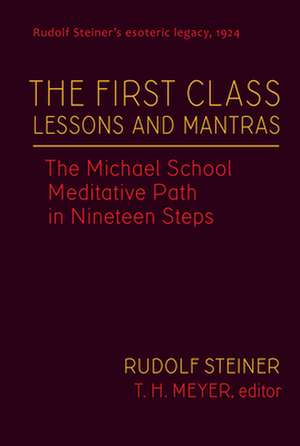
The First Class Lessons and Mantras
Autor Rudolf Steiner, T H Meyer Traducere de Jannebeth Röell, Paul V O'Leary, James Leeen Limba Engleză Hardback – 13 ian 2017
"People who have heard this in esoteric schools on Earth will go through the gate of death and will hear these words again sounding in harmony together--in the esoteric schools here and during the life between death and a new birth there. They will understand what rings forth. Or, people will be dull and unwilling to respond to what the esoteric schools, prepared by general Anthroposophy, have to say. They'll fail to perceive what can be heard through initiation science from the realms of the heights. They pass through the gate of death. There they hear what they should have already heard while here on Earth . . . but they do not understand it. These words of power--when the gods speak to one another--sound to them like an unintelligible clanging, mere cosmic noise."
These words alone, heard in real earnestness, should be enough to dispel any reservations about spreading the teaching of the Michael School. This content does not belong only to those who are closely connected with Anthroposophy and its movement; every seeking human being should be able to find them as a path through life on Earth and after death.
Preț: 302.55 lei
Puncte Express: 454
Carte tipărită la comandă
Livrare economică 22 august-05 septembrie
Livrare express 18-24 iulie pentru 57.35 lei
Livrare prin curier în România Termenul estimat este afișat lângă disponibilitate.
Transport gratuit de la 400.00 lei Plată online sau ramburs, în funcție de opțiunile comenzii.
Retur gratuit în 14 zile Comandă securizată și suport în română.
Specificații
ISBN-13: 9781621481737
ISBN-10: 1621481735
Pagini: 428
Dimensiuni: 159 x 236 x 35 mm
Greutate: 0.72 kg
Editura: Steiner Books
ISBN-10: 1621481735
Pagini: 428
Dimensiuni: 159 x 236 x 35 mm
Greutate: 0.72 kg
Editura: Steiner Books
V-ar putea interesa
-
 Journey to the HeartMelody BeattiePreț: 78.91 lei
 -
 Unplug: A Simple Guide to Meditation for Busy Sceptics and Modern Soul SeekersSuze Yalof Schwartz-28%Preț: 46.05 lei63.73 lei
 -
 Journey of AwakeningRam Dass-30%Preț: 51.76 lei73.86 lei
 -
 -29%Preț: 34.39 lei48.30 lei
 -
 -42%Preț: 115.02 lei197.64 lei
 -
 -26%Preț: 63.46 lei85.24 lei
 -
 Preț: 130.27 lei
 -
 The Warmth MeditationPeter SelgPreț: 81.06 lei
 -
 Quiet the MindMatthew Johnstone-28%Preț: 51.02 lei70.71 lei
 -
 Preț: 83.41 lei
 -
 Homemaking and Personal DevelopmentVeronika Van DuinPreț: 75.51 lei
 -
 The Circle of FireDon Miguel RuizPreț: 63.45 lei
 -
 Rudolf Steiner's Core MissionT. H. MeyerPreț: 99.09 lei
 -
 Clairvoyance and ConsciousnessT. H. MeyerPreț: 82.02 lei
 -
 Barefoot Through Burning LavaT. H. MeyerPreț: 74.79 lei
 -
 Buddhist MeditationKamalashilaPreț: 132.09 lei
 -
 Montando BurbujasLori LitePreț: 70.52 lei
 -
 Living a Life of AwarenessDon Miguel RuizPreț: 94.17 lei
Notă biografică
Rudolf Steiner (1861-1925) was born in the small village of Kraljevec, Austro-Hungarian Empire (now in Croatia), where he grew up. As a young man, he lived in Weimar and Berlin, where he became a well-published scientific, literary, and philosophical scholar, known especially for his work with Goethe's scientific writings. At the beginning of the twentieth century, he began to develop his early philosophical principles into an approach to systematic research into psychological and spiritual phenomena. Formally beginning his spiritual teaching career under the auspices of the Theosophical Society, Steiner came to use the term Anthroposophy (and spiritual science) for his philosophy, spiritual research, and findings. The influence of Steiner's multifaceted genius has led to innovative and holistic approaches in medicine, various therapies, philosophy, religious renewal, Waldorf education, education for special needs, threefold economics, biodynamic agriculture, Goethean science, architecture, and the arts of drama, speech, and eurythmy. In 1924, Rudolf Steiner founded the General Anthroposophical Society, which today has branches throughout the world. He died in Dornach, Switzerland.