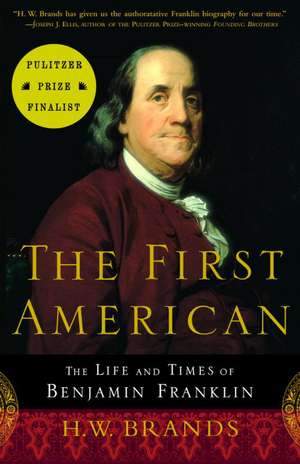
The First American
Autor H. W. Brandsen Limba Engleză Paperback – 12 mar 2002
Dacă Thomas Jefferson a fost arhitectul idealist al libertății americane, Benjamin Franklin a fost motorul ei pragmatic, omul care a înțeles că o națiune nu se naște doar din declarații, ci din negocieri dure și alianțe strategice. Îl întâlnim pe Franklin în paginile volumului The First American nu ca pe efigia statică de pe bancnota de o sută de dolari, ci ca pe un tânăr fugar care părăsește Bostonul cu buzunarele goale, mânat de o ambiție ce avea să reconfigureze cursul istoriei. Putem afirma că H. W. Brands reușește să recupereze omul din spatele mitului, oferindu-ne o scenă vibrantă a secolului al XVIII-lea, unde Franklin pendulează între experimentele cu electricitate și saloanele diplomatice ale Parisului. Abordarea jurnalistică evocă structura din Benjamin Franklin de Walter Isaacson, dar perspectiva lui Brands este mult mai ancorată în rigoarea istorică a arhivelor, utilizând scrisori inedite pentru a evidenția transformarea sa dintr-un supus loial al coroanei britanice în artizanul independenței. Suntem de părere că această biografie completează organic opera autorului; dacă în The Man Who Saved the Union Brands explora geniul militar al lui Grant, iar în Traitor to His Class analiza carisma lui FDR, aici el se concentrează pe polimatul care a definit caracterul american înainte ca Statele Unite să existe oficial. Ritmul narativ este susținut, transformând erudiția într-o experiență cinematică ce ne poartă prin cercurile intelectuale ale lui Voltaire și Hume, demonstrând de ce Franklin a fost considerat primul om al Renașterii în Lumea Nouă.
Preț: 139.23 lei
Carte disponibilă
Livrare economică 16-30 noiembrie
Specificații
ISBN-10: 0385495404
Pagini: 784
Dimensiuni: 135 x 204 x 34 mm
Greutate: 0.55 kg
Ediția:Anchor Books.
Editura: Knopf Doubleday Publishing Group
V-ar putea interesa
-
 WashingtonRon Chernow-12%Preț: 127.94 lei145.85 lei
 -
 Undaunted Mind: The Intellectual Life of Benjamin FranklinKevin J. Hayes-8%Preț: 252.19 lei275.27 lei
 -
 Book of AgesJill LeporePreț: 118.71 lei
 -
 The Amazing Life of Benjamin FranklinJames GiblinPreț: 46.39 lei
 -
 Who Was Ben Franklin?Dennis Brindell FradenPreț: 39.95 lei
 -
 The Autobiography and Other WritingsBenjamin FranklinPreț: 37.81 lei
 -
 The Autobiography of Benjamin FranklinBenjamin Franklin-65%Preț: 18.38 lei52.69 lei
 -
 Benjamin FranklinKay Melchisedech OlsonPreț: 48.94 lei
 -
 Benjamin Franklin: An American LifeWalter Isaacson-20%Preț: 91.40 lei114.16 lei
 -
 A Benjamin Franklin ReaderWalter IsaacsonPreț: 137.33 lei
 -
 Electric BenRobert ByrdPreț: 113.08 lei
 -
 Great ImprovisationStacy SchiffPreț: 128.42 lei
 -
 DianaramaAndy WebbPreț: 124.70 lei
 -
 The Autobiography of Benjamin FranklinBenjamin FranklinPreț: 40.29 lei
 -
 -17%Preț: 66.39 lei79.92 lei
 -
 Preț: 82.71 lei
 -
 The Science and Technology of Ben FranklinAlicia KlepeisPreț: 136.44 lei
 -
 Preț: 80.16 lei
 -
 Benjamin FranklinKevin J. HayesPreț: 133.18 lei
 -
 Benjamin FranklinBenjamin FranklinPreț: 57.23 lei
De ce să citești această carte
Recomandăm această biografie cititorilor care doresc să descopere complexitatea Iluminismului prin ochii celei mai versatile figuri americane. The First American nu este doar o lecție de istorie, ci un studiu despre reinventare și diplomație. Veți câștiga o înțelegere profundă a modului în care curiozitatea intelectuală și pragmatismul pot schimba destinul unui întreg continent, totul într-o relatare captivantă care depășește clișeele manualelor școlare.
Despre autor
H. W. Brands este profesor de istorie la Texas A&M University și un autor prolific, cu peste douăzeci de volume dedicate istoriei americane. Recunoscut pentru capacitatea sa de a transforma cercetarea academică densă în narațiuni accesibile, el a fost finalist al Premiului Pulitzer pentru biografie. Opera sa explorează teme precum expansiunea spre vest în Dreams of El Dorado și destinele președinților americani, Brands fiind considerat unul dintre cei mai importanți biografi contemporani datorită modului în care umanizează figurile legendare ale trecutului.
Descriere scurtă
He was the foremost American of his day, yet today he is little more than a mythic caricature in the public imagination. Benjamin Franklin, perhaps the pivotal figure in colonial and revolutionary America, comes vividly to life in this masterly biography.
Wit, diplomat, scientist, philosopher, businessman, inventor, and bon vivant, Benjamin Franklin was in every respect America’s first Renaissance man. From penniless runaway to highly successful printer, from ardently loyal subject of Britain to architect of an alliance with France that ensured America’s independence, Franklin went from obscurity to become one of the world’s most admired figures, whose circle included the likes of Voltaire, Hume, Burke, and Kant. Drawing on previously unpublished letters and a host of other sources, acclaimed historian H. W. Brands has written a thoroughly engaging biography of the eighteenth-century genius. A much needed reminder of Franklin’s greatness and humanity, The First American is a work of meticulous scholarship that provides a magnificent tour of a legendary historical figure, a vital era in American life, and the countless arenas in which the protean Franklin left his legacy.
Recenzii
“Like its subject, this biography is both solid and enchanting.” —The New Yorker
“[A] biography with a rich cast of secondary characters and a large and handsome stock of historical scenery.... Brands writes clearly and confidently about the full spectrum of the polymath’s interests.... This is a Franklin to savor.” —The Wall Street Journal
“Benjamin Franklin’s life is one every American should know well, and it has not been told better than by Mr. Brands.” —The Dallas Morning News
“A vivid portrait of the 18th-century milieu and of the 18th-century man.... [Brands is] a master storyteller.” —The Christian Science Monitor
“A thorough biography of Benjamin Franklin, America’s first Renaissance man.... In graceful, even witty prose.... Brands relates the entire, dense-packed life.” —The Washington Post
“A lively re-introduction to Franklin.... Rich in the descriptions of settings, personalities, and action.... [Brands] offers ... a succession of amusing anecdotes and vivid tales.” —The New Republic
“Comprehensive, lively.... [Brands] is a skilled narrator who believes in making good history accessible to the non-specializing book lover, and the general reader can read this book with sustained enjoyment.” —The Boston Globe
Notă biografică
Extras
Humiliation was the purpose of the proceeding.
It was the outcome eagerly anticipated by the lords of the Privy Council who constituted the official audience, by the members of the House of Commons and other fashionable Londoners who packed the room and hung on the rails of the balcony, by the London press that lived on scandal and milled outside to see how this scandal would unfold, by the throngs that bought the papers, savored the scandals, rioted in favor of their heroes and against their villains, and made politics in the British imperial capital often unpredictable, frequently disreputable, always entertaining. The proceeding today would probably be disreputable. It would certainly be entertaining.
The venue was fitting: the Cockpit. In the reign of Henry VIII, that most sporting of monarchs in a land that loved its bloody games, the building on this site had housed an actual cockpit, where Henry and his friends brought their prize birds and wagered which would tear the others to shreds. The present building had replaced the real cockpit, but this room retained the old name and atmosphere. The victim today was expected to depart with his reputation in tatters, his fortune possibly forfeit, his life conceivably at peril.
Nor was that the extent of the stakes. Two days earlier the December packet ship from Boston had arrived with an alarming report from the royal governor of Massachusetts, Thomas Hutchinson. The governor described an organized assault on three British vessels carrying tea of the East India Company. The assailants, townsmen loosely disguised as Indians, had boarded the ships, hauled hundreds of tea casks to deck, smashed them open, and dumped their contents into the harbor forty-five tons of tea, enough to litter the beaches for miles and depress the company's profits for years. This rampage was the latest in a series of violent outbursts against the authority of Crown and Parliament; the audience in the Cockpit, and in London beyond, demanded to know what Crown and Parliament intended to do about it.
Alexander Wedderburn was going to tell them. The solicitor general possessed great rhetorical gifts and greater ambition. The former had made him the most feared advocate in the realm; the latter lifted him to his present post when he abandoned his allies in the opposition and embraced the ministry of Lord North. Wedderburn was known to consider the Boston tea riot treason, and if the law courts upheld his interpretagtion, those behind the riot would be liable to the most severe sanctions, potentially including death. Wedderburn was expected to argue that the man in the Cockpit today was the prime mover behind the outburst in Boston. The crowd quivered with anticipation.
They all knew the man in the pit; indeed, the whole world knew Benjamin Franklin. His work as political agent for several of the American colonies had earned him recognition around London, but his fame far transcended that. He was, quite simply, one of the most illustrious scientists and thinkers on earth. His experiments with electricity, culminating in his capture of lightning from the heavens, had won him universal praise as the modern Prometheus. His mapping of the Gulf Stream saved the time and lives of countless sailors. His ingenious fireplace conserved fuel and warmed homes on both sides of the Atlantic. His contributions to economics, meteorology, music, and psychology expanded the reach of human knowledge and the grip of human power. For his accomplishments the British Royal Society had awarded him its highest prize; foreign societies had done the same. Universities queued to grant him degrees. The ablest minds of the age consulted him on matters large and small. Kings and emperors summoned him to court, where they admired his brilliance and basked in its reflected glory.
Genius is prone to producing envy. Yet it was part of Franklin's genius that he had produced far less than his share, due to an unusual ability to disarm those disposed to envy. In youth he discovered that he was quicker of mind and more facile of pen than almost everyone he met; he also discovered that a boy of humble birth, no matter how gifted, would block his own way by letting on that he knew how smart he was. He learned to deflect credit for some of his most important innovations. He avoided arguments wherever possible; when important public issues hinged on others' being convinced of their errors, he often argued anonymously, adopting assumed names, or Socratically, employing the gentle questioning of the Greek master. He became almost as famous for his sense of humor as for his science; laughing, his opponents listened and were persuaded.
Franklin's self-effacing style succeeded remarkably; at sixty-eight he had almost no personal enemies and comparatively few political enemies for a man of public affairs. But those few included powerful figures. George Grenville, the prime minister responsible for the Stamp Act, the tax bill that triggered all the American troubles, never forgave him for single-handedly demolishing the rationale for the act in a memorable session before the House of Commons.
Grenville and his allies lay in wait to exact their revenge on Franklin. Yet he never made a false step. Until now. A mysterious person had delivered into his hands confidential letters from Governor Hutchinson and other royal officials in Massachusetts addressed to an undersecretary of state in London. These letters cast grave doubt on the bona fides of Hutchinson, for years the bête noire of the Massachusetts assembly. As Massachusetts's agent, Franklin had forwarded the letters to friends in Boston. Hutchinson's enemies there got hold of the letters and published them.
The publication provoked an instant uproar. In America the letters were interpreted as part of a British plot to enslave the colonies; the letters fueled the anger that inspired the violence that produced the Boston tea riot. In England the letters provoked charges and countercharges as to who could have been so dishonorable as to steal and publish private correspondence. A duel at swords left one party wounded and bothparties aching for further satisfaction; only at this point--to prevent more bloodshed--did Franklin reveal his role in
transmitting the letters.
His foes seized the chance to destroy him. Since that session in Commons eight years before, he had become the symbol and spokesman in London of American resistance to the sovereignty of Parliament; on his head would be visited all the wrath and resentment that had been building in that proud institution from the time of the Stamp Act to the tea riot. Alexander Wedderburn sharpened his tongue and moved in for the kill.
None present at the Cockpit on January 29, 1774, could afterward recall the like of the hearing that day. The solicitor general outdid himself. For an hour he hurled invective at Franklin, branding him a liar, a thief, the instigator of the insurrection in Massachusetts, an outcast from the company of all honest men, an ingrate whose attack on Hutchinson betrayed nothing less than a desire to seize the governor's office for himself. So slanderous was Wedderburn's diatribe that no London paper would print it. But the audience reveled in it, hooting and applauding each sally, each bilious bon mot. Not even the lords of the Privy Council attempted to disguise their delight at Wedderburn's astonishing attack. Almost to a man and a woman, the spectators that day concluded that Franklin's reputation would never recover. Ignominy, if not prison or worse, was his future now.