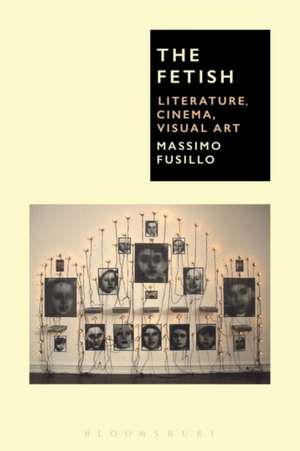
The Fetish: Literature, Cinema, Visual Art
Autor Professor Massimo Fusilloen Limba Engleză Hardback – 21 sep 2017
Whereas all these patterns are characterized by a projection of emotional values onto objects, modernism highlights a more latent component of object fetishism: the fascination with the alterity of matter, variously inflected by Proust, Woolf, Joyce, Barnes, and Mann. The last turning point in Fusillo's analysis is postmodernism and its obsession with mass media icons-from DeLillo's maximalist frescos and Zadie Smith's reflections on autographs to Palahniuk's porn objects; from pop art to commodity sculpture.
Preț: 707.84 lei
Preț vechi: 1052.40 lei
-33%
Puncte Express: 1062
Carte tipărită la comandă
Livrare economică 27 noiembrie-11 decembrie
Livrare prin curier în România Termenul estimat este afișat lângă disponibilitate.
Transport gratuit pentru acest produs Plată online sau ramburs, în funcție de opțiunile comenzii.
Retur gratuit în 14 zile Comandă securizată și suport în română.
Specificații
ISBN-13: 9781501312359
ISBN-10: 1501312359
Pagini: 200
Dimensiuni: 152 x 229 mm
Greutate: 0.59 kg
Editura: Bloomsbury Publishing
Colecția Bloomsbury Academic
Locul publicării:New York, United States
ISBN-10: 1501312359
Pagini: 200
Dimensiuni: 152 x 229 mm
Greutate: 0.59 kg
Editura: Bloomsbury Publishing
Colecția Bloomsbury Academic
Locul publicării:New York, United States
V-ar putea interesa
-
 Albert CamusOlivier ToddPreț: 124.76 lei
 -
 A Voyage Round John MortimerValerie GrovePreț: 133.44 lei
 -
 Why Read the Classics?Italo CalvinoPreț: 79.09 lei
 -
 Paul Valery and MusicBrian StimpsonPreț: 389.87 lei
 -
 Ted HughesSusan BassnettPreț: 229.28 lei
 -
 The White Devil: A Critical ReaderPaul Frazer-25%Preț: 179.17 lei238.98 lei
 -
 Ovid Heroides: A SelectionDr John GodwinPreț: 120.76 lei
 -
 Tacitus Annals I: A SelectionKatharine Radice-21%Preț: 135.81 lei172.07 lei
 -
 Seneca Letters: A SelectionEliot Maunder-17%Preț: 108.32 lei130.87 lei
 -
 Virgil Aeneid X: A SelectionChristopher Tanfield-22%Preț: 108.92 lei139.84 lei
 -
 Propertius, Tibullus and Ovid: A Selection of Love PoetryDr Anita Nikkanen-21%Preț: 138.02 lei174.87 lei
 -
 Cicero Pro Milone: A SelectionRobert West-23%Preț: 138.02 lei179.45 lei
 -
 Virgil Aeneid VIII: A SelectionDr Keith Maclennan-17%Preț: 108.76 lei131.14 lei
 -
 -5%Preț: 120.56 lei126.92 lei
Cuprins
Preface: Creativity Is In the Details
Introduction: Object and Fetish: Theory, Intersection, Vision
1. The Object of Seduction
2. The Memorial Object: Between Wound and Catharsis
3. The Magic Object: Animating the Inanimate
4. Creating Worlds: The Mythopoetic Power of Objects
5. Theatricalizing the Fetish-Object
6. The Alterity of Matter
7. The Object-Icon
Bibliography
Index
Introduction: Object and Fetish: Theory, Intersection, Vision
1. The Object of Seduction
2. The Memorial Object: Between Wound and Catharsis
3. The Magic Object: Animating the Inanimate
4. Creating Worlds: The Mythopoetic Power of Objects
5. Theatricalizing the Fetish-Object
6. The Alterity of Matter
7. The Object-Icon
Bibliography
Index
Recenzii
Brilliantly debunking received understandings of fetishism as an individual perversion or as a consumerist obsession, and effectively severing it from its ideological and moralistic anchorings, Massimo Fusillo theorises the fetishist gaze as an inexhaustible site of creative production and compares it to the processes of literary composition and artistic creation. Richly interdisciplinary and convincingly argued, using philosophy, psychoanalysis, aesthetics, anthropology, and feminist, queer, and postcolonial theory as critical frameworks, Fusillo draws examples across a wide variety of genres-literature, film, the visual arts, photography, popular culture, and performance-to demonstrate the ways in which fetishism and artistic creativity project passions, impulses, and memories on to everyday objects and produce alternative worlds. Original and highly innovative in content and style, the book's relational approach to the fetish challenges allegiances to hierarchal knowledge and absolute identities, compelling a radical rethinking of our critical paradigms for the comparative study of literature and culture.
This is a remarkably well-integrated volume with a clear purpose: to redefine and interpret 'the fetish' in a broad range of works, from Marx and Freud to contemporary cinema. It offers brilliant exercises in close reading and unassailable overall arguments. It should establish itself as an important reference point in literary and cultural theory.
Brimming with new ideas and examples, Massimo Fusillo's thought-provoking The Fetish leads us into a magic land where concrete objects radiate boundless energy. Seductive or violent, theatrical or incomprehensible, these objects inhabit the works of art and literature, be they realist, modernist, or post-modernist, and fill them with an irresistible power to attract. The most respectable traditional literature and the oddest contemporary art are thus shown to share crucial common interests.
This is a remarkably well-integrated volume with a clear purpose: to redefine and interpret 'the fetish' in a broad range of works, from Marx and Freud to contemporary cinema. It offers brilliant exercises in close reading and unassailable overall arguments. It should establish itself as an important reference point in literary and cultural theory.
Brimming with new ideas and examples, Massimo Fusillo's thought-provoking The Fetish leads us into a magic land where concrete objects radiate boundless energy. Seductive or violent, theatrical or incomprehensible, these objects inhabit the works of art and literature, be they realist, modernist, or post-modernist, and fill them with an irresistible power to attract. The most respectable traditional literature and the oddest contemporary art are thus shown to share crucial common interests.