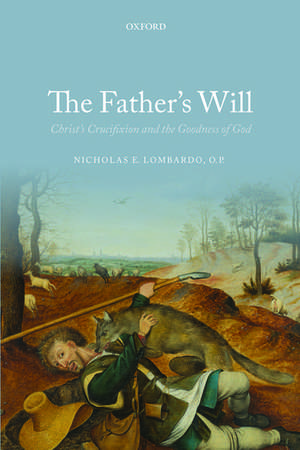
The Father's Will: Christ's Crucifixion and the Goodness of God
Autor Nicholas E. Lombardoen Limba Engleză Hardback – 28 noi 2013
Preț: 995.86 lei
Preț vechi: 1426.18 lei
-30%
Puncte Express: 1494
Carte tipărită la comandă
Livrare economică 10-16 decembrie
Livrare prin curier în România Termenul estimat este afișat lângă disponibilitate.
Transport gratuit pentru acest produs Plată online sau ramburs, în funcție de opțiunile comenzii.
Retur gratuit în 14 zile Comandă securizată și suport în română.
Specificații
ISBN-13: 9780199688586
ISBN-10: 0199688583
Pagini: 288
Dimensiuni: 162 x 240 x 24 mm
Greutate: 0.58 kg
Editura: OUP OXFORD
Colecția OUP Oxford
Locul publicării:Oxford, United Kingdom
ISBN-10: 0199688583
Pagini: 288
Dimensiuni: 162 x 240 x 24 mm
Greutate: 0.58 kg
Editura: OUP OXFORD
Colecția OUP Oxford
Locul publicării:Oxford, United Kingdom
V-ar putea interesa
-
 The Structure of Resurrection BeliefPeter Carnley-27%Preț: 356.69 lei486.31 lei
 -
 Christianity and Liberal SocietyRobert Song-11%Preț: 508.49 lei571.34 lei
 -
 Canon and Criterion in Christian Theology: From the Fathers to FeminismWilliam J. Abraham-30%Preț: 651.30 lei927.60 lei
 -
 Life in the Flesh: An Anti-Gnostic Spiritual PhilosophyAdam G. Cooper-31%Preț: 743.40 lei1071.86 lei
 -
 -24%Preț: 418.73 lei550.13 lei
 -
 -14%Preț: 298.25 lei347.26 lei
 -
 Good God: The Theistic Foundations of MoralityDavid Baggett-13%Preț: 307.81 lei352.56 lei
 -
 Preț: 406.60 lei
 -
 A User's Guide to Franz Rosenzweig's Star of RedemptionNorbert Samuelson-15%Preț: 478.15 lei562.54 lei
 -
 The Critique of Theological ReasonMackey James P.Preț: 305.83 lei
 -
 God of Salvation: Soteriology in Theological PerspectiveMurray A. RaePreț: 461.15 lei
 -
 Preț: 230.45 lei
 -
 The Good GodMichael ReevesPreț: 82.93 lei
 -
 Café TheologyMichael LloydPreț: 118.28 lei
 -
 The Holy Spirit in the World TodayJane Ed WilliamsPreț: 69.08 lei
Recenzii
Lombardos reading of theological sources is careful and incisive ... this is an impressive and refreshing approach to the well-worn rehabilitation of the ransom trope in Atonement theory.
Lombardo convincingly argues for the unity of the Trinity and the morality of the divine will in the crucifixion while raising a ridiculed metaphor of redemption back to respectability and thus beautifully inviting the church to re-appropriate its most ancient theory of redemption, the devils ransom theory.
Lombardo convincingly argues for the unity of the Trinity and the morality of the divine will in the crucifixion while raising a ridiculed metaphor of redemption back to respectability and thus beautifully inviting the church to re-appropriate its most ancient theory of redemption, the devils ransom theory.
Notă biografică
Nicholas E. Lombardo, O.P., received his Ph.D. from the University of Cambridge, and is now Assistant Professor of Historical and Systematic Theology at The Catholic University of America in Washington, D.C. His book The Logic of Desire: Aquinas on Emotion is published by The Catholic University of America Press, for which he was awarded the John Templeton Award for Theological Promise in 2011.