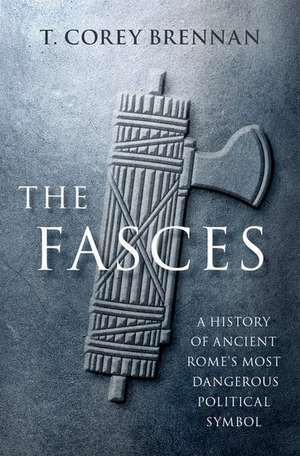
The Fasces: A History of Ancient Rome's Most Dangerous Political Symbol
Autor T. Corey Brennanen Limba Engleză Hardback – 21 noi 2022
Preț: 218.46 lei
Preț vechi: 260.13 lei
-16%
Puncte Express: 328
Carte disponibilă
Livrare economică 30 octombrie-04 noiembrie
Livrare express 14-20 octombrie pentru 76.09 lei
Livrare prin curier în România Termenul estimat este afișat lângă disponibilitate.
Transport gratuit de la 400.00 lei Plată online sau ramburs, în funcție de opțiunile comenzii.
Retur gratuit în 14 zile Comandă securizată și suport în română.
Specificații
ISBN-13: 9780197644881
ISBN-10: 0197644880
Pagini: 304
Ilustrații: 24 b/w illustrations
Dimensiuni: 237 x 165 x 27 mm
Greutate: 0.57 kg
Editura: Oxford University Press
Colecția OUP USA
Locul publicării:New York, United States
ISBN-10: 0197644880
Pagini: 304
Ilustrații: 24 b/w illustrations
Dimensiuni: 237 x 165 x 27 mm
Greutate: 0.57 kg
Editura: Oxford University Press
Colecția OUP USA
Locul publicării:New York, United States
Recenzii
This is a highly readable, interesting and useful survey, and an illustration of how we can always learn from history. The line between Romulus, the consuls, Marianne, Lincoln and Mussolini isn't a straight one: symbols too can be easily manipulated.
Brennan follows a symbol of authority from ancient Rome, via Mussolini and Lincoln, to today's far Right.... Compelling.
Few political icons can boast the longevity of the fasces, the bundle of rods surrounding an axe variously employed by the ancient Etruscans and Romans, French and American revolutionaries, and (most infamously) Mussolini's fascists. In the first comprehensive study of its kind, Cory Brennan expertly traces the complex history and shifting meanings of this powerful symbol
Power expresses itself through symbols and perhaps no symbol has been as potent, from imperial Rome to Mussolini's fascist Italy, as the Roman fasces. T. Corey Brennan in his illuminating and eloquently written book traces this use of the fasces from its origins to the present, exploring what this symbol seeks to impart. He dissects, in the process, the nature of autocratic power and the manipulation of symbols to justify and suppress aspirations for liberty.
The fasces are one of the most potent symbols of terrifying power and are ineradicably associated with contemporary political extremism. But their history is longer, richer, and even more fascinating. No-one is better equipped than Corey Brennan to tell this story — and he tells it brilliantly.
[An] impressive history of the ancient symbol...Brennan's long history of the fasces reminds us that there is a time and place for symbol-smashing, but also that if we attempt to erase such symbols we risk caricaturing them, forgetting the nuance of their historical reality and ultimately ceding their unquestionable power to those who would use them to promote hate-fuelled ideologies.
This is a beautifully written book about a potent, malleable and sinister symbol. The volume concludes by saying: 'We are now a full century past the point where one can argue that the primary associations of the fasces are benign'. Every one of us needs to know what happened, and the easiest way to do that is to read Professor Brennan's brilliant book.
An engrossing study... The evolution of the fasces from ancient to modern times reminds us of how dramatically the meanings of such objects can shift, or even invert, as different eras project onto them the values they want to uphold... Brennan's study is disturbingly timely... By making the fasces more recognizable and less ambiguous, Brennan's book aims to prevent its return as a banner for authoritarianism.
By making the fasces more recognizable and less ambiguous, Brennan's book aims to prevent its return as a banner for authoritarianism.
A wide-reaching, ambitious book presenting a global history of fasces... Brennan covers a vast sweep of time, moving from their Etruscan origins in antiquity to the revival of the symbol in fascist Europe.
The word 'fascism' has universal awareness in contemporary political discourse, which thus makes this, the first book to trace the full arc of the fasces' almost 3,000-year history, essential reading for all who wish to understand how the past informs the present.
This work is certainly of interest to any serious student of ancient Roman history or the reception of ancient Roman symbology in the modern world...It is definitely a valuable work and its relevance in modern political discourse only helps to highlight the value of understanding the history of this ancient symbol.
B.'s classic will be admired by the general educated public as well as scholars. The astonishment and horror it elicits support the book's main purpose, to shake us out of complacency. No one will have an excuse now for ignoring the implications of this potent symbol.
Brennan follows a symbol of authority from ancient Rome, via Mussolini and Lincoln, to today's far Right.... Compelling.
Few political icons can boast the longevity of the fasces, the bundle of rods surrounding an axe variously employed by the ancient Etruscans and Romans, French and American revolutionaries, and (most infamously) Mussolini's fascists. In the first comprehensive study of its kind, Cory Brennan expertly traces the complex history and shifting meanings of this powerful symbol
Power expresses itself through symbols and perhaps no symbol has been as potent, from imperial Rome to Mussolini's fascist Italy, as the Roman fasces. T. Corey Brennan in his illuminating and eloquently written book traces this use of the fasces from its origins to the present, exploring what this symbol seeks to impart. He dissects, in the process, the nature of autocratic power and the manipulation of symbols to justify and suppress aspirations for liberty.
The fasces are one of the most potent symbols of terrifying power and are ineradicably associated with contemporary political extremism. But their history is longer, richer, and even more fascinating. No-one is better equipped than Corey Brennan to tell this story — and he tells it brilliantly.
[An] impressive history of the ancient symbol...Brennan's long history of the fasces reminds us that there is a time and place for symbol-smashing, but also that if we attempt to erase such symbols we risk caricaturing them, forgetting the nuance of their historical reality and ultimately ceding their unquestionable power to those who would use them to promote hate-fuelled ideologies.
This is a beautifully written book about a potent, malleable and sinister symbol. The volume concludes by saying: 'We are now a full century past the point where one can argue that the primary associations of the fasces are benign'. Every one of us needs to know what happened, and the easiest way to do that is to read Professor Brennan's brilliant book.
An engrossing study... The evolution of the fasces from ancient to modern times reminds us of how dramatically the meanings of such objects can shift, or even invert, as different eras project onto them the values they want to uphold... Brennan's study is disturbingly timely... By making the fasces more recognizable and less ambiguous, Brennan's book aims to prevent its return as a banner for authoritarianism.
By making the fasces more recognizable and less ambiguous, Brennan's book aims to prevent its return as a banner for authoritarianism.
A wide-reaching, ambitious book presenting a global history of fasces... Brennan covers a vast sweep of time, moving from their Etruscan origins in antiquity to the revival of the symbol in fascist Europe.
The word 'fascism' has universal awareness in contemporary political discourse, which thus makes this, the first book to trace the full arc of the fasces' almost 3,000-year history, essential reading for all who wish to understand how the past informs the present.
This work is certainly of interest to any serious student of ancient Roman history or the reception of ancient Roman symbology in the modern world...It is definitely a valuable work and its relevance in modern political discourse only helps to highlight the value of understanding the history of this ancient symbol.
B.'s classic will be admired by the general educated public as well as scholars. The astonishment and horror it elicits support the book's main purpose, to shake us out of complacency. No one will have an excuse now for ignoring the implications of this potent symbol.
Notă biografică
T. Corey Brennan is a Professor of Classics at Rutgers University and author of The Praetorship in the Roman Republic and Sabina Augusta: An Imperial Journey. He has appeared on television documentaries that concern the ancient world, most recently for Netflix, BBC2, and the History Channel.
Cuprins
- Acknowledgments
- List of Illustrations
- Chapter 1. Introduction to The Roman Fasces
- Chapter 2. Origins of The Fasces
- Chapter 3. Images of The Roman Fasces
- Chapter 4. Roman Fasces in Action
- Chapter 5. Limits and Discontinuities of The Fasces
- Chapter 6. Carrying the Fasces
- Chapter 7. Medieval and Renaissance Fasces
- Chapter 8. Early Modern and Neoclassical Fasces
- Chapter 9. Popular and Revolutionary Fasces
- Chapter 10. American Fasces
- Chapter 11. Constructing Fasces in Mussolini's Italy
- Chapter 12. Eradication of Fasces
- Abbreviations and Note on Translations
- Bibliography
- Illustrations