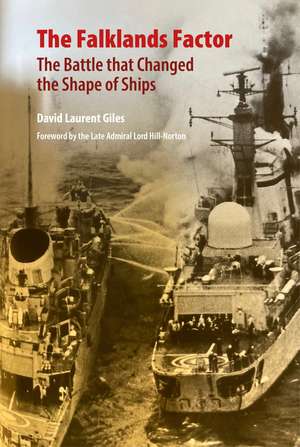
The Falklands Factor
Autor David Laurent Gilesen Limba Engleză Hardback – 17 apr 2025
After the failure of Britain’s latest air-defence destroyers in the 1982 Falklands War, a public controversy began over an alternative: the S90 ‘Short Fat’ frigate designed and proposed by Peter Thornycroft and David Giles. This is the almost incredible but well-documented story of the author’s forty-year hard-fought batt le with naval authorities and governments on both sides of the Atlantic to prove the virtues of his designs, which they had rejected on the basis of theory rather than fact, and then eventually to win substantial compensation aft er they covertly infringed his patents in two new classes of warship. With a Foreword by the late Admiral Lord Hill-Norton, former Chief of the Defence Staff ; Technical Appendices; Glossary and Dramatis Personae.
Preț: 235.96 lei
Puncte Express: 354
Carte disponibilă
Livrare economică 16-30 noiembrie
Livrare express 30 octombrie-05 noiembrie pentru 60.33 lei
Livrare prin curier în România Termenul estimat este afișat lângă disponibilitate.
Transport gratuit de la 400.00 lei Plată online sau ramburs, în funcție de opțiunile comenzii.
Retur gratuit în 14 zile Comandă securizată și suport în română.
Specificații
ISBN-13: 9781739164072
ISBN-10: 1739164075
Pagini: 360
Dimensiuni: 167 x 244 x 29 mm
Greutate: 1.01 kg
Editura: Unicorn Publishing Group
ISBN-10: 1739164075
Pagini: 360
Dimensiuni: 167 x 244 x 29 mm
Greutate: 1.01 kg
Editura: Unicorn Publishing Group
V-ar putea interesa
-
 Harrier 809Rowland White-24%Preț: 66.16 lei86.54 lei
 -
 -25%Preț: 71.21 lei94.83 lei
 -
 A Study In Failure: Churchill at the Admiralty, 1939-1940Simon Matthews-24%Preț: 145.88 lei191.64 lei
 -
 My Friends, The EnemyNick Van Der BijlPreț: 79.33 lei
 -
 SAS: Sea King DownMark Aston-30%Preț: 66.31 lei94.17 lei
 -
 The Falklands Naval Campaign 1982: War in the South AtlanticDr Edward Hampshire-30%Preț: 85.30 lei122.23 lei
 -
 -25%Preț: 106.75 lei143.23 lei
 -
 British Aircraft Carriers 1945-2010Angus Konstam-28%Preț: 65.55 lei91.13 lei
 -
 -27%Preț: 89.42 lei121.82 lei
 -
 -27%Preț: 66.94 lei92.27 lei
 -
 Warship 2025John Jordan-39%Preț: 266.02 lei434.17 lei
 -
 Warship 2026John Jordan-25%Preț: 267.63 lei355.18 lei
 -
 The Falklands War - There and Back AgainMike NormanPreț: 116.68 lei
 -
 The Battle for the FalklandsMax Hastings-33%Preț: 91.92 lei136.94 lei
 -
 One Hundred DaysSandy WoodwardPreț: 159.00 lei
 -
 -25%Preț: 53.70 lei72.05 lei
 -
 QE2 in the Falklands WarCommodore Ronald W. Warwick OBEPreț: 193.86 lei
 -
 Shaping the VulcanStephen LiddlePreț: 281.33 lei
 -
 Preț: 108.84 lei
Notă biografică
David Giles, son of the famous yacht designer, Jack Laurent Giles, first discovered the possible benefi ts of a hull’s ‘lift ing’ properties in a racing dinghy, and from his father’s explanation with a teaspoon dangled under an open tap. After National Service as a submarine off icer, he learnt the principles of advanced wing design for increasing the size and speed of jet airliners while working for the de Havilland Aircraft Company. Then in 1976, he formed a partnership with the naval architect Peter Thornycroft , whose success with the design of small lift ing hulls convinced him that these could be scaled up and applied to larger, faster vessels, as had been proved with aircraft .