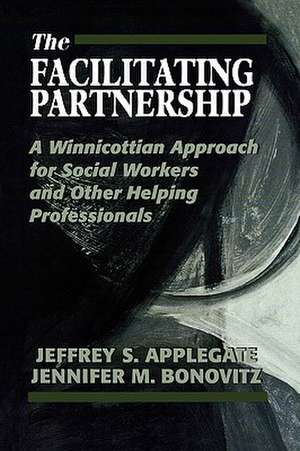
The Facilitating Partnership: A Winnicottian Approach for Social Workers and Other Helping Professionals
Autor Jeffrey S. Applegate, Jennifer M. Bonovitzen Limba Engleză Paperback – apr 1995
Preț: 364.60 lei
Preț vechi: 463.11 lei
-21%
Puncte Express: 547
Carte tipărită la comandă
Livrare economică 30 noiembrie-14 decembrie
Livrare prin curier în România Termenul estimat este afișat lângă disponibilitate.
Transport gratuit de la 400.00 lei Plată online sau ramburs, în funcție de opțiunile comenzii.
Retur gratuit în 14 zile Comandă securizată și suport în română.
Specificații
ISBN-13: 9780765702012
ISBN-10: 0765702010
Pagini: 296
Dimensiuni: 163 x 232 x 22 mm
Greutate: 0.44 kg
Editura: Bloomsbury Publishing
Colecția Jason Aronson Inc
Locul publicării:New York, United States
ISBN-10: 0765702010
Pagini: 296
Dimensiuni: 163 x 232 x 22 mm
Greutate: 0.44 kg
Editura: Bloomsbury Publishing
Colecția Jason Aronson Inc
Locul publicării:New York, United States
V-ar putea interesa
-
 Therapeutic Storytelling for Adolescents and Young AdultsJohanna Slivinske-30%Preț: 524.71 lei750.10 lei
 -
 A Social Justice Approach to Survey Design and AnalysisLlewellyn J. Cornelius-26%Preț: 369.84 lei496.99 lei
 -
 -25%Preț: 522.43 lei700.38 lei
 -
 -34%Preț: 606.75 lei921.93 lei
 -
 -26%Preț: 208.47 lei280.14 lei
 -
 Teamworking Skills for Social WorkersRuben Martin-30%Preț: 168.38 lei239.50 lei
 -
 Working with RiskHazel KemshallPreț: 150.31 lei
 -
 Surviving your Social Work PlacementKaren Jones-25%Preț: 194.68 lei258.13 lei
 -
 Social Work ArtfullyChristina SindingPreț: 424.10 lei
 -
 -25%Preț: 207.19 lei275.20 lei
 -
 -25%Preț: 256.84 lei340.78 lei
 -
 -25%Preț: 256.62 lei341.29 lei
 -
 -20%Preț: 115.58 lei144.82 lei
 -
 -25%Preț: 182.27 lei243.99 lei
 -
 -20%Preț: 155.20 lei193.33 lei
Cuprins
Chapter 1
Chapter I. WINNICOTT: PERSON, THEORIST, CLINICIAN
Chapter 2 Finding an Approach to Helping
Chapter 3 Winnicott's Developmental Theory
Chapter 4 Winnicott's Concepts of Vulnerability and Disturbance
Chapter 5
Chapter II. PRACTICE
Chapter 6 The Holding Environment
Chapter 7 Ego Relatedness
Chapter 8 The Transitional Process
Chapter 9 Object Relating and Object Use
Chapter 10 The True and False Self
Chapter 11
Chapter III. BROADER IMPLICATIONS
Chapter 12 The Good-Enough Social Worker
Chapter I. WINNICOTT: PERSON, THEORIST, CLINICIAN
Chapter 2 Finding an Approach to Helping
Chapter 3 Winnicott's Developmental Theory
Chapter 4 Winnicott's Concepts of Vulnerability and Disturbance
Chapter 5
Chapter II. PRACTICE
Chapter 6 The Holding Environment
Chapter 7 Ego Relatedness
Chapter 8 The Transitional Process
Chapter 9 Object Relating and Object Use
Chapter 10 The True and False Self
Chapter 11
Chapter III. BROADER IMPLICATIONS
Chapter 12 The Good-Enough Social Worker
Recenzii
This book will be of great interest not only to social workers but to all clinicians who are trying to make use of psychoanalytic ideas in settings other than that of private practice. Applegate and Bonovitz award Winnicott a central place in unfolding post-classical theories and methods, where the experience of the therapeutic relationship is itself deemed a powerful mutative factor. Not only do the authors explicate clearly Winnicott's sometimes puzzling metaphorical and poetic language, but they provide us with what is so often lacking in such texts?a rich array of clinical cases from agency-based social work practice, demonstrating anew the ever-widening scope of psychoanalytic thought...
Social workers and helpers from similar professions have increasingly been recognizing that D. W. Winnicott's ideas are extremely useful to practice, but these ideas have been scattered throughout numerous papers and books. In pulling together and explaining the entirety of Winnicott's work, Applegate and Bonovitz have done us all a major service. The work is very readable and the application through extensive case material makes it ideal for both experienced practitioners and as a text for beginning students. It is particularly welcome as a reminder that the overly technique-oriented pressures from managed care result in a loss of an essential understanding of the client's inner life...
Drs. Applegate and Bonovitz have written a book about real patients: sullen, regressed, messy, frightened, and often resourceless. Their therapeutic approach is unabashedly pragmatic, at times innovative, and always unmistakably humane. While largely based upon Winnicott's ideas, their work is more than an exposition. They skillfully synthesize his views with those of Klein, Mahler, Kohut, Anzieu, Bollas, and Stern. More important, they succeed in achieving the risky but precious balance between individual psychotherapy and environmental intervention that is needed by many despondent and helpless individuals. Truly a superb work!!!
Social workers and helpers from similar professions have increasingly been recognizing that D. W. Winnicott's ideas are extremely useful to practice, but these ideas have been scattered throughout numerous papers and books. In pulling together and explaining the entirety of Winnicott's work, Applegate and Bonovitz have done us all a major service. The work is very readable and the application through extensive case material makes it ideal for both experienced practitioners and as a text for beginning students. It is particularly welcome as a reminder that the overly technique-oriented pressures from managed care result in a loss of an essential understanding of the client's inner life...
Drs. Applegate and Bonovitz have written a book about real patients: sullen, regressed, messy, frightened, and often resourceless. Their therapeutic approach is unabashedly pragmatic, at times innovative, and always unmistakably humane. While largely based upon Winnicott's ideas, their work is more than an exposition. They skillfully synthesize his views with those of Klein, Mahler, Kohut, Anzieu, Bollas, and Stern. More important, they succeed in achieving the risky but precious balance between individual psychotherapy and environmental intervention that is needed by many despondent and helpless individuals. Truly a superb work!!!