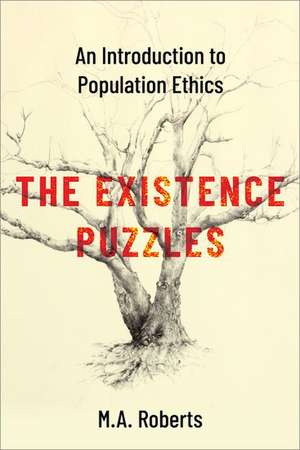
The Existence Puzzles: An Introduction to Population Ethics
Autor M. A. Robertsen Limba Engleză Hardback – 19 iun 2024
Bazându-ne pe analizele recente din cadrul eticii populației publicate de Oxford University Press, observăm că The Existence Puzzles reprezintă o schimbare de paradigmă în modul în care abordăm responsabilitățile morale față de generațiile viitoare. M. A. Roberts propune o incursiune riguroasă în dilemele existențiale, pornind de la premisa că teoriile morale clasice eșuează adesea atunci când numărul și identitatea persoanelor viitoare depind de alegerile noastre prezente. Apreciem în mod deosebit structura inovatoare a volumului: în loc să prezinte o teorie gata formată, autoarea invită cititorul să exploreze cinci „puzzle-uri” fundamentale — Asimetria, Pareto, Adiția, Anonimatul și Șansa mai bună. Această metodă inductivă permite construirea unei teorii parțiale a populației, ancorată în intuiție dar supusă cerințelor formale de consistență.
Notăm cu interes capitolul introductiv care trasează istoria recentă a domeniului, de la variabilitatea populației la analiza contrastantă dintre maximizarea agregată și cea individuală. Comparabil cu Ethical Theory de Daniel Muñoz prin utilizarea puzzle-urilor și experimentelor de gândire ca instrumente pedagogice, volumul lui Roberts se distinge printr-o focalizare mai îngustă și mai profundă pe mecanismele logice ale existenței. De asemenea, lucrarea este similară în rigoare cu Ethics and Existence de Jeff McMahan, însă M. A. Roberts actualizează dezbaterea prin integrarea unor probleme contemporane presante, cum sunt schimbările climatice și etica procreației. Textul reușește să mențină un echilibru între claritatea necesară unui debutant și complexitatea cerută de experții în economie sau drept, oferind soluții concrete unor probleme care, până recent, păreau insolubile în filosofia morală.
Preț: 414.41 lei
Preț vechi: 588.50 lei
-30%
Carte disponibilă
Livrare economică 13-18 noiembrie
Specificații
ISBN-10: 0197544142
Pagini: 280
Ilustrații: 20
Dimensiuni: 201 x 145 x 41 mm
Greutate: 0.39 kg
Editura: Oxford University Press
Colecția OUP USA
Locul publicării:New York, United States
De ce să citești această carte
Recomandăm această carte oricărui cititor interesat de fundamentele morale ale deciziilor care afectează viitorul umanității. Veți câștiga o înțelegere clară a modului în care aducerea unei noi persoane pe lume influențează valoarea morală a universului. Este o resursă esențială pentru studenții la filosofie și profesioniștii care caută o teorie coerentă a populației, dincolo de simpla aplicare a utilitarismului clasic.
Despre autor
M. A. Roberts este o figură proeminentă în filosofia morală contemporană, recunoscută pentru contribuțiile sale sistematice în etica populației. Prin lucrarea de față, publicată sub egida Oxford University Press, autorul își consolidează poziția de expert în analiza puzzle-urilor existențiale care stau la baza politicilor sociale și ecologice moderne. Abordarea sa se remarcă prin sensibilitatea față de intuițiile morale umane dublată de o rigoare logică specifică filosofiei analitice, fiind o voce autoritară în dezbaterile privind statutul moral al persoanelor posibile și viitoare.
Descriere
Recenzii
Notă biografică
Cuprins
- Acknowledgments
- Dedication
- List of accepted principles and rejected principles
- Lists of figures
- Preface
- Chapter 1: Recent history and current perplexed state of population ethics
- 1.1 Population variability and the inquiry into existential status
- 1.2 The case of Jaime versus Harry
- 1.3 A quick turn back to traditional total view
- 1.4 More than one way to maximize: maximizing on the aggregate; maximizing on the individual
- 1.5 Are hormones to blame?
- 1.6 Conceptual necessities also puzzle pieces; more inventive approaches on hold
- 1.7 The puzzle method; the role of intuition; the off ramp
- 1.8 Connection thesis; accessibility relation
- 1.9 Five existence puzzles
- Chapter 2: The Asymmetry Puzzle
- 2.1 The miserable child case and the happy child case
- 2.2 The puzzle
- 2.3 Attempts to solve the puzzle that go nowhere
- 2.4 The existence-sensitive solution to the asymmetry
- 2.5 Objections and replies
- Chapter 3: The Pareto puzzle
- 3.1 The three option case
- 3.2 The puzzle
- 3.3 Attempts to solve the puzzle by tossing out some of the puzzle pieces
- 3.4 The Pareto minus solution to the Pareto puzzle
- 3.5 Objection and reply: Doesn't the Pareto minus solution violate the independence of irrelevant alternatives?
- Chapter 4: The Addition Puzzle
- 4.1 The puzzle
- 4.2 Why we love addition
- 4.3 Inversive existence-sensitive solution to the addition puzzle
- 4.4 Objection and reply: Isn't inversive existence-sensitive addition circular?
- 4.5 Applications of inversive existence-sensitive addition
- 4.6 Wouldn't it be simpler to "minimize aggregate complaints"?
- Chapter 5: The Anonymity Puzzle
- 5.1 The case of simple addition and reversal
- 5.2 The case of indefinitely iterated addition and reversal; the puzzle
- 5.3 When the cures are worse than the disease
- 5.4 Identity-sensitive solution to the anonymity puzzle
- 5.5 Objections and replies
- Chapter 6: The Better Chance Puzzle
- 6.1 Probability questions
- 6.2 Expected value: the wrong way to make a wrong a right
- 6.3 Probable value: a better way to make a wrong a right
- 6.4 Objections and replies
- Chapter 7: Person-based consequentialism and a New Way of Doing the Best We Can
- Appendix A: Nonexistence Comparability
- Appendix B: The Loss Distinction Thesis
- Appendix C: Broome on the Neutrality Intuition
- Index
- Bibliography