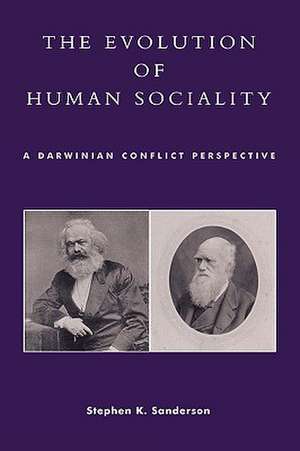
The Evolution of Human Sociality: A Darwinian Conflict Perspective
Autor Stephen K. Sandersonen Limba Engleză Paperback – 13 iun 2001
Preț: 397.76 lei
Preț vechi: 554.83 lei
-28%
Puncte Express: 597
Carte tipărită la comandă
Livrare economică 20 noiembrie-04 decembrie
Livrare prin curier în România Termenul estimat este afișat lângă disponibilitate.
Transport gratuit de la 400.00 lei Plată online sau ramburs, în funcție de opțiunile comenzii.
Retur gratuit în 14 zile Comandă securizată și suport în română.
Specificații
ISBN-13: 9780847695355
ISBN-10: 0847695352
Pagini: 416
Dimensiuni: 148 x 228 x 22 mm
Greutate: 0.54 kg
Ediția:0416
Editura: Bloomsbury Publishing
Colecția Rowman & Littlefield
Locul publicării:New York, United States
ISBN-10: 0847695352
Pagini: 416
Dimensiuni: 148 x 228 x 22 mm
Greutate: 0.54 kg
Ediția:0416
Editura: Bloomsbury Publishing
Colecția Rowman & Littlefield
Locul publicării:New York, United States
V-ar putea interesa
-
 Cameron at 10Anthony SeldonPreț: 123.59 lei
 -
 -28%Preț: 65.18 lei90.58 lei
 -
 International Relations Theory TodayKen BoothPreț: 360.16 lei
 -
 More HumanJason Bade-18%Preț: 87.53 lei107.12 lei
 -
 -25%Preț: 116.19 lei155.58 lei
 -
 Preț: 86.72 lei
 -
 Mossad: The Greatest Missions of the Israeli Secret ServiceMichael Bar-ZoharPreț: 86.66 lei
Cuprins
Chapter 1 Introduction
Part 2 Sociological Explanations that Do Not Work
Chapter 3 Functionalist Explanations
Chapter 4 Social Constructionist Explanations
Chapter 5 Structuralist, Poststructuralist, and Postmodernist Explanations
Part 6 Sociological Explanations that Work Better
Chapter 7 Marxian Conflict Explanations
Chapter 8 Weberian Conflict Explanations
Part 9 Sociological Explanations that Work Best
Chapter 10 Exchange and Rational Choice Explanations
Chapter 11 Cultural Materialist Explanations
Chapter 12 Sociobiological Explanations
Part 13 Toward Theoretical Synthesis
Chapter 14 Darwinian Conflict Theory: A Unified Evolutionary Theory of Human Society
Part 15 Darwinian Conflict Theory: The Weight of the Evidence
Chapter 16 Reproductive Behavior
Chapter 17 Human Sexuality
Chapter 18 Sex and Gender
Chapter 19 Marriage, Family, and Kinship
Chapter 20 Economic Behavior and Economic Systems
Chapter 21 Social Hierarchies
Chapter 22 Politics and War
Chapter 23 Epilogue
Part 2 Sociological Explanations that Do Not Work
Chapter 3 Functionalist Explanations
Chapter 4 Social Constructionist Explanations
Chapter 5 Structuralist, Poststructuralist, and Postmodernist Explanations
Part 6 Sociological Explanations that Work Better
Chapter 7 Marxian Conflict Explanations
Chapter 8 Weberian Conflict Explanations
Part 9 Sociological Explanations that Work Best
Chapter 10 Exchange and Rational Choice Explanations
Chapter 11 Cultural Materialist Explanations
Chapter 12 Sociobiological Explanations
Part 13 Toward Theoretical Synthesis
Chapter 14 Darwinian Conflict Theory: A Unified Evolutionary Theory of Human Society
Part 15 Darwinian Conflict Theory: The Weight of the Evidence
Chapter 16 Reproductive Behavior
Chapter 17 Human Sexuality
Chapter 18 Sex and Gender
Chapter 19 Marriage, Family, and Kinship
Chapter 20 Economic Behavior and Economic Systems
Chapter 21 Social Hierarchies
Chapter 22 Politics and War
Chapter 23 Epilogue
Recenzii
An emphatically original work. . . . The book makes the point quite forcibly that sociology makes no sense unless it is anchored, not only in evolutionary biology, but also in anthropology.
Stephen Sanderson is one of the leading figures in the world today among scholars trying to reconnect the social and biological sciences. His new book is cutting-edge. It is a unique argument, bound to excite, irritate, and initiate lively debate. No one else has said what he is saying in this book. The argument is extremely well organized, and the author writes in an engaging manner.
This is a break-through in sociological theory, demonstrating how a powerful new conflict theory can be framed from Neo-Darwinian, Marxian, Weberian, and other sources.
The best parts of Sanderson's book are the early sections, where he reviews and critiques the major existing paradigms of sociology, including functionalism, Marxism, and sociobiology.
Stephen Sanderson's The Evolution of Human Sociality provides a serious and wide-ranging treatise on sociobiology, its relationship to other styles of social explanation, and its pertinence to various domains of social life. Sanderson has given us a highly commendable work, and one that would surely benefit our discipline if its contentions were widely read and seriously engaged.
Stephen Sanderson's most recent book provides a powerful corrective to the current fragmented state of sociological theorizing. Sanderson's principal aim is to construct a viable theoretical foundation for sociology. He attempts a synthesis of ideas drawn primarily from conflict, exchange, cultural materialist, and sociobiologial theoretical premises. He then employs these tools to assess several topics that are of continuing interest to sociologists-the nature of human sexuality, gender relations and the family; the evolution of systems of economic behavior; the nature and transformation of dominance orders in human societies; and the nature of the politics of war. But the value of his contribution is found in the variety of topics and the scope of empirical evidence that he is able to handle successfully by reference to his synthesized theoretical principles.
This ambitious book is chock full of telling criticisms and worthy efforts at interdisciplinary synthesis. I hope that sociologists read it and take it seriously, and any evolutionist who is willing to push on despite finding nits to pick will get a lot out of it, too.
Stephen Sanderson is one of the leading figures in the world today among scholars trying to reconnect the social and biological sciences. His new book is cutting-edge. It is a unique argument, bound to excite, irritate, and initiate lively debate. No one else has said what he is saying in this book. The argument is extremely well organized, and the author writes in an engaging manner.
This is a break-through in sociological theory, demonstrating how a powerful new conflict theory can be framed from Neo-Darwinian, Marxian, Weberian, and other sources.
The best parts of Sanderson's book are the early sections, where he reviews and critiques the major existing paradigms of sociology, including functionalism, Marxism, and sociobiology.
Stephen Sanderson's The Evolution of Human Sociality provides a serious and wide-ranging treatise on sociobiology, its relationship to other styles of social explanation, and its pertinence to various domains of social life. Sanderson has given us a highly commendable work, and one that would surely benefit our discipline if its contentions were widely read and seriously engaged.
Stephen Sanderson's most recent book provides a powerful corrective to the current fragmented state of sociological theorizing. Sanderson's principal aim is to construct a viable theoretical foundation for sociology. He attempts a synthesis of ideas drawn primarily from conflict, exchange, cultural materialist, and sociobiologial theoretical premises. He then employs these tools to assess several topics that are of continuing interest to sociologists-the nature of human sexuality, gender relations and the family; the evolution of systems of economic behavior; the nature and transformation of dominance orders in human societies; and the nature of the politics of war. But the value of his contribution is found in the variety of topics and the scope of empirical evidence that he is able to handle successfully by reference to his synthesized theoretical principles.
This ambitious book is chock full of telling criticisms and worthy efforts at interdisciplinary synthesis. I hope that sociologists read it and take it seriously, and any evolutionist who is willing to push on despite finding nits to pick will get a lot out of it, too.