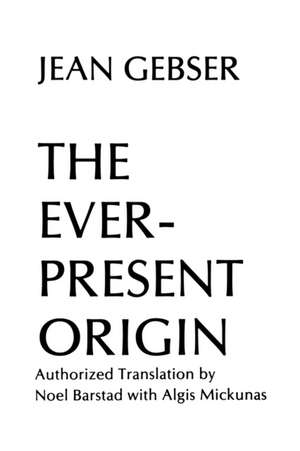
The Ever-Present Origin: Part One: Foundations Of The Aperspectival World
Autor Jean Gebser Contribuţii de Noel Barstad, Algis Mickūnasen Limba Engleză Paperback – 31 aug 1986
Ne-a atras atenția această ediție de referință publicată de Ohio University Press, care pune la dispoziția publicului academic traducerea integrală a operei „Ursprung und Gegenwart”. The Ever-Present Origin reprezintă efortul monumental al lui Jean Gebser de a sintetiza criza culturală a secolului XX nu ca pe un declin terminal, ci ca pe o mutație necesară către o nouă structură de conștiință. Remarcăm modul în care autorul ancorează discuția în fundamentele științelor naturii, citând trecerea de la fizica clasică la cea cuantică (Planck) pentru a argumenta abandonarea determinismului mecanicist.
Textul este structurat pentru a ghida cititorul prin evoluția umanității, de la originile arhaice până la emergența lumii „aperspectivale”. Spre deosebire de pesimismul istoric al lui Spengler, Gebser propune o viziune universală unde timpul nu mai este o progresie liniară, ci o prezență integrală. Apreciem rigoarea cu care sunt incluse în analiză artele, sociologia și economia politică, oferind o perspectivă interdisciplinară asupra modului în care omul contemporan poate depăși diviziunea interioară cauzată de raționalismul unilateral.
Cititorii familiarizați cu Seeing Through the World de Jeremy D Johnson vor aprecia profunzimea tehnică și detaliul filosofic pe care acest volum original îl aduce, oferind sursa primară pentru conceptele de „libertate față de timp” și „conștiință integrală”. În timp ce lucrări precum Consciousness and Culture explorează impactul lui Gebser asupra postmodernismului, The Ever-Present Origin rămâne fundamentul teoretic indispensabil pentru înțelegerea acestor mutații culturale. Stilul este dens, academic și marcat de o precizie terminologică necesară pentru a descrie fenomene care transcend limbajul dualist obișnuit.
Preț: 356.15 lei
Carte disponibilă
Livrare economică 30 octombrie-13 noiembrie
Livrare express 16-22 octombrie pentru 61.54 lei
Specificații
ISBN-10: 0821407694
Pagini: 647
Dimensiuni: 152 x 229 x 43 mm
Greutate: 0.93 kg
Ediția:1
Editura: Ohio University Press
Colecția Ohio University Press
V-ar putea interesa
-
 Deep SpiritChristian de QuinceyPreț: 146.03 lei
 -
 Collected Works of C. G. Jung, Volume 17C. G. JungPreț: 187.81 lei
 -
 Preț: 348.02 lei
 -
 DichotomyPhillip D. ReisnerPreț: 170.09 lei
 -
 Things We Think aboutSiro AltamiranoPreț: 60.15 lei
 -
 The New WayEric AllenPreț: 75.66 lei
 -
 Geschichte Der Neuern PhilosophieLudwig FeuerbachPreț: 110.17 lei
 -
 23C. J. CalaPreț: 213.25 lei
 -
 Refutation D'HelvetiusDenis DiderotPreț: 99.88 lei
 -
 Nietzsche and Other Exponents of IndividualismMR Paul CarusPreț: 86.28 lei
 -
 Where No Fear WasArthur Christopher BensenPreț: 39.66 lei
 -
 Yoda SpeaksChristopher C. Baker MDPreț: 120.26 lei
 -
 Carceral Civilizations: Volume 1Algis Mickūnas-26%Preț: 534.63 lei727.21 lei
 -
 Filling the Credibility GapAlgis Mickūnas-26%Preț: 642.62 lei872.90 lei
 -
 Cosmic Passion for the AestheticsAlgis Mickūnas-27%Preț: 1216.95 lei1659.16 lei
 -
 This We AreTom EvansPreț: 75.84 lei
 -
 Ursprung und Gegenwart (2 Bde)Jean Gebser-7%Preț: 578.31 lei621.83 lei
 -
 Über Wahrnehmung, mentale Zustände und adverbialen GehaltAlexander G. MirnigPreț: 311.22 lei
 -
 Die Finanz- und Wirtschaftskrise seit 2006 - unvermeidlich?Paul DiederichPreț: 75.16 lei
 -
 Russkaq religioznaq filosofiq: otechestwennoe i wselenskoeStanislaw RocinskijPreț: 334.13 lei
 -
 Preț: 216.43 lei
 -
 Preț: 283.35 lei
De ce să citești această carte
Această lucrare este esențială pentru cercetătorii din domeniul filozofiei culturii și al studiilor de conștiință. Cititorul va câștiga o înțelegere profundă a modului în care paradigmele științifice și artistice se întrepătrund pentru a forma viziunea noastră asupra lumii. Este recomandată celor care caută o alternativă riguroasă la modelele liniare de progres, oferind un cadru teoretic solid pentru interpretarea transformărilor sociale contemporane.
Despre autor
Jean Gebser (1905–1973) a fost un filozof, poet și lingvist germano-elvețian, recunoscut pentru teoriile sale despre evoluția conștiinței umane. Opera sa se situează la intersecția dintre fenomenologie, misticism intelectual și știință. Spre deosebire de corespondența sa personală și intimă publicată în Eine Freundschaft, care documentează prietenia sa cu istoricul Jean Rudolf von Salis, scrierile sale teoretice sunt vaste și sintetice. Gebser a exercitat o influență majoră asupra gândirii integrale și a studiilor interdisciplinare, fiind unul dintre primii gânditori care au articulat trecerea de la modernitate la o structură de conștiință post-rațională.
Descriere scurtă
“The path which led Gebser to his new and universal perception of the world is, briefly, as follows. In the wake of materialism and social change, man had been described in the early years of our century as the “dead end” of nature. Freud had redefined culture as illness—a result of drive sublimation; Klages had called the spirit (and he was surely speaking of the hypertrophied intellect) the “adversary of the soul,” propounding a return to a life like that of the Pelasgi, the aboriginal inhabitants of Greece; and Spengler had declared the “Demise of the West” during the years following World War I. The consequences of such pessimism continued to proliferate long after its foundations had been superseded.
It was with these foundations—the natural sciences—that Gebser began. As early as Planck it was known that matter was not at all what materialists had believed it to be, and since 1943 Gebser has repeatedly emphasized that the so-called crisis of Western culture was in fact an essential restructuration.…
Gebser has noted two results that are of particular significance: first, the abandonment of materialistic determinism, of a one-sided mechanistic-causal mode of thought; and second, a manifest “urgency of attempts to discover a universal way of observing things, and to overcome the inner division of contemporary man who, as a result of his one-sided rational orientation, thinks only in dualisms.”
Against this background of recent discoveries and conclusions in the natural sciences Gebser discerned the outlines of a potential human universality. He also sensed the necessity to go beyond the confines of this first treatise so as to include the humanities (such as political economics and sociology) as well as the arts in a discussion along similar lines. This was the point of departure of The Ever-Present Origin.
From In memoriam Jean Gebser by Jean Keckeis