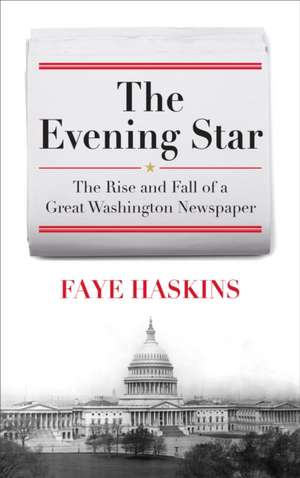
The Evening Star: The Rise and Fall of a Great Washington Newspaper
Autor Faye Haskinsen Limba Engleză Hardback – 11 sep 2019
The book also exposes the complex reasons for the Star's rise and fall from dominance in Washington's newspaper market. The Noyes and Kauffmann families who owned and operated the Star for a century play an important role in that story. Patriarch Crosby Noyes' life and legacy is the most fascinating -a classic Horatio Alger story of the illegitimate son of a Maine farmer who by the time of his death was a respected newspaper publisher and member of Washington's influential elite. In 1974 his descendants sold the once-great newspaper Noyes built to Joseph Allbritton. Allbritton and then Time, Inc. tried to save the Star but failed.
Preț: 263.85 lei
Preț vechi: 337.08 lei
-22%
Puncte Express: 396
Preț estimativ în valută:
46.70€ • 54.57$ • 40.54£
46.70€ • 54.57$ • 40.54£
Carte tipărită la comandă
Livrare economică 19 februarie-05 martie
Preluare comenzi: 021 569.72.76
Specificații
ISBN-13: 9780742548725
ISBN-10: 0742548724
Pagini: 326
Ilustrații: 18 b/w photos
Dimensiuni: 160 x 237 x 23 mm
Greutate: 0.65 kg
Editura: Bloomsbury Publishing
Colecția Rowman & Littlefield Publishers
Locul publicării:New York, United States
ISBN-10: 0742548724
Pagini: 326
Ilustrații: 18 b/w photos
Dimensiuni: 160 x 237 x 23 mm
Greutate: 0.65 kg
Editura: Bloomsbury Publishing
Colecția Rowman & Littlefield Publishers
Locul publicării:New York, United States
V-ar putea interesa
-
 Preț: 129.55 lei
 -
 The Publishing Industry in ChinaRobert Baensch-22%Preț: 149.13 lei190.86 lei
 -
 -31%Preț: 429.71 lei624.91 lei
 -
 The Librarian's Guide to Writing for PublicationRachel Singer Gordon-28%Preț: 390.17 lei542.36 lei
 -
 -37%Preț: 588.49 lei930.72 lei
 -
 Thr Arthur H. Clark Company: An Americana Century, 1902-2002Robert A. Clark-23%Preț: 433.61 lei563.13 lei
 -
 -34%Preț: 760.23 lei1143.79 lei
 -
 Journalism, Democracy, and Human Rights in ZimbabweBruce Mutsvairo-31%Preț: 511.24 lei744.57 lei
 -
 -24%Preț: 167.63 lei220.87 lei
 -
 Notjohn's Guide to E-Book FormattingNotjohn, N. J.Preț: 70.10 lei
 -
 The Business of WritingKim Iverson HeadleePreț: 108.82 lei
 -
 -33%Preț: 527.22 lei792.38 lei
 -
 -9%Preț: 6700.23 lei7362.89 lei
 -
 -23%Preț: 815.55 lei1059.16 lei
 -
 Der Verleger Johann Friedrich Cotta: Chronologische Verlagsbibliographie 1787-1832Deutsches Literaturarchiv-9%Preț: 5291.07 lei5814.36 lei
 -
 Das Verschwinden des AutorsElmar PodlechPreț: 139.48 lei
Recenzii
The old line about newspapers and the bottom of a birdcage is especially pertinent when it comes to newspapers no longer in business. Even the great dailies of yesteryear-the Philadelphia Public Ledger, New York Herald Tribune, Boston Evening Transcript-tend to live on largely in the memories of old hands, in historical cartoons, or in the biographies of novelists who began as reporters. A case in point is Washington's old Evening Star, always "old" in the recollection of ex-staffers and aging residents of the nation's capital, with the original name preferred to its brief, final incarnation: the Washington Star. If the Evening Star is remembered at all nowadays, it is recalled as an incubator of political journalists of the last century-David Broder, Mary McGrory, Haynes Johnson and others-and as the newspaper that was put out of business by the Washington Post, where Broder, McGrory and Johnson found new homes and wider fame. The whole story is faithfully chronicled by Faye Haskins, a former library archivist, in The Evening Star: The Rise and Fall of a Great Washington Newspaper.
. . .a comprehensive, unbiased history of a newspaper that was once considered one of the top ten in the US. Many Washingtonians cannot recall a time when the city had competing journalistic voices, and Haskins successfully gives the Star its rightful place in the historiography by presenting examples of past coverage of divisive politics, race relations, crime and corruption, sports, local events, and the creative arts and by exposing behind-the-scenes intrigue in the newsroom. The first history of the Evening Star, this volume fills a longstanding void and illuminates the newspaper's successes and failures in an engaging style. In the present age of newspaper closures and takeovers, Haskins's narrative serves as a loving eulogy amid gloomy forecasts for the industry.
Librarian Haskins (Behind the Headlines) chronicles Washington D.C.'s Evening Star newspaper in this intelligent though dense history. Chapters focus on themes and events from the paper's inception in 1852 to its shuttering in 1981, with an emphasis on the editorial decisions behind the coverage. The response to Lincoln's assassination reveals the workings of a mid-19th-century newsroom, including a chilling eyewitness account from the theater. The paper's influence is heralded throughout, exemplified by its lobbying for the 23rd Amendment that allowed D.C. citizens to vote for president in 1960. The Star's progressive but spotty record on race features groundbreaking moments like publishing an NAACP letter during the 1919 race riots, but regrettable practices like running real estate ads that encouraged segregation. A chapter titled "Murder and Mayhem" includes such anecdotes as the reported 1949 story of demonic possession that inspired The Exorcist. The postwar political section details the days after John F. Kennedy's assassination, highlighting the resilience of both reporters and the Kennedy family. The Vietnam era marked the paper's final glory days, with reporters like Mary McGrory earning spots on Nixon's "enemies list." This astute history serves as a thorough primer on Beltway journalism
Though it pains me to admit it, for much of its life The Evening Star was the best newspaper in Washington, with a broad and talented bench of ink-stained journalists who loved it like a sailor loves his ship. That The Star was eclipsed is a sad fact. But Faye Haskins won't let it be forgotten. Her account of the newspaper's 129-year history is important reading for anyone who has an affection for journalism or Washington or both.
The rise and fall of the Washington Star stands as a morality tale for modern journalism. Faye Haskins' careful history reveals how the Star became a great paper, how well it covered the news of its day, and why it failed to survive.
Faye Haskins has done it. She has taken us back in time to a past of glory and, yes, gore, to good times and bad, the bitter and the sweet. The life and death of an institution like the Washington Evening Star is painful enough to live through; to believe that a great paper's and a great city's fates were intertwined. Reading that history leaves one with the realization that a dying publication was not indicative of a dying city. Faye's recapitulation forces one to wish the Evening Star's fate had mirrored that of Washington. And that is a painful reminder for all of us exes who were so Star Struck.
"From age 16 to 21, I was lucky enough to learn the craft of newspapering at The Washington Evening Star. Faye Haskins now masterfully gives us both the history of this greatest of American afternoon newspapers and captures the spirit of its unique role for more than 150 years in the life of the Capital of the United States. Along the way, she paints indelible portraits of those who, in the 1950s and 60s especially, reported and wrote-usually on deadline-stories that represent an incomparably vivid account of this pivotal era of our national life. No newsroom in those days could have been more exciting or committed to the highest principles of journalism. I know: because this wonderful band of reporters and editors were my teachers."
. . .a comprehensive, unbiased history of a newspaper that was once considered one of the top ten in the US. Many Washingtonians cannot recall a time when the city had competing journalistic voices, and Haskins successfully gives the Star its rightful place in the historiography by presenting examples of past coverage of divisive politics, race relations, crime and corruption, sports, local events, and the creative arts and by exposing behind-the-scenes intrigue in the newsroom. The first history of the Evening Star, this volume fills a longstanding void and illuminates the newspaper's successes and failures in an engaging style. In the present age of newspaper closures and takeovers, Haskins's narrative serves as a loving eulogy amid gloomy forecasts for the industry.
Librarian Haskins (Behind the Headlines) chronicles Washington D.C.'s Evening Star newspaper in this intelligent though dense history. Chapters focus on themes and events from the paper's inception in 1852 to its shuttering in 1981, with an emphasis on the editorial decisions behind the coverage. The response to Lincoln's assassination reveals the workings of a mid-19th-century newsroom, including a chilling eyewitness account from the theater. The paper's influence is heralded throughout, exemplified by its lobbying for the 23rd Amendment that allowed D.C. citizens to vote for president in 1960. The Star's progressive but spotty record on race features groundbreaking moments like publishing an NAACP letter during the 1919 race riots, but regrettable practices like running real estate ads that encouraged segregation. A chapter titled "Murder and Mayhem" includes such anecdotes as the reported 1949 story of demonic possession that inspired The Exorcist. The postwar political section details the days after John F. Kennedy's assassination, highlighting the resilience of both reporters and the Kennedy family. The Vietnam era marked the paper's final glory days, with reporters like Mary McGrory earning spots on Nixon's "enemies list." This astute history serves as a thorough primer on Beltway journalism
Though it pains me to admit it, for much of its life The Evening Star was the best newspaper in Washington, with a broad and talented bench of ink-stained journalists who loved it like a sailor loves his ship. That The Star was eclipsed is a sad fact. But Faye Haskins won't let it be forgotten. Her account of the newspaper's 129-year history is important reading for anyone who has an affection for journalism or Washington or both.
The rise and fall of the Washington Star stands as a morality tale for modern journalism. Faye Haskins' careful history reveals how the Star became a great paper, how well it covered the news of its day, and why it failed to survive.
Faye Haskins has done it. She has taken us back in time to a past of glory and, yes, gore, to good times and bad, the bitter and the sweet. The life and death of an institution like the Washington Evening Star is painful enough to live through; to believe that a great paper's and a great city's fates were intertwined. Reading that history leaves one with the realization that a dying publication was not indicative of a dying city. Faye's recapitulation forces one to wish the Evening Star's fate had mirrored that of Washington. And that is a painful reminder for all of us exes who were so Star Struck.
"From age 16 to 21, I was lucky enough to learn the craft of newspapering at The Washington Evening Star. Faye Haskins now masterfully gives us both the history of this greatest of American afternoon newspapers and captures the spirit of its unique role for more than 150 years in the life of the Capital of the United States. Along the way, she paints indelible portraits of those who, in the 1950s and 60s especially, reported and wrote-usually on deadline-stories that represent an incomparably vivid account of this pivotal era of our national life. No newsroom in those days could have been more exciting or committed to the highest principles of journalism. I know: because this wonderful band of reporters and editors were my teachers."