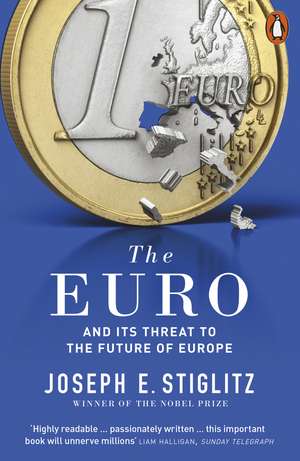
The Euro
Autor Joseph E. Stiglitzen Limba Engleză Paperback – 28 noi 2017
Considerăm această lucrare o resursă esențială de nivel master și referință profesională pentru oricine dorește să înțeleagă arhitectura financiară a Europei contemporane. The Euro nu este doar o cronică a crizei, ci o analiză chirurgicală a modului în care o monedă comună, concepută pentru a aduce prosperitate, a devenit un factor de divergență economică. Joseph E. Stiglitz demonstrează că 'viciul de la naștere' al monedei euro a fost lipsa unei integrări politice care să susțină uniunea monetară, lăsând țările vulnerabile în fața șocurilor externe. Remarcăm modul în care autorul extinde cadrul propus de The Euro and the Crisis de Nazaré Da Costa Cabral cu date noi din perioada 2010-2016, oferind o perspectivă mult mai critică asupra politicilor de austeritate. În timp ce alte lucrări similare, precum Emerging from the Euro Debt Crisis de Michael Heise, se concentrează pe mecanisme de stabilitate în interiorul sistemului actual, Joseph E. Stiglitz pune sub semnul întrebării însăși supraviețuirea zonei euro în forma sa prezentă. Stilul este analitic și direct, demontând consensul legat de mandatul Băncii Centrale Europene și oferind alternative radicale, de la reforme profunde până la conceptul inovator de 'euro flexibil'. Această lucrare reprezintă o evoluție naturală în opera autorului, continuând temele inegalității și ale eșecului instituțiilor globale explorate în The Price of Inequality și Globalization and Its Discontents Revisited. Dacă în lucrările anterioare Joseph E. Stiglitz critica mecanismele globalizării la nivel mondial, aici își îndreaptă atenția spre cel mai ambițios proiect economic al Europei, oferind o lectură urgentă pentru economiști și decidenți politici.
Preț: 76.19 lei
Preț vechi: 107.07 lei
-29%
Carte disponibilă
Livrare economică 30 octombrie-10 noiembrie
Livrare express 13-17 octombrie pentru 57.03 lei
Specificații
ISBN-10: 0141983248
Pagini: 512
Dimensiuni: 126 x 195 x 27 mm
Greutate: 0.35 kg
Editura: Penguin Books
Colecția Penguin Press
Locul publicării:London, United Kingdom
V-ar putea interesa
-
 Making Globalization WorkJoseph E. Stiglitz-30%Preț: 65.52 lei93.85 lei
 -
 FreefallJoseph E. StiglitzPreț: 134.22 lei
 -
 Globalization and Its Discontents RevisitedJoseph E. Stiglitz-18%Preț: 76.59 lei93.27 lei
 -
 In Defence of Europe: Can the European Project Be Saved?Loukas Tsoukalis-20%Preț: 130.62 lei162.74 lei
 -
 Europe Isn't WorkingLarry ElliottPreț: 80.40 lei
 -
 Preț: 193.88 lei
 -
 End This Depression Now!Paul KrugmanPreț: 86.29 lei
 -
 Rewriting the Rules of the European EconomyJoseph E. StiglitzPreț: 198.51 lei
 -
 Planet PonziMitch Feierstein-20%Preț: 74.46 lei92.75 lei
 -
 The Rotten Heart of EuropeBernard ConnollyPreț: 135.99 lei
 -
 Preț: 236.37 lei
 -
 The Price of InequalityJoseph E. Stiglitz-18%Preț: 89.49 lei109.16 lei
 -
 The Shifts and the ShocksMartin Wolf-28%Preț: 77.69 lei108.55 lei
 -
 The Crisis of the European UnionJürgen HabermasPreț: 114.81 lei
 -
 Europe's Economic Crisis: Transatlantic PerspectivesRobert M. SolowPreț: 99.28 lei
 -
 -25%Preț: 48.31 lei64.82 lei
 -
 Macroeconomics (European Edition)N. Gregory Mankiw-38%Preț: 521.16 lei847.22 lei
 -
 Can the Euro Be Saved?Malcolm SawyerPreț: 83.87 lei
 -
 The Collapse of Global LiberalismPhilip PilkingtonPreț: 112.99 lei
 -
 -41%Preț: 77.32 lei132.12 lei
 -
 And the Weak Suffer What They Must?Yanis Varoufakis-31%Preț: 64.28 lei93.11 lei
 -
 Return to GrowthJon MoynihanPreț: 195.60 lei
 -
 The Reform of EuropeMichel AgliettaPreț: 110.40 lei
 -
 KaputWolfgang MunchauPreț: 78.91 lei
 -
 The Road to FreedomJoseph E. StiglitzPreț: 92.47 lei
 -
 Doom LoopEswar S. PrasadPreț: 184.74 lei
 -
 Off the TargetMuhammad Ali Nasir-15%Preț: 673.16 lei791.95 lei
De ce să citești această carte
Recomandăm această carte studenților la economie și relații internaționale, precum și profesioniștilor din sectorul financiar. Cititorul va câștiga o înțelegere profundă a mecanismelor care guvernează zona euro și a motivelor pentru care politicile actuale produc stagnare. Este o analiză rară care nu se mulțumește să descrie criza, ci oferă soluții structurale pentru salvarea sau transformarea sistemului monetar european.
Despre autor
Joseph E. Stiglitz este laureat al Premiului Nobel pentru Economie și profesor la Universitatea Columbia. Recunoscut la nivel mondial pentru analizele sale critice asupra piețelor libere și a globalizării, a ocupat funcții de prestigiu, inclusiv cea de economist-șef al Băncii Mondiale și președinte al Consiliului Consilierilor Economici al Președintelui SUA. Autor de bestselleruri precum The Price of Inequality și The Great Divide, Stiglitz este o voce autoritară în dezbaterea despre inegalitate și guvernanță economică, fiind un colaborator constant al publicațiilor New York Times și Project Syndicate.
Notă biografică
Recenzii
Stiglitz could hardly have timed The Euro better ... one of those economists with a rare ability to help readers understand complex ideas
Coolly analytical ... he is surely right: without a radical overhaul of its workings, the Euro seems all but certain to fail
Descriere scurtă
Nobel prize-winning economist Joseph E. Stiglitz dismantles the prevailing consensus around what ails Europe - arguing that economic stagnation is a direct result of the Euro's flawed birth, demolishing the champions of austerity and offering solutions that can rescue the continent from further devastation.
'Stiglitz could hardly have timed The Euro better ... one of those economists with a rare ability to help readers understand complex ideas' Philip Aldrick, The Times
'Original, hard-hitting ... Much more than a demolition job. These chapters are full of constructive proposals' Martin Sandbu, Financial Times
'Terrific and clarifying' Peter Goodman, The New York Times
'Coolly analytical ... he is surely right: without a radical overhaul of its workings, the Euro seems all but certain to fail' Economist
Descriere
In 2010, the 2008 global financial crisis morphed into the "eurocrisis." It has not abated. The 19 countries of Europe that share the euro currency-the eurozone-have been rocked by economic stagnation and debt crises. Some countries have been in depression for years while the governing powers of the eurozone have careened from emergency to emergency, most notably in Greece. In The Euro, Nobel Prize-winning economist and best-selling author Joseph E. Stiglitz dismantles the prevailing consensus around what ails Europe, demolishing the champions of austerity while offering a series of plans that can rescue the continent-and the world-from further devastation. Hailed by its architects as a lever that would bring Europe together and promote prosperity, the euro has done the opposite. As Stiglitz persuasively argues, the crises revealed the shortcomings of the euro. Europe's stagnation and bleak outlook are a direct result of the fundamental challenges in having a diverse group of countries share a common currency-the euro was flawed at birth, with economic integration outpacing political integration. Stiglitz shows how the current structure promotes divergence rather than convergence. The question then is: Can the euro be saved? After laying bare the European Central Bank's misguided inflation-only mandate and explaining how eurozone policies, especially toward the crisis countries, have further exposed the zone's flawed design, Stiglitz outlines three possible ways forward: fundamental reforms in the structure of the eurozone and the policies imposed on the member countries; a well-managed end to the single-currency euro experiment; or a bold, new system dubbed the "flexible euro." With its lessons for globalization in a world economy ever more deeply connected, The Euro is urgent and essential reading.