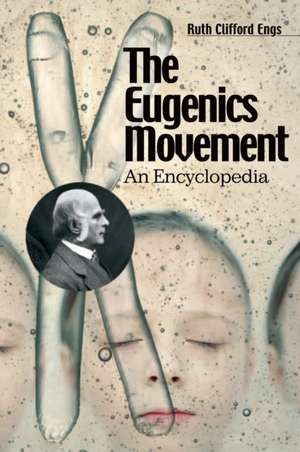
The Eugenics Movement: An Encyclopedia
Autor Ruth Clifford Engsen Limba Engleză Hardback – 30 iun 2005
Descoperim în The Eugenics Movement o resursă esențială pentru înțelegerea modului în care pseudo-știința și dorința de reformă socială s-au intersectat periculos la începutul secolului XX. Deși tema centrală este eugenismul — teoria îmbunătățirii generațiilor umane prin reproducere selectivă — Ruth Clifford Engs reușește să depășească simpla definiție tehnică, oferind o privire de ansamblu asupra figurilor proeminente și organizațiilor care au susținut acest curent. Observăm o atenție deosebită acordată legislației și evenimentelor care au definit perioada de glorie a mișcării în Statele Unite, dar și ramificațiile sale globale.
Această enciclopedie extinde cadrul propus de Eugenics de Philippa Levine prin integrarea unor date detaliate despre legislația specifică și publicațiile de epocă, oferind o structură de referință mult mai aplicată. În contextul operei sale, The Eugenics Movement reprezintă o continuare firească a cercetărilor din The Progressive Era's Health Reform Movement, consolidând expertiza autoarei în istoria sănătății publice americane. Dacă în Bizarre Medicine Ruth Clifford Engs explora remediile marginale, aici analizează un curent care a dominat mediul academic și politic oficial.
Structura volumului este una riguroasă, fiind organizată alfabetic pentru a facilita consultarea rapidă, completată de o cronologie selectată care ajută la plasarea evenimentelor într-un context temporal clar. Ritmul lecturii este cel specific unei lucrări de referință, însă introducerea și conexiunile făcute cu ingineria genetică contemporană adaugă o relevanță critică pentru studenții și cercetătorii din domeniul științelor sociale și biologiei.
Preț: 399.76 lei
Preț vechi: 715.75 lei
-44%
Carte tipărită la comandă
Livrare economică 03-17 decembrie
Specificații
ISBN-10: 0313327912
Pagini: 304
Dimensiuni: 186 x 258 x 26 mm
Greutate: 0.8 kg
Editura: Bloomsbury Publishing
Colecția Greenwood
Locul publicării:New York, United States
V-ar putea interesa
-
 Epidemiology and Demography in Public HealthJaphet Killewo-25%Preț: 545.35 lei725.88 lei
 -
 The Routledge Handbook of African DemographyClifford O. Odimegwu-18%Preț: 1733.53 lei2114.06 lei
 -
 Sliding to the RightSamuel C. HeilmanPreț: 288.12 lei
 -
 Preț: 245.58 lei
 -
 The End of BurnoutJonathan MalesicPreț: 194.52 lei
 -
 The Anatomy of Racial AttitudesRichard A. Apostle-23%Preț: 540.64 lei702.13 lei
 -
 Africa's Challenge to AmericaChester Bowles-23%Preț: 555.87 lei721.91 lei
 -
 In Too DeepRachel KimbroPreț: 244.04 lei
 -
 Punishing Places – The Geography of Mass ImprisonmentJessica T. Simes-23%Preț: 537.11 lei697.54 lei
 -
 Retail Inequality – Reframing the Food Desert DebateKenneth H. KolbPreț: 228.06 lei
 -
 The Feminist War on CrimeAya GruberPreț: 169.24 lei
 -
 Preț: 223.04 lei
 -
 Almost DeadMichael Lawrence Dickinson-27%Preț: 703.14 lei963.21 lei
 -
 -23%Preț: 567.23 lei736.66 lei
 -
 Conversations in the AbbeyRuth Clifford EngsPreț: 141.69 lei
 -
 CONVERSATIONS IN THE ABBEY, VOL. IIRuth Clifford EngsPreț: 140.98 lei
 -
 MethlandNick RedingPreț: 97.60 lei
 -
 Preț: 118.64 lei
 -
 The Demographic Transition and Development in AfricaCharles Teller-15%Preț: 675.42 lei794.62 lei
De ce să citești această carte
Această enciclopedie este indispensabilă pentru studenții și cadrele didactice care analizează istoria medicinei și a politicilor sociale. Oferă o bază factuală solidă pentru a înțelege cum ideile despre ereditate au fost folosite pentru a justifica măsuri legislative controversate. Cititorul câștigă o perspectivă clară asupra legăturii dintre trecutul eugenist și dilemele etice moderne ale clonării umane și ingineriei genetice.
Despre autor
Ruth Clifford Engs este profesor emerit în cadrul Departamentului de Științe Aplicate ale Sănătății la Indiana University, Bloomington. Cu o carieră dedicată studiului mișcărilor de reformă a sănătății și igienei în context american, ea a publicat lucrări de referință precum „Clean Living Movements” și „The Progressive Era's Health Reform Movement”. Expertiza sa se concentrează pe intersecția dintre moralitate, sănătate publică și politici sociale, oferind o perspectivă istorică documentată asupra modului în care societatea încearcă să reglementeze corpul uman și comportamentele sociale prin intermediul științei.
Descriere
Cuprins
Acknowledgments
List of Entries
Introduction
Dictionary Entries
Selected Chronology
Index
Recenzii
Engs has produced a solid treatment of a topic that should be of particular interest to the reading public at large as well as to students of political ideologies, eugenics, genetics, public health, and modern biology. It is difficult to think of another general introduction as comprehensible as this.
The Eugenics Movement: An Encyclopedia makes a handy and sober guide to the subject..an appropriate selection for public and academic libraries.
[T]his book is the kind of solid, rich, well-crafted compendium on a specialized topic that librarians hand long been able to expect from Greenwood. Its contents provide the beginning and scholarly user with a broad and authoritative introduction to the topic of eugenics, the science of the improvement of the human race by better breeding, in the words of one of its key spokesmen Charles Davenport..Eugenics has become a hot topic of late, thanks to the growth of cultural studies, a new interest in the history of science, and the revival of many of the issues with which it was associated, thanks to recent developments in genetics. One imagines this work providing librarians working with college and high school students, and even some more advances researchers, in beginning to understand the key questions surrounding this topic, and then finding their way to further material on the subject.
Engs provides information concerning prominent people, organizations, publications, conferences, and concepts involved in the hereditarian and eugenics movements from the middle 19th century to 2005. Though she focuses on the early 20th-century in the US, she also discusses links between the past and present and with Britain and German, the other two countries most involved with the eugenic measures and debates. Among her topics are whether such techniques as cloning, genetic engineering, and genetic testing do or do not qualify as eugenics.
In 250 alphabetically arranged entries on people (including birth and death dates), organizations, publications, conferences, and concepts, the author describes how the movement developed and spread. Entries are clearly and succinctly written, with enough length when necessary..Extensive cross-references are in bold type, and further reading is suggested at the end of each entry. While recognizing that some entries and terminology may be offensive, the author points out in her preface that it is important to examine such terms in their historical context. ^LThe information in this unique resource is accurate and current, with events and books from 2004. A list of entries at the front, black-and-white photos, an index, a 20-page chronology (beginning in 1853), and a 14-page bibliography are helpful for locating entries and engaging in further study..This is a recommended resource for large public and academic libraries.
[R]eviews almost 200 years of history and packs in reference entries on different eugenics movements, theories, history, and laws around the world. An intriguing health and social issues title which college-level collections won't want to miss.