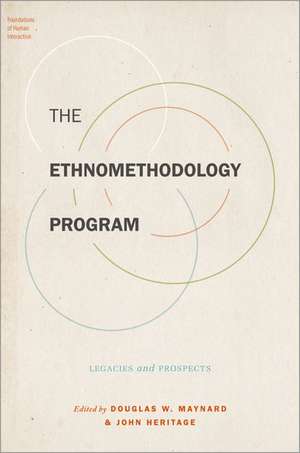
The Ethnomethodology Program: Legacies and Prospects: Foundations of Human Interaction
Editat de Douglas W. Maynard, John Heritageen Limba Engleză Paperback – 21 noi 2022
Din seria Foundations of Human Interaction
- 24%
 Preț: 602.10 lei
 - 30%
 Preț: 434.58 lei
 - 32%
 Preț: 573.61 lei
 - 31%
 Preț: 724.87 lei
 - 35%
 Preț: 627.44 lei
 - 31%
 Preț: 725.33 lei
 - 22%
 Preț: 409.50 lei
 - 31%
 Preț: 726.42 lei
 - 28%
 Preț: 411.78 lei
 - 31%
 Preț: 661.74 lei
 - 31%
 Preț: 933.81 lei
 - 31%
 Preț: 692.06 lei
 - 19%
 Preț: 375.00 lei
 - 28%
 Preț: 357.62 lei
 - 31%
 Preț: 620.10 lei
 - 19%
 Preț: 613.50 lei
 - 34%
 Preț: 627.42 lei
 - 18%
 Preț: 277.96 lei
 - 31%
 Preț: 617.88 lei
Preț: 360.35 lei
Preț vechi: 425.80 lei
-15%
Puncte Express: 541
Carte disponibilă
Livrare economică 06-17 noiembrie
Livrare express 23-29 octombrie pentru 113.49 lei
Livrare prin curier în România Termenul estimat este afișat lângă disponibilitate.
Transport gratuit de la 400.00 lei Plată online sau ramburs, în funcție de opțiunile comenzii.
Retur gratuit în 14 zile Comandă securizată și suport în română.
Specificații
ISBN-13: 9780190854416
ISBN-10: 0190854413
Pagini: 528
Dimensiuni: 235 x 154 x 31 mm
Greutate: 0.76 kg
Editura: Oxford University Press
Colecția OUP USA
Seria Foundations of Human Interaction
Locul publicării:New York, United States
ISBN-10: 0190854413
Pagini: 528
Dimensiuni: 235 x 154 x 31 mm
Greutate: 0.76 kg
Editura: Oxford University Press
Colecția OUP USA
Seria Foundations of Human Interaction
Locul publicării:New York, United States
Notă biografică
Douglas W. Maynard is the Maureen T. Hallinan Professor of Sociology, Emeritus at the University of Wisconsin-Madison. He is author or editor of numerous books, including Bad News, Good News: Conversational Order in Everyday Talk and Clinical Settings. He has published not only in the ethnomethodological and conversation analytic literature, but also has conducted EMCA research in domains ranging from medical sociology to survey research. His research has been supported by the NIH, the National Cancer Institution, and the National Science Foundation. John Heritage is Distinguished Professor of Sociology, Emeritus at the University of California, Los Angeles. His research focuses on the sphere of social organization that Erving Goffman calls the "interaction order" and includes studies of epistemics and other topics in action formation and sequence organization in ordinary interaction, the study of political speeches, news interviews and presidential news conferences, anddoctor-patient interaction in a wide variety of practice settings.
Cuprins
- Chapter One: Introduction: Garfinkel and the Ethnomethodology Movement
- John Heritage and Douglas W. Maynard
- SECTION ONE: ANTECEDENTS AND THEORY
- Chapter Two: A Comparison of Decisions Made on Four 'Pre-Theoretical' Problems by Talcott Parsons and Alfred Schuetz
- Harold Garfinkel
- Chapter Three: Harold Garfinkel's Focus on Racism, Inequality and Social Justice: The Early Years 1939-1952
- Anne W. Rawls
- Chapter Four: Garfinkel's Studies of Work
- Michael E. Lynch
- SECTION 2: EMPIRICAL IMPACT
- Chapter Five: Ways of Working: An Introduction to the Study of Naturally Organized Ordinary Activities
- Harold Garfinkel
- Chapter Six: Rules and Their Enforcement "For Another First Time": Policing the Sidewalk
- Geoffrey Raymond, Lillian Jungleib, Don Zimmerman, and Nikki Jones
- Chapter Seven: The Co-Operative, Transformative Organization of Human Action and Knowledge
- Charles Goodwin
- Chapter Eight: Sex and the Sociological Dope: Garfinkel's Intervention into the Emerging Disciplines of Sex/Gender
- Kristen Schilt
- Chapter Nine: Garfinkel, Social Problems, and Deviance: Reflections on the Values of Ethnomethodology
- Darin Weinberg
- Chapter Ten: Ethnomethodology and Conversation Analysis: Mutual Influences
- Steven Clayman, John Heritage, and Douglas W. Maynard
- SECTION 3: GROWTH POINTS
- Chapter Eleven: The Situated and Methodic Production of Accountable Action: The Challenges of Multimodality
- Lorenza Mondada
- Chapter Twelve: Recovering the Work of a Discovering Science with a Video Camera in Hand: The Electronically Probed/Visually Discovered Spectrum
- Philippe Sormani
- Chapter Thirteen: Research with Numbers
- Michael Mair, Christian Greiffenhagen, and Wes Sharrock
- Chapter Fourteen: The Sherlock Experiment
- Eric Livingston and John Heritage
- Chapter Fifteen: Technology in Action
- Christian Heath and Paul Luff
- Chapter Sixteen: Occam's Razor and the Challenges of Generalization in Ethnomethodology
- Iddo Tavory
- Chapter Seventeen: Ethnomethodology and Atypical Interaction: The Case of Autism
- Douglas W. Maynard and Jason J. Turowetz
- Index