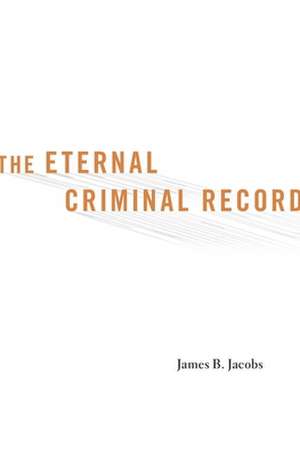
The Eternal Criminal Record
Autor James B. Jacobsen Limba Engleză Hardback – 2 feb 2015
The United States is unique in making criminal information easy to obtain by employers, landlords, neighbors, even cyberstalkers. Its nationally integrated rap-sheet system is second to none as an effective law enforcement tool, but it has also facilitated the transfer of ever more sensitive information into the public domain. While there are good reasons for a person's criminal past to be public knowledge, records of arrests that fail to result in convictions are of questionable benefit. Simply by placing someone under arrest, a police officer has the power to tag a person with a legal history that effectively incriminates him or her for life.
In James Jacobs's view, law-abiding citizens have a right to know when individuals in their community or workplace represent a potential threat. But convicted persons have rights, too. Jacobs closely examines the problems created by erroneous record keeping, critiques the way the records of individuals who go years without a new conviction are expunged, and proposes strategies for eliminating discrimination based on criminal history, such as certifying the records of those who have demonstrated their rehabilitation.
Preț: 351.67 lei
Puncte Express: 528
Carte tipărită la comandă
Livrare economică 04-18 decembrie
Livrare prin curier în România Termenul estimat este afișat lângă disponibilitate.
Transport gratuit de la 400.00 lei Plată online sau ramburs, în funcție de opțiunile comenzii.
Retur gratuit în 14 zile Comandă securizată și suport în română.
Specificații
ISBN-13: 9780674368262
ISBN-10: 0674368266
Pagini: 416
Dimensiuni: 177 x 246 x 33 mm
Greutate: 0.73 kg
Editura: Harvard University Press
ISBN-10: 0674368266
Pagini: 416
Dimensiuni: 177 x 246 x 33 mm
Greutate: 0.73 kg
Editura: Harvard University Press
V-ar putea interesa
-
 Intuitions of Justice and the Utility of DesertPaul H. Robinson-30%Preț: 1166.61 lei1666.30 lei
 -
 Preț: 248.97 lei
 -
 Satan's ChoiceLorne Campbell-25%Preț: 98.11 lei130.15 lei
 -
 Unleashed: The Phenomena of Status Dogs and Weapon DogsSimon HardingPreț: 222.98 lei
 -
 -27%Preț: 887.66 lei1209.78 lei
 -
 Violent Crossroads of Central AmericaThomas J O'Callaghan-27%Preț: 1053.55 lei1437.47 lei
 -
 The CartelGraham Johnson-26%Preț: 62.54 lei84.69 lei
 -
 -25%Preț: 60.18 lei80.16 lei
 -
 Understanding Crime and Social PolicyEmma WincupPreț: 252.60 lei
Descriere
For 60 million Americans a criminal record overshadows everything else about their identity. Citizens have a right to know when someone around them represents a threat. But convicted persons have rights too. James Jacobs examines the problem of erroneous records and proposes ways to eliminate discrimination for those who have been rehabilitated.