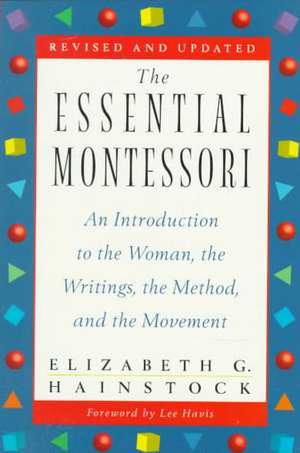
The Essential Montessori
Autor Elizabeth G. Hainstocken Limba Engleză Paperback – apr 1997
For those interested in the best education for their children, this volume fully lives up to its title. It has earned its place as the essential work on the subject.
Preț: 125.50 lei
Puncte Express: 188
Carte disponibilă
Livrare economică 15-29 mai
Specificații
ISBN-13: 9780452277960
ISBN-10: 0452277965
Pagini: 160
Dimensiuni: 135 x 203 x 9 mm
Greutate: 0.19 kg
Ediția:Revizuită
Editura: Penguin Random House LLC (No Starch)
ISBN-10: 0452277965
Pagini: 160
Dimensiuni: 135 x 203 x 9 mm
Greutate: 0.19 kg
Ediția:Revizuită
Editura: Penguin Random House LLC (No Starch)
Notă biografică
Certified as a Montessori teacher by St. Nicholas Training Centre in London, and active on behalf of the method since 1960, Elizabeth G. Hainstock became a Montessori consultant for the Department of Health, Education and Welfare in 1971. She currently sits on the board of the International Montessori Society and makes her home in San Juan Bautista, California.
Cuprins
Foreword
Preface
Introduction
1. Maria Montessori: The Woman and the Method
2. Introduction of the Method into the United States
1912
1958
3. Criticisms of the Method
Answers to Some Common Criticisms
4. Adaptability of the Method
Special Education
Culturally Disadvantaged
Behavior Modification
Public Schools
In the Home
Federally Funded Programs
5. The Relevance of Montessori Today and in the Future
6. Montessori's Views of Her Work
The First Children's House
Sources of Inspiration
The Adult and the Child
The Discovery of the Child: The Absorbent Mind; Normalization; Observations of the Child; The Child and Work
The Sensitive Periods
Independence
Obedience
Liberty, Freedom, and Order
Movement and Activity
The Method
The Prepared Environment: The Children's House; The Teacher; The Materials and the Lessons
Practical Applications of the Theory: Sensory Education; Language; Writing and Reading; Arithmetic; Imagination and Fantasy; Art and Music; Physical Education and Nature
On Education and Schools
7. Appendixes
A. Familiar Montessori Terms
B. Classroom Materials
C. A Comparison of Montessori and Traditional Pre-School Education
D. Choosing a Montessori School for Your Child
E. The Evolution of the Montessori Community
F. Montessori Informational Sources: Organizations; Other Sources; Materials
G. Montessori Teacher Education Programs
H. Research and the Six-Year Study
I. Selected Bibliography
J. Some Highlights in the Life of Maria Montessori
Preface
Introduction
1. Maria Montessori: The Woman and the Method
2. Introduction of the Method into the United States
1912
1958
3. Criticisms of the Method
Answers to Some Common Criticisms
4. Adaptability of the Method
Special Education
Culturally Disadvantaged
Behavior Modification
Public Schools
In the Home
Federally Funded Programs
5. The Relevance of Montessori Today and in the Future
6. Montessori's Views of Her Work
The First Children's House
Sources of Inspiration
The Adult and the Child
The Discovery of the Child: The Absorbent Mind; Normalization; Observations of the Child; The Child and Work
The Sensitive Periods
Independence
Obedience
Liberty, Freedom, and Order
Movement and Activity
The Method
The Prepared Environment: The Children's House; The Teacher; The Materials and the Lessons
Practical Applications of the Theory: Sensory Education; Language; Writing and Reading; Arithmetic; Imagination and Fantasy; Art and Music; Physical Education and Nature
On Education and Schools
7. Appendixes
A. Familiar Montessori Terms
B. Classroom Materials
C. A Comparison of Montessori and Traditional Pre-School Education
D. Choosing a Montessori School for Your Child
E. The Evolution of the Montessori Community
F. Montessori Informational Sources: Organizations; Other Sources; Materials
G. Montessori Teacher Education Programs
H. Research and the Six-Year Study
I. Selected Bibliography
J. Some Highlights in the Life of Maria Montessori