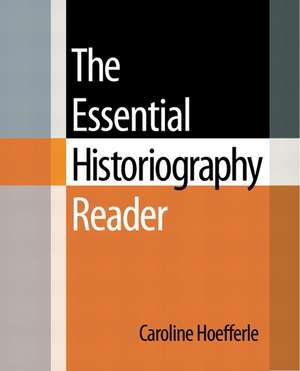
The Essential Historiography Reader
Autor Caroline Hoefferleen Limba Engleză Paperback – 2011
În procesul de formare a unui viitor istoric, trecerea de la simpla acumulare de fapte la înțelegerea mecanismelor interpretative reprezintă un prag critic. Remarcăm că The Essential Historiography Reader este conceput special pentru a facilita această tranziție, oferind o metodologie aplicată prin care teoriile abstracte devin instrumente de lucru concrete. Volumul nu se limitează la a descrie evoluția disciplinei, ci integrează fragmente de text care permit studenților să identifice stilurile și filosofiile istorice direct în sursele primare și secundare.
Suntem de părere că structura binară a lucrării oferă un echilibru necesar: prima parte urmărește rădăcinile istoriografiei occidentale, din Grecia Antică până la profesionalizarea din secolul al XIX-lea, în timp ce a doua parte se concentrează pe specificul tradiției americane. Această abordare pragmatică o transformă într-o alternativă viabilă la History and Historians de Mark T. Gilderhus pentru cursurile de Istoriografie sau Metode Istorice, având avantajul unei selecții de texte care încurajează analiza critică în locul memorării cronologice.
Poziționarea autoarei Caroline Hoefferle este una riguroasă; dacă în British Student Activism in the Long Sixties aceasta demonstra o stăpânire fină a detaliului arhivistic și empiric, în acest volum își folosește experiența pentru a sintetiza concepte complexe într-un limbaj accesibil. Față de abordarea vastă și enciclopedică din Historiography de Ernst Breisach, lucrarea de față este mai focalizată, fiind un instrument pedagogic calibrat pentru nevoile semestriale ale studenților, punând accent pe modul în care teoria informează scrierea istorică propriu-zisă.
Preț: 741.48 lei
Preț vechi: 962.96 lei
-23%
Carte disponibilă
Livrare economică 12-26 noiembrie
Specificații
ISBN-10: 0321437624
Pagini: 320
Dimensiuni: 185 x 229 x 15 mm
Greutate: 0.46 kg
Ediția:New.
Editura: Pearson Education
Locul publicării:Upper Saddle River, United States
V-ar putea interesa
-
 The Undivided Past: History Beyond Our DifferencesDavid CannadinePreț: 88.96 lei
 -
 The Oxford Handbook of Latin American HistoryJose C. Moya-29%Preț: 400.84 lei564.70 lei
 -
 Herodotus: A Very Short IntroductionJennifer T. Roberts-20%Preț: 56.77 lei70.88 lei
 -
 -22%Preț: 448.07 lei577.08 lei
 -
 Processing the Past: Changing Authorities in History and the ArchivesFrancis X. Blouin, Jr-31%Preț: 791.51 lei1142.71 lei
 -
 The Organization of American Historians and the Writing and Teaching of American HistoryRichard S. Kirkendall-16%Preț: 250.25 lei297.79 lei
 -
 Transnational HistoryPierre-Yves SaunierPreț: 191.26 lei
 -
 History in the Digital AgeToni WellerPreț: 409.16 lei
 -
 British Student Activism in the Long SixtiesCaroline Hoefferle-18%Preț: 1250.64 lei1525.16 lei
 -
 The History Written on the Classical Greek BodyRobin OsbornePreț: 303.00 lei
 -
 Natural Experiments of HistoryJames A. RobinsonPreț: 171.67 lei
 -
 How to Stop Living and Start WorryingSimon CritchleyPreț: 114.25 lei
 -
 Companion Philosophy HistoryTuckerPreț: 428.00 lei
 -
 History in PracticeProf. Ludmilla Jordanova-13%Preț: 171.46 lei198.21 lei
De ce să citești această carte
Recomandăm această carte studenților la istorie care au nevoie de un ghid clar pentru a înțelege cum s-a schimbat scrierea istoriei de-a lungul timpului. Câștigul principal este capacitatea de a recunoaște diversele școli de gândire istoriografică prin intermediul fragmentelor incluse. Este un manual esențial pentru seminarele de metodologie, oferind o punte între teoria pură și practica redactării unui text academic.
Descriere
The book is organized into two main parts. The first part traces the origins of contemporary American historical traditions to their roots in ancient Greece and explains how the profession of history emerged and developed in Europe and America through the nineteenth century. The second part focuses more specifically on historiographical developments the United States since the nineteenth century.
Cuprins
PART I: FOUNDATIONS OF WESTERN HISTORIOGRAPHY
CHAPTER 1: EARLY HISTORIES
Herodotus, The Histories
Thucydides, History of the Peloponnesian War
Bede, A History of the English Church and People
CHAPTER 2: THE EVOLUTION OF “MODERN” HISTORY
Niccolo Machiavelli, The Prince
Giambattista Vico, The New Science
Marquis de Condorcet, Sketch for a Historical Picture of the Progress of the Human Mind
Mercy Otis Warren, History of the Rise Progress and Termination of the American Revolution
CHAPTER 3: NINETEENTH-century EUROPEAN HISTORIOGRAPHY
Karl Marx, The Eighteenth Brumaire of Louis Bonaparte
Leopold Von Ranke, History of the Latin and Teutonic Nations
Thomas Babington Macaulay, “The Task of the Historian” and The History of England
PART II: MODERN HISTORIOGRAPHY IN THE UNITED STATES
CHAPTER 4: AMERICAN HISTORY IN THE NINETEENTH CENTURY
George Bancroft, The History of the United States of America from the Discovery of the Continent
Herbert Baxter Adams, “Saxon Tithing-Men in America”
Frederick Jackson Turner, The Frontier in American History
CHAPTER 5: CONFLICT AND CONSENSUS: THE PROGRESSIVE CHALLENGE TO AMERICAN HISTORY
W.E.B. Du Bois, Souls of Black Folk
Charles and Mary Beard, The Rise of American Civilization
Daniel J. Boorstin, The Genius of American Politics
CHAPTER 6: MARXISM, ANNALES, AND THE NEW LEFT
Fernand Braudel, The Mediterranean and the Mediterranean World in the Age of Philip II
E. P. Thompson, The Making of the English Working Class
Jesse Lemisch, Jack Tar in the Streets: Merchant Seamen in the Politics of Revolutionary America
CHAPTER 7: NEW SOCIAL HISTORY
Robert William Fogel and Stanley L. Engerman, Time on the Cross: The Economics of American Negro Slavery
Carroll Smith-Rosenberg, The Hysterical Woman
John Hope Franklin, The Moral Legacy of the Founding Fathers
CHAPTER 8: THE LINGUISTIC TURN, POSTMODERNISM, AND NEW CULTURAL HISTORY
Michel Foucault, Discipline & Punish: The Birth of the Prison
Robert Darnton, The Great Cat Massacre
Ruth H. Bloch, The Construction of Gender in a Republican World
CHAPTER 9: WORLD HISTORIES
Edward Said, Orientalism
David Christian, World History in Context
Thomas Bender, A Nation Among Nations: America’s Place in World History
EPILOGUE: HISTORIOGRAPHY SINCE 1990
SELECT BIBLIOGRAPHY
Notă biografică
Caracteristici
- Explicitly devoted to supporting historiography education at the undergraduate level
- The first section of each chapter focuses on historical theories, methods, and developments.
- Key concepts and historians are noted in the margins, where space is provided for note-taking
- The second section of each chapter contains excerpts from the works of important historians described in the first section. These excerpts are reproduced exactly as they were originally written (or translated, as the case may be), including any citations included in the original works.
- Enables students to see the types of sources and methodology used in the excerpts
- The last excerpt in all but the first chapter illustrates how one prominent historian applied the approaches discussed in the first section of the chapter to the topic of the American Revolution.
- Enables students to see how historiography and historical context shapes the written history of a topic familiar to most American students
- Questions for Consideration are included for each excerpt to help guide student reading and thinking.
- Critical Analysis Worksheets provided in Appendix A enable students to take notes on the excerpts and dissect them.
- By critically analyzing the excerpts, students can gain a deeper understanding of various theoretical frameworks and methodologies, and can decide for themselves which of these approaches are the most promising or flawed.
- An epilogue discusses trends in American historiography since the 1990s, trends which continue to influence current historians and shape the environment in which history students now live and work.
- Following the epilogue, a sample historiographical review essay of the American Revolution is provided to illustrate how one might use the American Revolution excerpts in an actual historiographical essay.
- A bibliography is provided at the end of the book for those who wish to do further research on the topics discussed in each chapter.