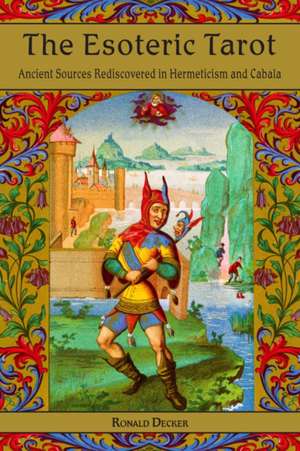
The Esoteric Tarot
Autor Ronald Deckeren Limba Engleză Paperback – 9 iul 2013
Suntem de părere că The Esoteric Tarot este o lectură esențială pentru cercetătorii serioși și practicanții avansați care doresc să depășească miturile romantice despre originile egiptene ale cărților de divinație. Ronald Decker propune o abordare riguroasă, aproape chirurgicală, prin care demontează concepțiile greșite și plasează evoluția Tarotului într-un context istoric și academic solid. Credem că valoarea acestui volum rezidă în capacitatea sa de a reconcilia rigoarea istorică cu profunzimea ezoterică, oferind o perspectivă rară asupra modului în care un simplu joc de curte italian a devenit un depozit de înțelepciune ermetică. În paginile sale, descoperim cum Arcanele Minore și cele Majore au fuzionat sub influența alchimiei, astrologiei și numerologiei abia în secolul al XVIII-lea, prin intervenția ocultiștilor parizieni. Complementar lui Mystical Origins of the Tarot: unde Paul Huson se concentrează pe rădăcinile simbolice din Persia antică și pe teatrul medieval, Decker explorează sistemele numerice pierdute bazate pe Cabala și riturile de inițiere mistagogice. Spre deosebire de ghidurile practice precum cele scrise de Lucinda Nile, care pun accent pe interpretarea intuitivă, acest volum analizează structura internă a sistemului de divinație. Această lucrare reprezintă o evoluție naturală față de A History of the Occult Tarot, consolidând poziția autorului ca autoritate în istoria cărților de joc. Dacă în lucrările anterioare Decker a cartografiat istoria generală a pachetelor oculte, aici el aprofundează mecanismele ezoterice specifice, oferind un instrument de studiu care transformă felul în care înțelegem arhitectura Tarotului contemporan.
Preț: 145.58 lei
Carte disponibilă
Livrare economică 09-23 noiembrie
Specificații
ISBN-10: 0835609081
Pagini: 344
Ilustrații: Illustrations
Dimensiuni: 151 x 228 x 27 mm
Greutate: 0.48 kg
Editura: Quest Books (IL)
V-ar putea interesa
-
 Tarot GamesCait JohnsonPreț: 90.70 lei
 -
 A Wicked Pack of Cards: Origins of the Occult TarotMichael DummettPreț: 379.92 lei
 -
 -17%Preț: 103.64 lei124.75 lei
 -
 Tarot of White CatsLo ScarabeoPreț: 130.50 lei
 -
 Tarot of the Secret ForestLo ScarabeoPreț: 129.83 lei
 -
 Journey of Love Oracle CardsAlana FairchildPreț: 153.57 lei
 -
 Ceccoli Tarot DeckNicoletta CeccoliPreț: 129.05 lei
 -
 Universal Tarot Grand TrumpsLo ScarabeoPreț: 120.50 lei
 -
 Nature's Whispers Oracle CardsAngela HartfieldPreț: 124.50 lei
 -
 TarotJoseph D'AgostinoPreț: 82.94 lei
 -
 Tarot Dictionary and CompendiumJana RileyPreț: 119.54 lei
 -
 Magical World of the TarotGareth KnightPreț: 89.55 lei
 -
 Tarot as a Way of LifeKaren Hamaker-ZondagPreț: 103.79 lei
 -
 Tarot and PsychologyArthur Rosengarten Ph DPreț: 118.05 lei
 -
 Haindl Tarot, Minor Arcana, REV Ed.Rachel PollackPreț: 89.94 lei
 -
 Everyday TarotGail FairfieldPreț: 76.05 lei
 -
 The Key to the TarotL. W. De LaurencePreț: 84.74 lei
 -
 Self-Knowledge: Volume OneMichael William BennettPreț: 64.25 lei
 -
 Palmistry CardsVernon MahabalPreț: 85.58 lei
De ce să citești această carte
Recomandăm această carte cititorilor care vor să înțeleagă „de ce” și „cum” în spatele simbolismului Tarotului, dincolo de ghicirea viitorului. Veți câștiga o perspectivă istorică documentată care separă legenda de fapt, învățând despre legăturile reale dintre cărți, alchimie și numerologie. Este un volum care transformă practica Tarotului dintr-o metodă intuitivă într-o disciplină intelectuală și spirituală profundă, ancorată în tradiția ermetică europeană.
Despre autor
Ronald Decker este un istoric de artă și artist plastic, deținând un masterat în pictură de la Universitatea din Cincinnati. Expertiza sa unică provine din perioada în care a fost curator de cărți antice la The U.S. Playing Card Company, poziție care i-a permis accesul la colecții rare din întreaga lume, de la Istanbul la Cairo. A studiat istoria Tarotului în cele mai importante capitale europene, devenind unul dintre cei mai respectați specialiști în evoluția istorică a pachetelor de cărți. Această experiență vastă se reflectă în abordarea sa academică, dar accesibilă, asupra tradițiilor ezoterice.
Descriere scurtă
The Tarot consists of the Minor Arcana, four suits of cards similar to our modern deck, and the Major Arcana, twenty-two allegorical or “trump” cards. Decker says the four-suit deck was invented in Asia Minor before AD 1000; Italian courtiers added the trumps in the 1400s. But Tarot was first used as a game. Tarot divination was only created in the 1700s by a Parisian fortuneteller who based the trump images on Hermeticism, which merges Greco-Egyptian alchemy, astrology, numerology, magic, and mysticism. Today, the suit-cards are often traced to the ancient Jewish Cabala. But, says Decker, they, too, acquired their meanings only in the 1700s, and he cites a lost numerical system based on Cabala at that time.
Decker’s interpretation integrates three whole systems-astrological, arithmological, mystagogical (concerning initiation rites into the Mysteries). His depth of knowledge makes the book a must-have for serious students of Tarot and esotericism.
Recenzii
"I think the contents of the book adds to the tarot interpreter's understanding of present day readings and will improve interpretation. I found there was greater substance in the older interpretations, of character, risk factors, effort and reputation, for instance, the Juggler could be considered as 'risk, test or experiment', and that this demon has dispensed our lot in life. The Fool with 'divine madness' encouraged by the Sun God, Apollo, had irrational behaviour which may have suggested the gift of prophecy. It is a scholarly book with a very extensive bibliography. It is ideal reading for tarot devotees and those who wish for an in-depth understanding of academic and practical aspects of the tarot." --MBS Circle Network, February 25, 2013
"A rigorously researched book that serves as the basis for Decker's arguments for a Tarot richly rooted in an ancient cosmic worldview--one that continues to speak to us today."
— Paul Quinn, author, Tarot for Life
"I have been following Ronald Decker's work for many years, and he has been developing the themes expressed in The Esoteric Tarot in articles and in books that he has written since the early 1990s. His views may be surprising to some, but everything Decker writes is carefully researched and contemplated. There is no other author I trust more than Decker for insights into the Tarot's history and symbolism."
— Robert M. Place, creator of The Alchemical Tarot and author of The Tarot: History, Symbolism, and Divination
"Noted art and playing card historian Ronald Decker deeply probes the Hermetic, Neoplatonic and Kabbalistic esoteric systems studied by Renaissance intellectuals and finds sufficient significant congruency between their symbols and tarot cards to build his intriguing theory that the tarot trumps may well have originated as a device with multilevel meanings developed for psychological and philosophical introspection, possibly divination.
Most important to Decker’s theory is his close examination of the life and theories of eighteenth century Parisian card reader Jean-Baptiste Alliette, who, perceiving the Hermetic resonances of the cards, first popularized the use of tarot cards for divination purposes under the pseudonym 'Etteilla.' His card interpretations became the basis for those of the Order of the Golden Dawn, and indeed form the basis of most tarot card interpretations used today.
Obviously this is an impressive book not to be missed; as readable as it is learned, it should have a definite appeal to tarot historian and tarot reader alike."
— Paul Huson, author, Mystical Origins of the Tarot