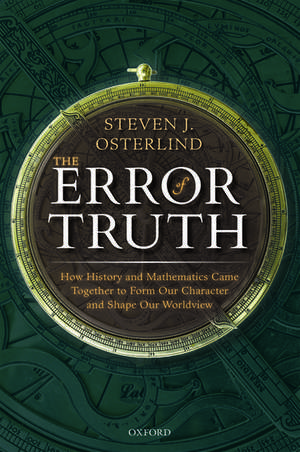
The Error of Truth: How History and Mathematics Came Together to Form Our Character and Shape Our Worldview
Autor Steven J. Osterlinden Limba Engleză Hardback – 7 feb 2019
Ne-a atras atenția modul în care The Error of Truth reușește să sintetizeze o istorie complexă a ideilor matematice, concentrându-se pe o fereastră temporală specifică și transformatoare: perioada dintre 1790 și 1920. Ceea ce aduce nou această lucrare față de literatura existentă este demonstrația riguroasă a modului în care „măsurarea incertitudinii” nu a fost doar o victorie a matematicii pure, ci un catalizator pentru schimbarea viziunii noastre despre lume, de la medicină la economie și inteligență artificială. Suntem de părere că perspectiva autorului, ancorată în expertiza sa vastă în psihometrie, oferă o claritate rară asupra mecanismelor prin care probabilitatea a devenit fundamentul gândirii moderne.
Comparabil cu The Empire of Chance de Gerd Gigerenzer în rigurozitatea cu care tratează transformarea științelor prin prisma hazardului, volumul de față se diferențiază prin focalizarea pe contextul sociotehnic al Revoluției Industriale și al Iluminismului târziu. Dacă în lucrările sale anterioare, precum Constructing Test Items sau Test Item Bias, Steven J. Osterlind se concentra pe aplicațiile tehnice ale statisticii în evaluarea educațională, aici el face un pas în spate pentru a oferi o viziune panoramică. Putem afirma că lucrarea reprezintă o evoluție firească a preocupărilor autorului, trecând de la instrumentele de măsurare propriu-zise la istoria intelectuală care a făcut aceste instrumente posibile. Structura narativă este una alertă, legând inovațiile matematice de creșterea ratelor de alfabetizare și de progresele în transporturi, oferind cititorului o înțelegere profundă a modului în care am ajuns să internalizăm o viziune cuantificată asupra realității.
Preț: 268.82 lei
Carte tipărită la comandă
Livrare economică 05-16 iunie
Specificații
ISBN-10: 0198831609
Pagini: 352
Ilustrații: 79
Dimensiuni: 164 x 241 x 25 mm
Greutate: 0.73 kg
Editura: OUP OXFORD
Colecția OUP Oxford
Locul publicării:Oxford, United Kingdom
De ce să citești această carte
Această carte este esențială pentru cei care doresc să înțeleagă rădăcinile lumii noastre obsedate de date. Cititorul va câștiga o perspectivă istorică solidă asupra modului în care probabilitatea și statistica au modelat societatea modernă. Este o recomandare excelentă pentru studenții la matematică, istoria științei sau științe sociale, oferind un context fascinant pentru concepte matematice care, altfel, ar putea părea abstracte sau aride.
Despre autor
Steven J. Osterlind este profesor emerit de măsurare și statistică la Universitatea Missouri-Columbia, unde a condus programul de psihologie educațională. Cu un doctorat obținut în 1976 la University of Southern California și o bursă post-doctorală la Yale University, Osterlind este o autoritate recunoscută în domeniul evaluării psihologice și al metodelor psihometrice. Expertiza sa în analiza varianței și dezvoltarea testelor standardizate transpare în modul meticulos în care abordează istoria gândirii cantitative în The Error of Truth.
Descriere
Recenzii
The book tells an important and interesting story with a good balance between sections that describe the general historical events from the considered period and parts that explain the mathematical accomplishments. Some of the sections explaining mathematical material, which fulfil the promise made in the Introduction of being written in plain English with mathematical content kept to a minimum, are illuminating.
...a fascinating story of how quantitative reasoning, especially probabilistic and statistical, was over a couple of hundred years taken up by more and more researchers and applied to an ever-increasing range of things which affect our lives — health care, insurance, urban planning, etc...
This book is written in a colloquial style and presents the history of statistical science and many examples, which explain relevant developments of statistics.
A revelatory history of how so much of humanity has come to internalize a quantified worldview. It's both thrilling and a little terrifying, all at once.