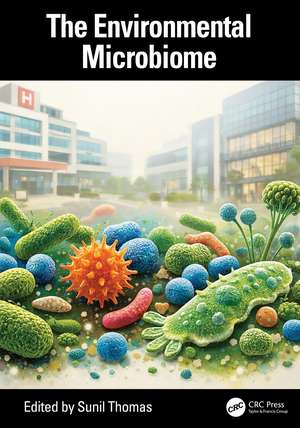
The Environmental Microbiome
Editat de Sunil Thomasen Limba Engleză Hardback – 13 sep 2026
Preț: 1154.38 lei
Preț vechi: 1407.78 lei
-18% Nou
Puncte Express: 1732
Carte tipărită la comandă
Livrare economică 30 noiembrie-14 decembrie
Livrare prin curier în România Termenul estimat este afișat lângă disponibilitate.
Transport gratuit pentru acest produs Plată online sau ramburs, în funcție de opțiunile comenzii.
Retur gratuit în 14 zile Comandă securizată și suport în română.
Specificații
ISBN-13: 9781041069362
ISBN-10: 1041069367
Pagini: 214
Ilustrații: 34
Dimensiuni: 178 x 254 mm
Greutate: 0.59 kg
Ediția:1
Editura: CRC Press
Colecția CRC Press
ISBN-10: 1041069367
Pagini: 214
Ilustrații: 34
Dimensiuni: 178 x 254 mm
Greutate: 0.59 kg
Ediția:1
Editura: CRC Press
Colecția CRC Press
Public țintă
Academic, Postgraduate, and Professional ReferenceNotă biografică
Professor Sunil Thomas is a Research Professor at the Lankenau Institute for Medical Research in Wynnewood, Pennsylvania, where he leads innovative work at the intersection of cell biology, microbiology, and translational medicine. His research is primarily focused on developing next-generation immunotherapies for complex and chronic conditions, including inflammatory bowel diseases and Alzheimer’s disease. A key component of his work involves investigating the role of the microbiome in disease progression and therapeutic response.
Over the course of his career, Professor Thomas has made significant contributions to the fields of infectious disease and vaccine development. He has been involved in the design and development of diagnostic tools and vaccines targeting a range of infectious pathogens. In addition, his research has extended into the structural biology of viruses, providing insights into viral mechanisms that inform both therapeutic and preventive approaches.
Professor Thomas earned his Ph.D. in Environmental Biotechnology from Cochin University of Science and Technology (CUSAT) in India. He subsequently completed postdoctoral training at the Indian Institute of Science in Bangalore and at the Mount Sinai School of Medicine in New York, where he further refined his expertise in molecular and translational biomedical research.
An accomplished scholar, Professor Thomas has authored more than 70 peer-reviewed publications and contributed to books on vaccines and infectious diseases. He is also an inventor on multiple patents, reflecting the practical and translational impact of his research.
Over the course of his career, Professor Thomas has made significant contributions to the fields of infectious disease and vaccine development. He has been involved in the design and development of diagnostic tools and vaccines targeting a range of infectious pathogens. In addition, his research has extended into the structural biology of viruses, providing insights into viral mechanisms that inform both therapeutic and preventive approaches.
Professor Thomas earned his Ph.D. in Environmental Biotechnology from Cochin University of Science and Technology (CUSAT) in India. He subsequently completed postdoctoral training at the Indian Institute of Science in Bangalore and at the Mount Sinai School of Medicine in New York, where he further refined his expertise in molecular and translational biomedical research.
An accomplished scholar, Professor Thomas has authored more than 70 peer-reviewed publications and contributed to books on vaccines and infectious diseases. He is also an inventor on multiple patents, reflecting the practical and translational impact of his research.
Cuprins
1. Environmental Microbiome
Manar El Samak, Abdelrahman M. Sedeek, Hasnaa L.Kamel, and Samar M. Solyman
2. Antibiotic Resistance Proliferation under the Influence of Environmental Determinants: Challenges and Mitigation
Bhumika Maharana and Nishant A. Dafale
3. Use of a Biosimulator in the Identification of Microbiome of Hospital Intensive Care Units
Sunil Thomas and Lawrence L. Livornese Jr.
4. Public Transit Microbiome: A Central Pointer for Human and Environmental Health
Shashi Prabha Kumari, Sunila Hooda, Prerna Diwan, and Rakesh Kumar Gupta
5. The Environmental Microbiome: A Computational Genomics Perspective
Lenore Pipes
6. The Secret Life of Ecosystems: Uncovering the Roles of Microbes in Shaping Environmental Processes
Hina H. Radadiya, Rajesh K. Patel, Charmy R. Kothari, and Ramesh K. Kothari
7. Soil Microbiome: Natural, Agricultural and Contaminated Soils
Acacio Aparecido Navarrete, Giselle Gomes Monteiro Fracetto, Paulo Ademar Avelar Ferreira, Talles Renan Souza Nicoletti, Kelly Hidalgo Martinez, Gabrielle Marques Inácio, and Valéria Maia de Oliveira
8. Unveiling Lytic Polysaccharide Monooxygenases from Environmental Microbiome: Nature's Biocatalyst for Bioprocess Advancement
Chetana Akhand, Riddhi Singh, Sejal Bhairam, Rashi Bamrotwar, and Nishant A. Dafale
9. Genomic Diversity and Novel Findings of Chitinase-Producing Bacteria in Yok Don National Park
Dinh Minh Tran
10. Beyond the Rhizosphere: Understanding Endophytic Communities in Environmental Microbiomes
Dhruvi K. Suvagiya, Sandeep Chovatiya, and Ramesh K. Kothari
Manar El Samak, Abdelrahman M. Sedeek, Hasnaa L.Kamel, and Samar M. Solyman
2. Antibiotic Resistance Proliferation under the Influence of Environmental Determinants: Challenges and Mitigation
Bhumika Maharana and Nishant A. Dafale
3. Use of a Biosimulator in the Identification of Microbiome of Hospital Intensive Care Units
Sunil Thomas and Lawrence L. Livornese Jr.
4. Public Transit Microbiome: A Central Pointer for Human and Environmental Health
Shashi Prabha Kumari, Sunila Hooda, Prerna Diwan, and Rakesh Kumar Gupta
5. The Environmental Microbiome: A Computational Genomics Perspective
Lenore Pipes
6. The Secret Life of Ecosystems: Uncovering the Roles of Microbes in Shaping Environmental Processes
Hina H. Radadiya, Rajesh K. Patel, Charmy R. Kothari, and Ramesh K. Kothari
7. Soil Microbiome: Natural, Agricultural and Contaminated Soils
Acacio Aparecido Navarrete, Giselle Gomes Monteiro Fracetto, Paulo Ademar Avelar Ferreira, Talles Renan Souza Nicoletti, Kelly Hidalgo Martinez, Gabrielle Marques Inácio, and Valéria Maia de Oliveira
8. Unveiling Lytic Polysaccharide Monooxygenases from Environmental Microbiome: Nature's Biocatalyst for Bioprocess Advancement
Chetana Akhand, Riddhi Singh, Sejal Bhairam, Rashi Bamrotwar, and Nishant A. Dafale
9. Genomic Diversity and Novel Findings of Chitinase-Producing Bacteria in Yok Don National Park
Dinh Minh Tran
10. Beyond the Rhizosphere: Understanding Endophytic Communities in Environmental Microbiomes
Dhruvi K. Suvagiya, Sandeep Chovatiya, and Ramesh K. Kothari
Descriere
The human microbiome is influenced by the environmental microbiome, which recognizes environmental elements as part of a complex ecosystem impacting human health. Microbiomes include species across all major kingdoms. Recent research is strengthening the idea that associated microorganisms make these contributions.