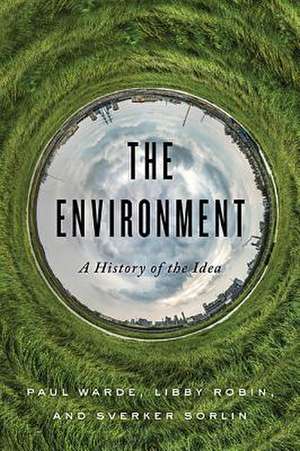
The Environment
Autor Libby Robin, Paul Warde, Sverker Sorlinen Limba Engleză Hardback – 25 ian 2019
Notăm cu interes apariția lucrării The Environment, o analiză istoriografică riguroasă care propune o perspectivă inedită: „mediul” nu este un dat imuabil, ci un concept intelectual construit într-un moment istoric precis. Descoperim aici că, înainte de mijlocul secolului al XX-lea, deși impactul uman asupra naturii era vizibil, lipsea cadrul conceptual necesar pentru a înțelege interconectarea globală și consecințele pe termen lung ale acțiunilor noastre. Autorii demonstrează cum, după 1945, s-a cristalizat un vocabular specific — incluzând termeni precum biodiversitate, poluare sau schimbări climatice — sub presiunea dublă a speranței postbelice și a fricii de distrugere totală. Suntem de părere că relevanța acestui volum pentru curriculumul de istoria științei este majoră, deoarece explică modul în care expertiza științifică a devenit esențială în gestionarea și disputarea crizelor ecologice. Cartea acoperă aceeași arie tematică precum Surroundings de Etienne S. Benson, dar cu o abordare axată mai puternic pe istoria ideilor post-1945 și pe rolul instituțiilor politice în legitimarea noii narațiuni planetare. Față de Nature's End, lucrare la care Sverker Sörlin a contribuit anterior, The Environment este mai sintetică, oferind o cronologie clară a modului în care am învățat să conceptualizăm viitorul planetei noastre. În contextul operei lui Paul Warde, acest titlu completează cercetările sale din The Invention of Sustainability, extinzând analiza de la resursele pre-industriale la complexitatea etică și politică a ecologismului contemporan. Stilul este academic, dar accesibil, oferind o structură narativă ce facilitează înțelegerea dinamicii dintre știință și opinia publică.
Preț: 294.16 lei
Carte disponibilă
Livrare economică 18 noiembrie-02 decembrie
Livrare express 03-07 noiembrie pentru 28.13 lei
Specificații
ISBN-10: 142142679X
Pagini: 256
Dimensiuni: 134 x 211 x 25 mm
Greutate: 0.36 kg
Editura: Johns Hopkins University Press
De ce să citești această carte
Suntem de părere că această carte este esențială pentru studenții la istorie, ecologie sau științe politice, oferind contextul istoric necesar pentru a înțelege de ce vorbim astăzi despre „mediu” ca despre o entitate globală. Cititorul câștigă o perspectivă critică asupra modului în care limbajul științific influențează politicile publice, fiind un instrument valoros pentru oricine dorește să navigheze dincolo de retorica ecologistă standard către originile intelectuale ale crizei actuale.
Despre autor
Paul Warde este lector de istorie la University of Cambridge, fiind un specialist recunoscut în relația dintre consumul de energie, economie și formarea statelor europene. Opera sa, care include titluri de referință precum Power to the People și The Invention of Sustainability, investighează modul în care resursele naturale au modelat dezvoltarea politică și socială a Europei din secolul al XVI-lea până în prezent. În lucrarea de față, Warde colaborează cu Libby Robin și Sverker Sörlin, aducându-și expertiza în istoria ideilor economice și de mediu pentru a explica geneza conceptului modern de „environment” în perioada postbelică.
Descriere scurtă
In this fascinating book, Paul Warde, Libby Robin, and Sverker Sörlin trace the emergence of the concept of the environment following World War II, a period characterized by both hope for a new global order and fear of humans' capacity for almost limitless destruction. It was at this moment that a new idea and a new narrative about the planet-wide impact of people's behavior emerged, closely allied to anxieties for the future. Now we had a vocabulary for talking about how we were changing nature: resource exhaustion and energy, biodiversity, pollution, and--eventually--climate change.
With the rise of "the environment," the authors argue, came new expertise, making certain kinds of knowledge crucial to understanding the future of our planet. The untold history of how people came to conceive, to manage, and to dispute environmental crisis, The Environment is essential reading for anyone who wants to help protect the environment from the numerous threats it faces today.
"Our relationship with nature goes far beyond resources, amenity, or the scientific idea of an archive we learn to read. There are, as The Environment shows, ethical complexities in how we use and abuse the planet--and in how we frame its improbable riches."--Nature
"Despite the importance in recent decades of environmentalism, environmental protection, environmental science, and so on, there has been strikingly little discussion of what exactly the environment is. Paul Warde, Libby Robin, and Sverker Sörlin examine the history of the concept as it has developed since the end of the Second World War, when they argue it took on its modern significance. The book is strongest in tracing the ways that changes in scientific institutions helped develop the modern idea of environment, as well as in its discussion of the ways that idea entered the popular imagination through works by Rachel Carson and others."--Environmental History
"This engaging and accessible book should be required reading for anyone concerned with the development of 'the environment' as a conceptual lodestone of both science and politics in the mid- to late-twentieth century. Moreover, it will be richly rewarding for anyone wishing to teach, research, or simply better understand the path dependencies and political dynamics of environmental issues today."--Local Environment
"Demonstrates the power of history to speak into the present. A wonderfully succinct, compelling, and revealing piece of writing."--Australian Book Review
"This is a highly recommended book that agricultural and rural historians will appreciate the significance of in tracing the history of the environment. It will be of interest to a wide academic readership, including historians of the environment, ideas, politics, science and technology. More importantly, this book deserves to be read by the wider public as it explains how perceptions of the environment have evolved relative to the history of the twentieth century. Understanding this history can inform contemporary responses to present and future environmental issues."--Agricultural History Review