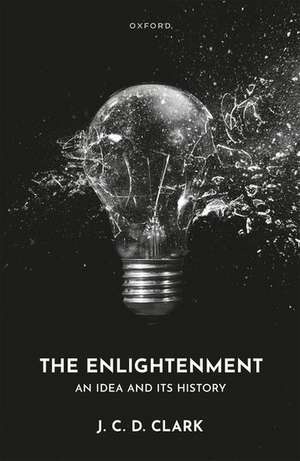
The Enlightenment: An Idea and Its History: Oxford University Press
Autor J. C. D. Clarken Limba Engleză Hardback – 26 iul 2024
Din seria Oxford University Press
- 5%
 Preț: 66.88 lei
 - 25%
 Preț: 229.84 lei
 - 19%
 Preț: 64.05 lei
 - 19%
 Preț: 52.70 lei
 - 26%
 Preț: 290.28 lei
 - 19%
 Preț: 58.63 lei
 - 28%
 Preț: 85.93 lei
 - 23%
 Preț: 148.10 lei
 -
 Preț: 59.17 lei
 - 19%
 Preț: 52.23 lei
 - 18%
 Preț: 100.67 lei
 -
 Preț: 64.48 lei
 - 21%
 Preț: 163.37 lei
 - 25%
 Preț: 231.41 lei
 -
 Preț: 142.18 lei
 - 26%
 Preț: 172.48 lei
 - 19%
 Preț: 64.36 lei
 - 29%
 Preț: 85.31 lei
 - 19%
 Preț: 104.37 lei
 -
 Preț: 70.12 lei
 - 25%
 Preț: 229.79 lei
 - 26%
 Preț: 262.14 lei
 - 17%
 Preț: 84.76 lei
 - 26%
 Preț: 289.99 lei
 - 20%
 Preț: 45.80 lei
 -
 Preț: 79.11 lei
 - 30%
 Preț: 213.42 lei
 - 19%
 Preț: 63.55 lei
 - 18%
 Preț: 203.85 lei
 - 21%
 Preț: 256.54 lei
 - 26%
 Preț: 257.20 lei
 - 18%
 Preț: 59.62 lei
 -
 Preț: 68.78 lei
 - 18%
 Preț: 82.31 lei
 - 29%
 Preț: 83.78 lei
 - 18%
 Preț: 64.75 lei
 - 29%
 Preț: 85.35 lei
 - 16%
 Preț: 56.15 lei
 - 28%
 Preț: 85.93 lei
 - 26%
 Preț: 224.28 lei
 -
 Preț: 54.45 lei
 -
 Preț: 62.42 lei
 - 15%
 Preț: 70.07 lei
 - 25%
 Preț: 230.11 lei
 -
 Preț: 119.64 lei
 - 26%
 Preț: 292.05 lei
 - 5%
 Preț: 318.35 lei
 -
 Preț: 94.75 lei
 - 15%
 Preț: 76.86 lei
 - 29%
 Preț: 215.08 lei
Preț: 293.66 lei
Preț vechi: 325.77 lei
-10%
Puncte Express: 440
Carte disponibilă
Livrare economică 12-18 noiembrie
Livrare express 27-31 octombrie pentru 90.87 lei
Livrare prin curier în România Termenul estimat este afișat lângă disponibilitate.
Transport gratuit de la 400.00 lei Plată online sau ramburs, în funcție de opțiunile comenzii.
Retur gratuit în 14 zile Comandă securizată și suport în română.
Specificații
ISBN-13: 9780198916284
ISBN-10: 0198916280
Pagini: 592
Dimensiuni: 160 x 240 x 34 mm
Greutate: 0.99 kg
Editura: OUP OXFORD
Colecția OUP Oxford
Seria Oxford University Press
Locul publicării:Oxford, United Kingdom
ISBN-10: 0198916280
Pagini: 592
Dimensiuni: 160 x 240 x 34 mm
Greutate: 0.99 kg
Editura: OUP OXFORD
Colecția OUP Oxford
Seria Oxford University Press
Locul publicării:Oxford, United Kingdom
Recenzii
A magnificent sweep of intellectual history over the long eighteenth century 1660 to 1832 and into the modern era.
Clark's erudition is truly impressive.
Especially impressive is Clark's fine grained comparison of translations of original works by Enlightenment writers, from those authors' original languages into other European tongues.
Clark's survey extends beyond the beliefs of French intellectuals to cover the so-called Enlightenment in England, Scotland, Germany, America and elsewhere. Thereafter, all the major writers on the Enlightenment are covered, if sometimes briefly - Cassirer gets his due but Jonathan Israel is demoted to a footnote. Still, the book is a triumph of scholarship and of clarity.
It is an example of rich and powerful scholarship in which a leading historian of ideas and intellectual history engages with wider politics and society. It is therefore as much an event as it is an important and stimulating book.
[...] full of daring originality and memorable insights. It will jolt the scholarly debate...J.C.D. Clark excels in scholarly demolition. His book promotes an "emancipation" from the Enlightenment label. Mr. Clark's scholarship tends to age well and reshape the terms of debate even for his critics. [He] promotes a history respectful of the past, one that is not written in the thrall of our present political priorities. That is a cause worth fighting for.
The "argument is simple, decisive, and demands to be faced squarely by anyone who writes about the Enlightenment in the future ... massive and marvellous ... a great valiant and lordly work of negative judgement: and I recommend everyone read it.
Writing with patient lucidity and ample quotation, Clark, with no overt polemical intention, exposes the weak points of some Enlightenment thinkers.
Clark's erudition is truly impressive.
Especially impressive is Clark's fine grained comparison of translations of original works by Enlightenment writers, from those authors' original languages into other European tongues.
Clark's survey extends beyond the beliefs of French intellectuals to cover the so-called Enlightenment in England, Scotland, Germany, America and elsewhere. Thereafter, all the major writers on the Enlightenment are covered, if sometimes briefly - Cassirer gets his due but Jonathan Israel is demoted to a footnote. Still, the book is a triumph of scholarship and of clarity.
It is an example of rich and powerful scholarship in which a leading historian of ideas and intellectual history engages with wider politics and society. It is therefore as much an event as it is an important and stimulating book.
[...] full of daring originality and memorable insights. It will jolt the scholarly debate...J.C.D. Clark excels in scholarly demolition. His book promotes an "emancipation" from the Enlightenment label. Mr. Clark's scholarship tends to age well and reshape the terms of debate even for his critics. [He] promotes a history respectful of the past, one that is not written in the thrall of our present political priorities. That is a cause worth fighting for.
The "argument is simple, decisive, and demands to be faced squarely by anyone who writes about the Enlightenment in the future ... massive and marvellous ... a great valiant and lordly work of negative judgement: and I recommend everyone read it.
Writing with patient lucidity and ample quotation, Clark, with no overt polemical intention, exposes the weak points of some Enlightenment thinkers.
Notă biografică
J. C. D. Clark was educated at Cambridge, where he was a Fellow of Peterhouse. At Oxford, he was a Fellow of All Souls College; at Chicago, he held a Visiting Professorship at the Committee on Social Thought; he has held visiting posts elsewhere. Latterly he was Hall Distinguished Professor of British History at the University of Kansas. He lives now in Northumberland. His interests are primarily in intellectual history, philosophy, social history, literature, and historiography, especially in the 'long eighteenth century', 1660-1832.
Cuprins
- Preface
- Acknowledgements
- Abbreviations
- Introduction: Why is the Enlightenment a Problem?
- Part I: Absences
- 1: Was the Enlightenment a Social Practice?
- 2: Was the Enlightenment Invented in France?
- 3: What Was English Discourse?
- 4: Did Anglophone Philosophers Design 'the Enlightenment'?
- 5: Why Could Even Leading Reformers in the Age of Revolution Not Conceptualize 'the Enlightenment'?
- Paart II: Anticipations?
- 6: Was the Enlightenment Invented in America?
- 7: Was British Empiricism the Framework of Common Sense?
- 8: Did Liberals Recognize the Enlightenment?
- 9: Did Socialists Recognize the Enlightenment?
- Part III: Achievements?
- 10: Was 'the Enlightenment' Invented in Germany?
- 11: Was There an 'Enlightenment Project'?
- 12: How Did Different Nationalities Construct Their Enlightenment?
- Conclusion: The Enlightenment, the History of Ideas, and Modernism
- Bibliography
- Index