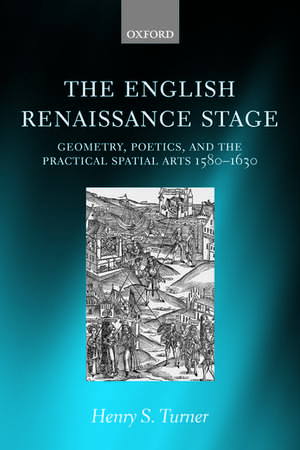
The English Renaissance Stage: Geometry, Poetics, and the Practical Spatial Arts 1580-1630
Autor Henry S. Turneren Limba Engleză Paperback – 25 noi 2010
Preț: 350.93 lei
Preț vechi: 477.76 lei
-27%
Puncte Express: 526
Carte tipărită la comandă
Livrare economică 20 noiembrie-01 decembrie
Livrare prin curier în România Termenul estimat este afișat lângă disponibilitate.
Transport gratuit de la 400.00 lei Plată online sau ramburs, în funcție de opțiunile comenzii.
Retur gratuit în 14 zile Comandă securizată și suport în română.
Specificații
ISBN-13: 9780199595457
ISBN-10: 0199595453
Pagini: 344
Ilustrații: 27 halftones
Dimensiuni: 155 x 234 x 19 mm
Greutate: 0.53 kg
Editura: OUP OXFORD
Colecția OUP Oxford
Locul publicării:Oxford, United Kingdom
ISBN-10: 0199595453
Pagini: 344
Ilustrații: 27 halftones
Dimensiuni: 155 x 234 x 19 mm
Greutate: 0.53 kg
Editura: OUP OXFORD
Colecția OUP Oxford
Locul publicării:Oxford, United Kingdom
V-ar putea interesa
-
 -29%Preț: 539.90 lei764.66 lei
 -
 -33%Preț: 2211.04 lei3289.56 lei
 -
 Arabian Nights' EntertainmentsRobert L. Mack-17%Preț: 98.12 lei117.53 lei
 -
 Early Modern TheatricalityHenry S. Turner-32%Preț: 1024.33 lei1512.30 lei
 -
 Samuel Johnson: The Arc of the PendulumFreya Johnston-31%Preț: 556.12 lei806.90 lei
 -
 -31%Preț: 975.00 lei1422.09 lei
 -
 Young Milton: The Emerging Author, 1620-1642Edward Jones-31%Preț: 949.79 lei1379.65 lei
 -
 Subversion and Sympathy: Gender, Law, and the British NovelMartha C. Nussbaum-31%Preț: 696.16 lei1012.38 lei
 -
 -12%Preț: 255.58 lei290.23 lei
 -
 The Merry Wives of WindsorProf. Eric Rasmussen-19%Preț: 66.33 lei81.51 lei
 -
 Teaching the Early Modern PeriodD. ConroyPreț: 387.19 lei
 -
 Shakespeare's SonnetsWilliam Shakespeare-27%Preț: 64.31 lei88.20 lei
 -
 -15%Preț: 661.58 lei778.33 lei
 -
 Preț: 396.86 lei
 -
 Preț: 370.75 lei
 -
 Reading Shakespeare's SonnetsDon PatersonPreț: 121.31 lei
 -
 Preț: 90.50 lei
 -
 Preț: 64.09 lei
Recenzii
Review from previous edition This is interdisciplinary work of impressive ambition and range, by someone who is arguably one of the most brilliant young scholars in the world working on Renaissance literature
The best first book of 2006
ambitious...fascinating material
a dense, rewarding study... Henry Turner presents a compelling picture of the early modern stage finding a metaphor for itself in the practical arts, and consequently developing as a complex system for making knowledge: 'a way of "thinking forward" about human action through models and artificial inventions'.
The English Renaissance Stage is a major book by a major critic that will change the ways in which we read the intersections of literature and mathematics in the late sixteenth and early seventeenth centuries.
without question one of the best pieces of Renaissance scholarship... in a decade... phenomenal ... a real pleasure.
Students are able to read short extracts from correspondence, legislation, theoretical and literary material, which substantiate the contexts they have been led to consider...this introduction to early English theatre distils much scholarship and should stimulate further explorations.
The best first book of 2006
ambitious...fascinating material
a dense, rewarding study... Henry Turner presents a compelling picture of the early modern stage finding a metaphor for itself in the practical arts, and consequently developing as a complex system for making knowledge: 'a way of "thinking forward" about human action through models and artificial inventions'.
The English Renaissance Stage is a major book by a major critic that will change the ways in which we read the intersections of literature and mathematics in the late sixteenth and early seventeenth centuries.
without question one of the best pieces of Renaissance scholarship... in a decade... phenomenal ... a real pleasure.
Students are able to read short extracts from correspondence, legislation, theoretical and literary material, which substantiate the contexts they have been led to consider...this introduction to early English theatre distils much scholarship and should stimulate further explorations.
Notă biografică
Henry S. Turner is Assistant Professor in the English Department at the University of Wisconsin-Madison, where he has taught since 2000. He received his BA from Wesleyan University, an MA in Renaissance Studies and Critical Theory from the University of Sussex, an MA, MPhil and PhD from Columbia University, and a Diplôme Supérieur d'Ètudes Françaises from the Université de Bourgogne. From 1993-94 he taught in the Département d'Anglais at the Université de Nice. At Madison, his primary research and teaching areas are in Renaissance literature and culture and in twentieth-century critical theory. He is affiliated with the Center for European Studies and with the Center for Renaissance and Early Modern Studies at Madison. He has received grants from the National Endowment for the Humanities, the Whiting Foundation, the Andrew W. Mellon Foundation, the University of Wisconsin-Vilas Foundation, and the Folger Shakespeare Library.