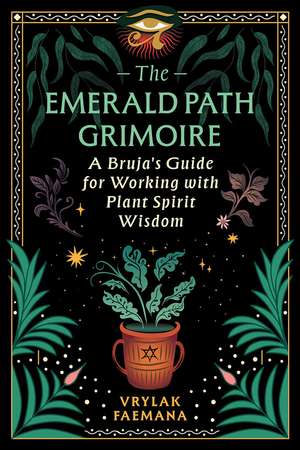
The Emerald Path Grimoire: A Bruja's Guide for Working with Plant Spirit Wisdom
Autor Vrylak Faemanaen Limba Engleză Paperback – 5 noi 2026
• Teaches ten clear protocols for ethical harvesting, ritual practice, and developing reciprocal relationships with plants
• Gives step-by-step instructions for preparing cleansing baths, mixing protective oils and healing incenses, and using ritual tools
• Provides a detailed herbarium with practical applications, planetary correspondences, and safety guidance for dozens of plants and resins
Drawing on animist principles and Latin American folk traditions, Vrylak Faemana presents a structured and practical approach to plant magic. Her grimoire outlines ten foundational laws that will guide you in ethical harvesting and help you build your own protocols for honoring plant spirits and expressing clear intentions.
Faemana provides exercises for cultivating relationships with plants based on observation, prayer, offerings, and intuitive communication. She then includes more than 75 recipes for a diverse range of botanical formulas—including spiritual baths, protective sprays, healing balms, and purifying incenses—along with guidance on timing, lunar phases, and planetary influences while preparing and charging these mixtures. Her instructions for ritual preparation, use, and energetic alignment allow you to integrate plant magic into your ceremonial work and daily practices. Her Herbarium describes the virtues, uses, and correspondences of more than 100 plants with notes on safe handling and identification.
By combining ancestral knowledge and folk magic with contemporary practices, The Emerald Path Grimoire will support you in building a respectful and reciprocal partnership with the green wisdom of the living garden.
Preț: 115.77 lei
Nou
Puncte Express: 174
Carte disponibilă
Livrare economică 06-20 noiembrie
Livrare prin curier în România Termenul estimat este afișat lângă disponibilitate.
Transport gratuit de la 400.00 lei Plată online sau ramburs, în funcție de opțiunile comenzii.
Retur gratuit în 14 zile Comandă securizată și suport în română.
Specificații
ISBN-13: 9798888503522
Pagini: 256
Ilustrații: 153 b&w illustrations
Dimensiuni: 152 x 229 x 18 mm
Greutate: 0.47 kg
Editura: Inner Traditions/Bear & Company
Colecția Destiny Books
Pagini: 256
Ilustrații: 153 b&w illustrations
Dimensiuni: 152 x 229 x 18 mm
Greutate: 0.47 kg
Editura: Inner Traditions/Bear & Company
Colecția Destiny Books
Notă biografică
Vrylak Faemana is a medicine woman, artist, and musician specializing in animist herbalism and plant spirit medicine. She is the founder of Estrella Esmeralda, an online school dedicated to magic and spirituality, and leads workshops and courses internationally. She lives in Mexico.
Extras
CHAPTER 1
Virtue and the Ten Laws of Plants
The Virtue of a plant is its mystery, its arcana. It is the power to create, transform, kill, bless, bring misfortune, heal, purify, and regenerate. This Virtue is the gift the plant offers to humankind: its spiritual essence, the emerald fire that permeates our workings, ceremonies, concoctions, rituals, and spells. This power is what we need for our actions to generate meaningful and potent effects. The Virtue of a plant is the fire that weaves the reality we seek when we approach the plant with respect and sincerity.
To access this Virtue, it is necessary to understand certain rules of the plants. However, I want to make clear that the “rules” I share here are not the only valid ones. As I mentioned before, there are countless ways to approach and work with the green beings. Take what resonates with you and what works in your practice. These rules are based on my personal experience after years of immersion in this branch of the arte magice, or magical art. I hope they serve as a starting point or as a tool to deepen your relationship with the plants.
ON THE USE OF PLANTS IN MAGIC
As beings inhabited by intelligent and wise consciousness, plants possess the power to change and transform, to create and even to destroy. They can have a profound impact on the material plane through their true essence, which dwells in the higher realms of the spiritual plane. In other cases, their consciousness resides deep within the Earth, in what we know as the chthonic plane or “that which lies beneath”—that vast darkness of the Earth’s womb, where all things germinate and are transformed.
The ancients understood these powers well. They discovered that plants are carriers of vast and profound knowledge, and over time, they developed a relationship with the green realm that went far beyond the use of plants for food, clothing, or survival.
Our ancestors learned that plants could heal—and also kill. That, under certain methods of working, they could bring misfortune or good fortune. They studied their characteristics and, little by little, developed an occult and hermetic knowledge to which only a few had access. This is the knowledge of witches, shamans, druids, herbalists, and healers. They learned to communicate with plants, listening to their messages in order to create potions, medicines, powders, smokes, and poisons. Thus was woven the ancient art of plant magic—the use of plants for medicine, ritual, ceremony, and healing.
Rule 1. Take Only What
You Need—No More, No Less.
Approach plant beings with love and humility. Ask for what you need and take only what is essential for your magical work. In most cases, we use only specific parts of a plant in our practices, though some, such as Plantain (Plantago major), are harvested in their entirety and used fully.
Before gathering any part of a plant, take the time to observe it. Examine its state of health, the stage of its life cycle (whether it is seeding, flowering, and so forth), and the environment in which it grows. If the plant bears seeds, sow some in the same place where you collected it, so that its presence may continue to flourish. Harvest roots, leaves, flowers, fruits, and seeds with gratitude and joy.
Remember that when a tree or plant is in bloom or bearing fruit, many insects and animals depend on it for survival. I have often come across trees in full flower surrounded by bumblebees fiercely guarding the blossoms as they go about their vital work. Be patient—observe and open your perception to receive the guidance of the plant spirit. Most plants open themselves generously to offer us what we need for our craft, so long as we approach them with respect and understanding.
Some plants, like the Brugmansia, prefer for their flowers to be gathered in complete silence, directly from the ground, rather than plucked from their branches. Certain traditions forbid the use of metal tools when harvesting plant parts (except in the case of bark, roots, or branches), suggesting instead that the hands be used whenever possible. If a tool is required, a pair of pruning shears reserved solely for gathering plant material will suffice. The shears must never touch flesh or blood, and their use should be strictly limited to working with plants; the same applies to other implements, such as the mortar and pestle. Keep these tools sacred and devoted to your practice, as they, too, absorb the energy of the plant realm and assist you in your craft.
Only 30 to 40 percent of a plant’s aerial parts should ever be harvested at one time. Moreover, it is essential to consider the phase of the moon. When the moon is full, the aerial parts are especially charged with energy. However, removing too many leaves can weaken the plant considerably and may even cause its death.
For seasonal plants—such as Yauhtli (Tagetes lucida), which blooms only from September through October—it is acceptable to harvest a more generous amount of branches, flowers, and leaves, drying them for use throughout the year. In such cases, it is appropriate to cut the herb close to the root, without stripping it entirely of branches, thus preserving its ability to regenerate.
When harvesting parts of a plant, carefully observe the arrangement of the petioles. Pluck from the buds, nodes, or peduncles in the case of flowers. If you are gathering them by hand, respect the shape of the plant to avoid causing unnecessary harm. For sturdier plants, it is appropriate to use specific tools such as stainless-steel scissors, bonsai shears, or a well-sharpened steel sickle. These tools should be disinfected beforehand with alcohol or with aguardiente or Florida water, both of which have a high alcohol content. Make sure to cut precisely and avoid abrupt movements that could injure the plant being.
If you need to take roots, keep a natural healing agent on hand to apply to the cut area. This will help the plant heal. Ground Cinnamon is an easily accessible antibacterial and healing agent that can be applied to the cut to protect our green companion.
If you are harvesting fruits and/or flowers, do not take them all; leave a generous portion for the animals, as they, too, depend on plants to survive. I recall an occasion when I tried to harvest the dark, mysterious berries of an Elder tree. I asked for permission and offered my respects before beginning, but during meditation, the tree conveyed to me that it was not the right time. These fruits were the first of the season and were meant for the Earth and the spirits of the place. I was to wait for the next harvest if I wished to receive them. Upon close observation, I noticed that many green fruits remained, which would ripen after the first ones had fallen to the ground. That encounter taught me the importance of considering the invisible neighbors that surround us. Plants, generous as they are, share their gifts with us; the least we can do is act with reverence and leave a portion for the other beings who also depend on them.
As a general rule, plants afflicted by fungi or infested with insects should not be harvested, as they will be of no use for either medicine or magic. A plant must be in good health. Likewise, depending on what you seek—roots, fruits, or flowers—it is essential to gather at the time of year, lunar phase, or hour of the day when the plant’s vital energy is most concentrated in that specific part.
One example is the harvest of Angelica (Angelica archangelica) root, which takes place during the autumn and winter months, before the arrival of spring. During this period, the plant’s life force is focused within its roots, making them ideal for both magical and medicinal use. Researching and delving deeper into these natural cycles is key to enriching our understanding of the appropriate times for harvesting.
On a deeper level, plants may also be gathered during specific lunar phases or through particular methods dictated by folk wisdom, magical tradition, or personal gnosis.* Additionally, certain planetary transits, sacred days, or seasonal moments, such as the liminal days known as solstices and equinoxes, are regarded as propitious times for collection. However, we will not delve into those aspects in this book; my hope is that the universal protocols shared here will offer you a strong foundation for your practice.
Virtue and the Ten Laws of Plants
The Virtue of a plant is its mystery, its arcana. It is the power to create, transform, kill, bless, bring misfortune, heal, purify, and regenerate. This Virtue is the gift the plant offers to humankind: its spiritual essence, the emerald fire that permeates our workings, ceremonies, concoctions, rituals, and spells. This power is what we need for our actions to generate meaningful and potent effects. The Virtue of a plant is the fire that weaves the reality we seek when we approach the plant with respect and sincerity.
To access this Virtue, it is necessary to understand certain rules of the plants. However, I want to make clear that the “rules” I share here are not the only valid ones. As I mentioned before, there are countless ways to approach and work with the green beings. Take what resonates with you and what works in your practice. These rules are based on my personal experience after years of immersion in this branch of the arte magice, or magical art. I hope they serve as a starting point or as a tool to deepen your relationship with the plants.
ON THE USE OF PLANTS IN MAGIC
As beings inhabited by intelligent and wise consciousness, plants possess the power to change and transform, to create and even to destroy. They can have a profound impact on the material plane through their true essence, which dwells in the higher realms of the spiritual plane. In other cases, their consciousness resides deep within the Earth, in what we know as the chthonic plane or “that which lies beneath”—that vast darkness of the Earth’s womb, where all things germinate and are transformed.
The ancients understood these powers well. They discovered that plants are carriers of vast and profound knowledge, and over time, they developed a relationship with the green realm that went far beyond the use of plants for food, clothing, or survival.
Our ancestors learned that plants could heal—and also kill. That, under certain methods of working, they could bring misfortune or good fortune. They studied their characteristics and, little by little, developed an occult and hermetic knowledge to which only a few had access. This is the knowledge of witches, shamans, druids, herbalists, and healers. They learned to communicate with plants, listening to their messages in order to create potions, medicines, powders, smokes, and poisons. Thus was woven the ancient art of plant magic—the use of plants for medicine, ritual, ceremony, and healing.
Rule 1. Take Only What
You Need—No More, No Less.
Approach plant beings with love and humility. Ask for what you need and take only what is essential for your magical work. In most cases, we use only specific parts of a plant in our practices, though some, such as Plantain (Plantago major), are harvested in their entirety and used fully.
Before gathering any part of a plant, take the time to observe it. Examine its state of health, the stage of its life cycle (whether it is seeding, flowering, and so forth), and the environment in which it grows. If the plant bears seeds, sow some in the same place where you collected it, so that its presence may continue to flourish. Harvest roots, leaves, flowers, fruits, and seeds with gratitude and joy.
Remember that when a tree or plant is in bloom or bearing fruit, many insects and animals depend on it for survival. I have often come across trees in full flower surrounded by bumblebees fiercely guarding the blossoms as they go about their vital work. Be patient—observe and open your perception to receive the guidance of the plant spirit. Most plants open themselves generously to offer us what we need for our craft, so long as we approach them with respect and understanding.
Some plants, like the Brugmansia, prefer for their flowers to be gathered in complete silence, directly from the ground, rather than plucked from their branches. Certain traditions forbid the use of metal tools when harvesting plant parts (except in the case of bark, roots, or branches), suggesting instead that the hands be used whenever possible. If a tool is required, a pair of pruning shears reserved solely for gathering plant material will suffice. The shears must never touch flesh or blood, and their use should be strictly limited to working with plants; the same applies to other implements, such as the mortar and pestle. Keep these tools sacred and devoted to your practice, as they, too, absorb the energy of the plant realm and assist you in your craft.
Only 30 to 40 percent of a plant’s aerial parts should ever be harvested at one time. Moreover, it is essential to consider the phase of the moon. When the moon is full, the aerial parts are especially charged with energy. However, removing too many leaves can weaken the plant considerably and may even cause its death.
For seasonal plants—such as Yauhtli (Tagetes lucida), which blooms only from September through October—it is acceptable to harvest a more generous amount of branches, flowers, and leaves, drying them for use throughout the year. In such cases, it is appropriate to cut the herb close to the root, without stripping it entirely of branches, thus preserving its ability to regenerate.
When harvesting parts of a plant, carefully observe the arrangement of the petioles. Pluck from the buds, nodes, or peduncles in the case of flowers. If you are gathering them by hand, respect the shape of the plant to avoid causing unnecessary harm. For sturdier plants, it is appropriate to use specific tools such as stainless-steel scissors, bonsai shears, or a well-sharpened steel sickle. These tools should be disinfected beforehand with alcohol or with aguardiente or Florida water, both of which have a high alcohol content. Make sure to cut precisely and avoid abrupt movements that could injure the plant being.
If you need to take roots, keep a natural healing agent on hand to apply to the cut area. This will help the plant heal. Ground Cinnamon is an easily accessible antibacterial and healing agent that can be applied to the cut to protect our green companion.
If you are harvesting fruits and/or flowers, do not take them all; leave a generous portion for the animals, as they, too, depend on plants to survive. I recall an occasion when I tried to harvest the dark, mysterious berries of an Elder tree. I asked for permission and offered my respects before beginning, but during meditation, the tree conveyed to me that it was not the right time. These fruits were the first of the season and were meant for the Earth and the spirits of the place. I was to wait for the next harvest if I wished to receive them. Upon close observation, I noticed that many green fruits remained, which would ripen after the first ones had fallen to the ground. That encounter taught me the importance of considering the invisible neighbors that surround us. Plants, generous as they are, share their gifts with us; the least we can do is act with reverence and leave a portion for the other beings who also depend on them.
As a general rule, plants afflicted by fungi or infested with insects should not be harvested, as they will be of no use for either medicine or magic. A plant must be in good health. Likewise, depending on what you seek—roots, fruits, or flowers—it is essential to gather at the time of year, lunar phase, or hour of the day when the plant’s vital energy is most concentrated in that specific part.
One example is the harvest of Angelica (Angelica archangelica) root, which takes place during the autumn and winter months, before the arrival of spring. During this period, the plant’s life force is focused within its roots, making them ideal for both magical and medicinal use. Researching and delving deeper into these natural cycles is key to enriching our understanding of the appropriate times for harvesting.
On a deeper level, plants may also be gathered during specific lunar phases or through particular methods dictated by folk wisdom, magical tradition, or personal gnosis.* Additionally, certain planetary transits, sacred days, or seasonal moments, such as the liminal days known as solstices and equinoxes, are regarded as propitious times for collection. However, we will not delve into those aspects in this book; my hope is that the universal protocols shared here will offer you a strong foundation for your practice.
Cuprins
INTRODUCTION The Great Emerald Mystery
PART 1
Venturing into the Living Garden
CHAPTER 1 Virtue and the Ten Laws of Plants
On the Use of Plants in Magic
Honor the Spirits of the Plants
Awaken the Spiritual Power of Plants
CHAPTER 2 Preparations of the Green Art
Baths, Cleansings, and Washes
Potions, Elixirs, and Cordials
Aromatic Extracts
Magical Oils, Waters, and Perfumes
Medicinal Formulas
Incense and Sacred Smoke
Magical Sachets
Magical Salts
CHAPTER 3 Work Your Magic
The Ritual Space
Invocations for the Sacred Moment
CHAPTER 4 Elemental Resonances and Correspondences
in Plants
Elemental Resonances
Planetary Correspondences
PART I I
Magical, Medicinal, and Ritual Formulas
of the Emerald Path
CHAPTER 5 Secrets of the Living Garden:
Names and Correspondences
Of Common Names and the Phenomenon of Repetition
Why Is It Important to Study Scientific Names?
How to Read the Correspondences of Each Formula
CHAPTER 6 Medicinal Formulary
CHAPTER 7 Esoteric Formulary
CHAPTER 8 Formulary of Rituals and Spells
of the Emerald Path
CHAPTER 9 Herbarium
CONCLUSION The Emerald Path: A Journey of Life
Bibliography
Herbarium Index
Index
PART 1
Venturing into the Living Garden
CHAPTER 1 Virtue and the Ten Laws of Plants
On the Use of Plants in Magic
Honor the Spirits of the Plants
Awaken the Spiritual Power of Plants
CHAPTER 2 Preparations of the Green Art
Baths, Cleansings, and Washes
Potions, Elixirs, and Cordials
Aromatic Extracts
Magical Oils, Waters, and Perfumes
Medicinal Formulas
Incense and Sacred Smoke
Magical Sachets
Magical Salts
CHAPTER 3 Work Your Magic
The Ritual Space
Invocations for the Sacred Moment
CHAPTER 4 Elemental Resonances and Correspondences
in Plants
Elemental Resonances
Planetary Correspondences
PART I I
Magical, Medicinal, and Ritual Formulas
of the Emerald Path
CHAPTER 5 Secrets of the Living Garden:
Names and Correspondences
Of Common Names and the Phenomenon of Repetition
Why Is It Important to Study Scientific Names?
How to Read the Correspondences of Each Formula
CHAPTER 6 Medicinal Formulary
CHAPTER 7 Esoteric Formulary
CHAPTER 8 Formulary of Rituals and Spells
of the Emerald Path
CHAPTER 9 Herbarium
CONCLUSION The Emerald Path: A Journey of Life
Bibliography
Herbarium Index
Index
Recenzii
“Vrylak Faemana is a trailblazer among Green Witches in Latin America and is profoundly attuned to the heart and spirit of the Emerald Path. The Emerald Path Grimoire stands as a testament to the depth of that work.”
“The Emerald Path Grimoire is a heartfelt expression of Faemana’s deep love for plants and her devotion to serving as a bridge between the botanical world and those seeking ecological wisdom to live more lovingly and respectfully. Faemana is a medicine woman of our time—a witch and herbalist who understands the needs of modern-day practitioners of magic and herbalism and who shares the wisdom of plants in a deeply accessible way. I recommend this book both to those who don’t yet know how to begin their relationship with plants and to those already attuned to the green world who wish to continue along the path in search of nature’s ancestral and divine wisdom. The knowledge shared in these pages, while approachable, is also profound, magical, and transformative.”
“The Emerald Path Grimoire is a verdant treasure rooted in ancient wisdom and lived experience. Vrylak’s deep knowledge of plant spirit medicine and the green mysteries shines through every recipe and ritual. This book is an invitation to walk the path of the wise with heart, hands, and soil entwined.”
“Vrylak is a force in the modern world of spiritual herbalism, green magic, and witchcraft. With profound heart and spirit, she brings forth ancestral wisdom and makes it accessible to those of us living in the here and now. There is no other voice like hers in the world, and those who are fortunate enough to hear it will receive countless verdant blessings. This book is an instant classic and a must-have for all plant workers.”
“In a world where nature is constantly instrumentalized, Vrylak offers a breath of fresh air by bringing an animistic and reverent approach to the plant realm back to the forefront. Her deep wisdom about green spirits—rooted in study and extensive lived experience—is an invaluable contribution to the landscape of magical herbalism. This work is a beautiful and inspired guide for forging meaningful relationships with plants.”
“Vrylak is a deeply gifted herbalist whose knowledge is rooted in ancestral practices seamlessly woven together with a modern perspective and her own lived experience. She is a profoundly sensitive and intuitive soul, and I have had the joy of witnessing her growth throughout the years of our friendship and shared work. She never ceases to amaze me with the originality of her ideas. Hers is the soul of an artist—something that radiates not only through her art but also in the way she speaks and writes. She has a rare gift for expressing herself with a voice that is at once poetic, esoteric, and grounded with no trace of effort. As an herbalist myself, I have learned so much about the hidden dimensions of the plant realm through the wisdom she has so generously shared. What’s more, she remains eager to learn and always open to new ideas and perspectives—qualities that make her a luminous teacher in the world of plants.”
“Like the stone with which this book shares a name, The Emerald Path Grimoire is a rare and precious jewel among books. Faemana’s work radiates warmth, wisdom, and magic from every page as it guides the reader through all the necessary steps to build a working relationship with plants and their spirits. From ethical precepts to herbal formulas, this book has everything you need for plant spirit magic.”
“The Emerald Path Grimoire is a heartfelt expression of Faemana’s deep love for plants and her devotion to serving as a bridge between the botanical world and those seeking ecological wisdom to live more lovingly and respectfully. Faemana is a medicine woman of our time—a witch and herbalist who understands the needs of modern-day practitioners of magic and herbalism and who shares the wisdom of plants in a deeply accessible way. I recommend this book both to those who don’t yet know how to begin their relationship with plants and to those already attuned to the green world who wish to continue along the path in search of nature’s ancestral and divine wisdom. The knowledge shared in these pages, while approachable, is also profound, magical, and transformative.”
“The Emerald Path Grimoire is a verdant treasure rooted in ancient wisdom and lived experience. Vrylak’s deep knowledge of plant spirit medicine and the green mysteries shines through every recipe and ritual. This book is an invitation to walk the path of the wise with heart, hands, and soil entwined.”
“Vrylak is a force in the modern world of spiritual herbalism, green magic, and witchcraft. With profound heart and spirit, she brings forth ancestral wisdom and makes it accessible to those of us living in the here and now. There is no other voice like hers in the world, and those who are fortunate enough to hear it will receive countless verdant blessings. This book is an instant classic and a must-have for all plant workers.”
“In a world where nature is constantly instrumentalized, Vrylak offers a breath of fresh air by bringing an animistic and reverent approach to the plant realm back to the forefront. Her deep wisdom about green spirits—rooted in study and extensive lived experience—is an invaluable contribution to the landscape of magical herbalism. This work is a beautiful and inspired guide for forging meaningful relationships with plants.”
“Vrylak is a deeply gifted herbalist whose knowledge is rooted in ancestral practices seamlessly woven together with a modern perspective and her own lived experience. She is a profoundly sensitive and intuitive soul, and I have had the joy of witnessing her growth throughout the years of our friendship and shared work. She never ceases to amaze me with the originality of her ideas. Hers is the soul of an artist—something that radiates not only through her art but also in the way she speaks and writes. She has a rare gift for expressing herself with a voice that is at once poetic, esoteric, and grounded with no trace of effort. As an herbalist myself, I have learned so much about the hidden dimensions of the plant realm through the wisdom she has so generously shared. What’s more, she remains eager to learn and always open to new ideas and perspectives—qualities that make her a luminous teacher in the world of plants.”
“Like the stone with which this book shares a name, The Emerald Path Grimoire is a rare and precious jewel among books. Faemana’s work radiates warmth, wisdom, and magic from every page as it guides the reader through all the necessary steps to build a working relationship with plants and their spirits. From ethical precepts to herbal formulas, this book has everything you need for plant spirit magic.”
Descriere
A practical manual for ethical plant magic rooted in the animist vision