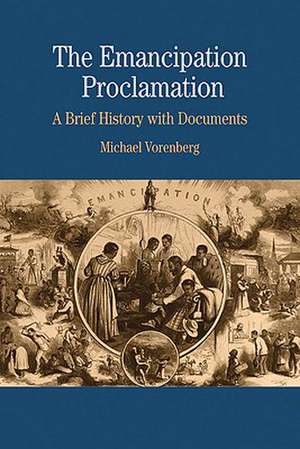
The Emancipation Proclamation
Autor Michael Vorenbergen Limba Engleză Paperback – 2010
Interdisciplinaritatea acestui volum rezidă în fuziunea dintre istoria politică, studiile juridice și sociologia mișcărilor sociale, oferind o analiză amplă a unui moment de cotitură în destinul Statelor Unite. Putem afirma că lucrarea lui Michael Vorenberg nu este doar o cronică a unui document oficial, ci o examinare a tensiunilor dintre autoritatea prezidențială și presiunea socială. Autorul demonstrează cum obiectivele Războiului Civil au fost transformate radical, trecând de la conservarea Uniunii la imperativul moral al abolirii sclaviei. Reținem structura riguroasă a cărții, care facilitează accesul la surse primare. Cele peste 40 de documente incluse — de la scrisori ale sclavilor la editoriale din epocă — permit cititorului să înțeleagă Proclamația ca pe un proces viu, nu ca pe un fapt împlinit. Prezența eseurilor semnate de Ira Berlin și James McPherson adaugă o dimensiune critică esențială, dezbătând dacă libertatea a fost „acordată” de sus în jos sau „câștigată” prin acțiunile directe ale celor asupriți. Cititorii familiarizați cu Rethinking American Emancipation de William A. Link vor aprecia în acest volum focalizarea pe documente de arhivă și instrumentele pedagogice care transformă lectura într-un exercițiu de cercetare activă. În contextul operei sale, The Emancipation Proclamation servește drept fundament pentru cercetările ulterioare ale autorului din Final Freedom. Dacă în lucrarea sa ulterioară Michael Vorenberg se concentrează pe limitările Proclamației și necesitatea Amendamentului al XIII-lea, în volumul de față el analizează geneza și impactul imediat al deciziei lui Lincoln. Recomandăm acest titlu pentru rigoarea documentară și pentru modul în care reușește să sintetizeze dezbaterile naționale despre cetățenie și drepturi umane.
Preț: 223.35 lei
Carte disponibilă
Livrare economică 14-28 noiembrie
Specificații
ISBN-10: 0312435819
Pagini: 192
Dimensiuni: 141 x 209 x 13 mm
Greutate: 0.18 kg
Editura: BEDFORD BOOKS
Locul publicării:New York, United States
V-ar putea interesa
-
 Choptank OdysseyTom HortonPreț: 225.81 lei
 -
 Preț: 146.40 lei
 -
 Warrior Nation: A History of the Red Lake OjibweAnton TreuerPreț: 151.42 lei
 -
 Churchill & Eisenhower: Together Again -- A Virginia VisitDr Brian A Dementi-10%Preț: 310.03 lei343.11 lei
 -
 Stamped from the BeginningIbram X KendiPreț: 275.78 lei
 -
 Preț: 352.64 lei
De ce să citești această carte
Recomandăm această carte studenților și pasionaților de istorie care doresc să înțeleagă mecanismele puterii în perioade de criză. Veți câștiga o perspectivă nuanțată asupra Războiului Civil, sprijinită de documente istorice autentice. Este o resursă excelentă pentru cursuri academice, oferind întrebări de reflecție și o cronologie clară care ajută la fixarea contextului complex în care a apărut Proclamația de Emancipare.
Despre autor
Michael Vorenberg este profesor asistent de istorie la Universitatea Brown, specializat în perioada Războiului Civil și a Reconstrucției. Expertiza sa se concentrează pe intersecția dintre istoria legală și cea politică, explorând modul în care instituțiile americane s-au transformat sub presiunea schimbărilor sociale. Lucrările sale sunt recunoscute pentru analiza atentă a Amendamentului al XIII-lea și a procesului legislativ care a dus la abolirea sclaviei, poziționându-l ca o voce autoritară în istoriografia americană contemporană.
Cuprins
PART II: THE DOCUMENTS
Abraham Lincoln, Cooper Union Address, February 27, 1860
Abraham Lincoln, Letter to Lyman Trumbull, December 10, 1861
Abraham Lincoln, Letter to Alexander H. Stephens,
Alexander H. Stephens, Cornerstone Speech, March 21, 1861
Abraham Lincoln, First Inaugural, March 4, 1861
John J. Cheatham, Letter to L. P. Walker, May 4, 1861
Benjamin Butler, Letter to Winfield Scott, May 24, 1861
Abraham Lincoln, Letter to Orville Browning, September 22, 1861
The Pacific Appeal, Editorial on Emancipation, June 14, 1862
George B. McClellan, Harrison's Landing Letter, July 7, 1862
Samuel J. Kirkwood, Letter to Henry W. Halleck, August 5, 1862
Lydia Maria Child, Letter to John G. Whittier, January 21, 1862
Frederick Douglass, 'The Slaveholders Rebellion,' July 4, 1862
Abraham Lincoln, Letter to Horace Greeley, August 22, 1862
Abraham Lincoln, Preliminary Emancipation Proclamation,
Benjamin R. Curtis, Executive Power, 1862
Grosvenor Lowrey, Commander-In-Chief, 1862
Edward D. Marchant, Abraham Lincoln, 1863
Adalbert Johann Volck, Writing the Emancipation
Abraham Lincoln, Annual Message to Congress, December 1, 1862
Abraham Lincoln, Final Emancipation Proclamation, January 1, 1863
The Pacific Appeal, 'The Year of Jubilee Has Come!' January 3, 1863
'The Emancipation Proclamation,' the Cincinnati Daily Enquirer,
January 3, 1863
James H. Hudson, Letter to the Pacific Appeal, February 25, 1863
Harper's Weekly, Sensation among 'Our Coloured Brethren,'
December 20, 1863
Thomas Nast, The Emancipation of the Negroes, January 24, 1863
H. Ford Douglas, Letter to Frederick Douglass, January 8, 1863
Frederick Douglass, 'Men of Colour, to Arms!,' March 1863
Sattie A. Douglas, Letter to the Anglo-African, June 20, 1863
Hannah Johnson, Letter to Abraham Lincoln, July 31, 1863
Martha Glover, Letter to Richard Glover, December 30, 1863
Charlotte Forten, 'Life on the Sea Islands,' June 1864
George E. Stephens, 'The Pay of Coloured Troops,' August 1, 1864
Spotswood Rice, Letter to Kitty Diggs, September 3, 1864
Patrick R. Cleburne, Letter to the Commanders of the Army of the
Tennessee, January 2, 1864
Congress of the Confederate States of America, 'Address to the
People of the Confederate States,' January 22, 1864
Robert E. Lee, Letter to Andrew Hunter, January 11, 1864
Charleston Mercury, 'Lunacy,' January 13, 1865
Richmond Examiner, 'Negro Troops,' February 25, 1865
Harriet Jacobs, Letter to Lydia Maria Child, March 18, 1863
C. B. Wilder, Testimony before the American Freedmen's Inquiry
Commission, May 9, 1863
Noyes Wheeler, 'The Riotous Outbreak in New York,' July 20, 1863
Abraham Lincoln, Gettysburg Address, November 19, 1863
Annie Davis, Letter to Abraham Lincoln, August 25, 1864
Abraham Lincoln, Second Inaugural, March 4, 1864
Abraham Lincoln, Last Public Address, April 11, 1865
Edward D. Townsend, Report on Meeting of African Americans with
Frederick Douglass, Speech in Memory of Abraham Lincoln,
April 14, 1876
Thomas Ball, Freedmen's Memorial to Abraham Lincoln, 1876
Henry W. Herrick, Reading the Emancipation Proclamation in
the Slaves' Cabin, 1864
Historians Assess Emancipation
James M. McPherson, 'Who Freed the Slaves?,' 1996
Ira Berlin, 'Who Freed the Slaves?: Emancipation and Its Meaning'
Recenzii
'Vorenberg has done a masterful job editing and contextualizing this collection of documents. The primary sources fascinate, the introduction and headnotes are informative and engaging, and Vorenberg guides students toward comprehension of the complexities of the emancipation question. This is a valuable collection.' - Robert E. May, Purdue University, USA
'The best brief introduction to the Emancipation Proclamation.' - James Oakes, CUNY Graduate Center, USA