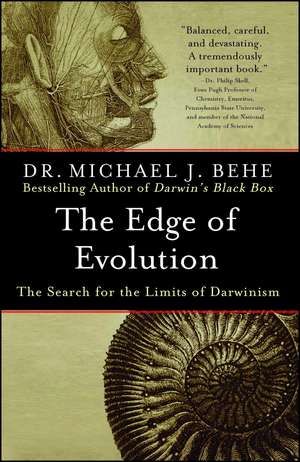
The Edge of Evolution
Autor Michael J. Beheen Limba Engleză Paperback – 17 iun 2008
Descoperim în The Edge of Evolution o schimbare de paradigmă în modul în care este abordată controversa designului inteligent. Dacă în lucrările anterioare accentul cădea pe complexitatea biochimică, această ediție aduce nou integrarea datelor masive provenite din revoluția geneticii. Notăm cu interes că Michael J. Behe nu se mai limitează la speculații teoretice, ci analizează dovezi directe: secvențierea genomului și observațiile asupra mutațiilor la microorganisme pe parcursul a zeci de mii de generații. Putem afirma că lucrarea reprezintă o rafinare a poziției autorului, stabilind o frontieră matematică și biologică între ceea ce selecția naturală poate explica și ceea ce necesită o cauză non-aleatorie. Cartea acoperă aceeași arie tematică precum Darwinism Under the Microscope, dar cu o abordare mult mai tehnică și ancorată în date empirice recente din laborator. În contextul operei sale, volumul face puntea necesară între intuițiile din Darwin's Black Box și concluziile mai radicale din Darwin Devolves, transformând „cutia neagră” a celulei într-un mecanism transparent, supus analizei matematice. Stilul este precis, evitând ambiguitățile, și se concentrează pe limitările matematice ale mutațiilor aleatorii. Behe propune o viziune interdisciplinară, legând biologia moleculară de conceptul de „fine-tuning” din cosmologie, sugerând că viața nu este un accident, ci rezultatul unui univers structurat pentru existență. Este o lectură densă, care solicită atenție la detalii tehnice, dar care redefinește radical termenii dezbaterii contemporane despre evoluționism.
Preț: 109.36 lei
Carte disponibilă
Livrare economică 16-30 noiembrie
Specificații
ISBN-10: 0743296222
Pagini: 336
Dimensiuni: 142 x 214 x 20 mm
Greutate: 0.31 kg
Editura: Free Press
V-ar putea interesa
-
 Darwin's DoubtStephen C. MeyerPreț: 148.88 lei
 -
 The Theory of Moral SentimentsAdam SmithPreț: 114.43 lei
 -
 -14%Preț: 151.13 lei176.47 lei
 -
 Preț: 159.00 lei
 -
 Preț: 159.00 lei
 -
 The Conscious Mind: In Search of a Fundamental TheoryDavid J. Chalmers-16%Preț: 146.89 lei175.59 lei
 -
 What Money Can't BuyMichael J. Sandel-36%Preț: 58.99 lei92.70 lei
 -
 Semiotics and the Philosophy of LanguageUmberto EcoPreț: 159.03 lei
 -
 Preț: 99.88 lei
 -
 Rethinking Life and DeathPeter SingerPreț: 118.34 lei
 -
 The Great PartnershipJonathan SacksPreț: 94.17 lei
 -
 Supervenience and MindJaegwon KimPreț: 324.68 lei
 -
 Mind and WorldJohn McDowellPreț: 248.76 lei
 -
 Peacemaking Among Primates (Paper)F. de WaalPreț: 311.85 lei
 -
 Primates and PhilosophersFrans De WaalPreț: 99.01 lei
 -
 Life After LifeRaymond Moody-24%Preț: 86.36 lei114.03 lei
 -
 The Emotion MachineMarvin MinskyPreț: 161.62 lei
 -
 By Love RefinedAlice Von HildebrandPreț: 126.46 lei
 -
 Mortal Questions (Canto Classics)Thomas NagelPreț: 119.35 lei
 -
 Preț: 401.31 lei
 -
 Sports Massage for Injury CareRobert E. McateePreț: 407.95 lei
 -
 The Feeling of ValueSharon Hewitt RawlettePreț: 158.39 lei
 -
 Coming Back by Raymond Moody, MDRaymond a. Moody MDPreț: 128.73 lei
 -
 Lessons in Leadership: A Weekly Reading of the Jewish BibleJonathan SacksPreț: 150.57 lei
 -
 Our Inner ApeFrans De WaalPreț: 150.03 lei
 -
 After VirtueProfessor Alasdair MacIntyre-13%Preț: 171.37 lei197.15 lei
 -
 MoneyYuval Noah Harari-19%Preț: 34.57 lei42.69 lei
 -
 The Light BeyondRaymond MoodyPreț: 93.21 lei
 -
 Syntactic StructuresNoam ChomskyPreț: 142.46 lei
De ce să citești această carte
Această carte este esențială pentru cititorii interesați de biologia moleculară și de fundamentele matematice ale teoriei evoluționiste. Veți câștiga o perspectivă tehnică asupra limitelor mutațiilor genetice, bazată pe date reale de laborator. Este o recomandare solidă pentru cei care doresc să înțeleagă argumentele științifice moderne care susțin designul inteligent, dincolo de simplele dispute ideologice.
Despre autor
Michael J. Behe este profesor de științe biologice la Universitatea Lehigh din Pennsylvania, unde își desfășoară activitatea din 1985. Cu un doctorat în biochimie, acesta a realizat cercetări postdoctorale asupra structurii ADN-ului la National Institutes of Health. Este recunoscut la nivel mondial ca fiind figura centrală a mișcării designului inteligent, statut dobândit odată cu publicarea lucrării sale de referință, Darwin's Black Box. De-a lungul carierei, a publicat peste patruzeci de lucrări tehnice, expertiza sa în biochimie fiind pilonul pe care își construiește argumentația critică la adresa mecanismelor darwiniene clasice.
Notă biografică
Recenzii
- Professor David Snoke, Department of Physics and Astronomy, University of Pittsburgh
"In The Edge of Evolution Michael Behe carefully assesses the evidence of what Darwin's mechanism of random mutation and selection can achieve in well documented cases, and shows that even in those cases that maximize its power as a creative force it has only been able to generate very trivial examples of evolutionary change. Could such an apparently impotent and mindless force really have built the sophisticated molecular devices found throughout nature? The answer, he insists, is no. The only common-sense explanation is intelligent design."
-- Michael Denton, M.D., Ph.D., author of Nature's Destiny
"In crystal-clear prose Behe systematically shreds the central dogma of atheistic science, the doctrine of the random universe. This book, like the natural phenomena it so elegantly describes, shows the unmistakable signs of a very deep intelligence at work."
-- JEffrey M. Schwartz, M.D., Research Psychiatrist, UCLA, and author of The Mind & The Brain
"Until the past decade and the genomics revolution, Darwin's theory rested on indirect evidence and reasonable speculation. Now, however, we have begun to scratch the surface of direct evidence, of which this book offers the best possible treatment. Though many critics won't want to admit it, The Edge of Evolution is very balanced, careful, ¬and devastating. A tremendously important book."
-- Dr. Philip Skell, Evan Pugh Professor of Chemistry, Emeritus, at Pennsylvania State University, and member of the National Academy of Sciences
Descriere
When Michael J. Behe's first book, Darwin's Black Box, was published in 1996, it launched the intelligent design movement. Critics howled, yet hundreds of thousands of readers -- and a growing number of scientists -- were intrigued by Behe's claim that Darwinism could not explain the complex machinery of the cell.
Now, in his long-awaited follow-up, Behe presents far more than a challenge to Darwinism: He presents the evidence of the genetics revolution -- the first direct evidence of nature's mutational pathways -- to radically redefine the debate about Darwinism.
How much of life does Darwin's theory explain? Most scientists believe it accounts for everything from the machinery of the cell to the history of life on earth. Darwin's ideas have been applied to law, culture, and politics.
But Darwin's theory has been proven only in one sense: There is little question that all species on earth descended from a common ancestor. Overwhelming anatomical, genetic, and fossil evidence exists for that claim. But the crucial question remains: How did it happen? Darwin's proposed mechanism -- random mutation and natural selection -- has been accepted largely as a matter of faith and deduction or, at best, circumstantial evidence. Only now, thanks to genetics, does science allow us to seek direct evidence. The genomes of many organisms have been sequenced, and the machinery of the cell has been analyzed in great detail. The evolutionary responses of microorganisms to antibiotics and humans to parasitic infections have been traced over tens of thousands of generations.
As a result, for the first time in history Darwin's theory can be rigorously evaluated. The results are shocking. Although it can explain marginal changes in evolutionary history, random mutation and natural selection explain very little of the basic machinery of life. The "edge" of evolution, a line that defines the border between random and nonrandom mutation, lies very far from where Darwin pointed. Behe argues convincingly that most of the mutations that have defined the history of life on earth have been nonrandom.
Although it will be controversial and stunning, this finding actually fits a general pattern discovered by other branches of science in recent decades: The universe as a whole was fine-tuned for life. From physics to cosmology to chemistry to biology, life on earth stands revealed as depending upon an endless series of unlikely events. The clear conclusion: The universe was designed for life.