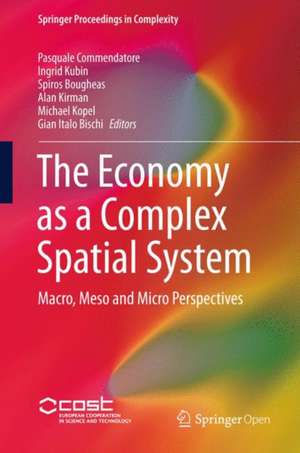
The Economy as a Complex Spatial System: Springer Proceedings in Complexity
Editat de Pasquale Commendatore, Ingrid Kubin, Spiros Bougheas, Alan Kirman, Michael Kopel, Gian Italo Bischien Limba Engleză Hardback – 19 sep 2017
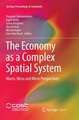
This collected volume represents the final outcome of the COST Action IS1104 “The EU in the new complex geography of economic systems: models, tools and policy evaluation”.
Visualizing the EU as a complex and multi-layered network, the book is organized in three parts, each of them dealing with a different level of analysis: At the macro-level, Part I considers the interactions within large economic systems (regions or countries) involving trade, workers migration, and other factor movements. At the meso-level, Part II discusses interactions within specific but wide-ranging markets, with a focus on financial markets and banking systems. Lastly, at the micro-level, Part III explores the decision-making of single firms, especially in the context of location decisions.
Din seria Springer Proceedings in Complexity
- 18%
 Preț: 1249.73 lei
 - 20%
 Preț: 1202.39 lei
 - 18%
 Preț: 1313.51 lei
 - 18%
 Preț: 1224.81 lei
 - 18%
 Preț: 1232.88 lei
 - 18%
 Preț: 1172.35 lei
 - 18%
 Preț: 1397.91 lei
 - 18%
 Preț: 924.22 lei
 - 18%
 Preț: 924.52 lei
 - 20%
 Preț: 949.61 lei
 - 20%
 Preț: 621.94 lei
 - 15%
 Preț: 671.36 lei
 - 18%
 Preț: 960.05 lei
 - 18%
 Preț: 1497.91 lei
 - 20%
 Preț: 668.71 lei
 - 15%
 Preț: 619.75 lei
 - 24%
 Preț: 1207.56 lei
 - 18%
 Preț: 981.05 lei
 - 24%
 Preț: 921.42 lei
 - 18%
 Preț: 1310.62 lei
 - 18%
 Preț: 930.00 lei
 - 18%
 Preț: 1175.66 lei
 - 18%
 Preț: 1282.29 lei
 - 15%
 Preț: 645.82 lei
 -
 Preț: 413.54 lei
 - 18%
 Preț: 1190.36 lei
 - 18%
 Preț: 1201.59 lei
 - 18%
 Preț: 1287.56 lei
 - 18%
 Preț: 917.39 lei
 - 15%
 Preț: 616.95 lei
 - 20%
 Preț: 647.19 lei
 - 18%
 Preț: 930.61 lei
 -
 Preț: 407.68 lei
 - 18%
 Preț: 1169.07 lei
 - 20%
 Preț: 1295.18 lei
 - 15%
 Preț: 650.68 lei
 - 18%
 Preț: 1282.51 lei
 - 20%
 Preț: 1248.84 lei
 - 24%
 Preț: 1221.21 lei
Preț: 427.08 lei
Puncte Express: 641
Carte tipărită la comandă
Livrare economică 21 noiembrie-05 decembrie
Livrare prin curier în România Termenul estimat este afișat lângă disponibilitate.
Transport gratuit pentru acest produs Plată online sau ramburs, în funcție de opțiunile comenzii.
Retur gratuit în 14 zile Comandă securizată și suport în română.
Specificații
ISBN-13: 9783319656267
ISBN-10: 3319656260
Pagini: 232
Ilustrații: XII, 220 p. 35 illus.
Dimensiuni: 160 x 241 x 19 mm
Greutate: 0.52 kg
Ediția:1st edition 2018
Editura: Springer
Colecția Springer Proceedings in Complexity
Seria Springer Proceedings in Complexity
Locul publicării:Cham, Switzerland
ISBN-10: 3319656260
Pagini: 232
Ilustrații: XII, 220 p. 35 illus.
Dimensiuni: 160 x 241 x 19 mm
Greutate: 0.52 kg
Ediția:1st edition 2018
Editura: Springer
Colecția Springer Proceedings in Complexity
Seria Springer Proceedings in Complexity
Locul publicării:Cham, Switzerland
V-ar putea interesa
-
 Preț: 466.27 lei
 -
 A Political Theory PrimerPeter C. Ordeshook-18%Preț: 1412.81 lei1722.93 lei
 -
 Reflexivity: Theory, Method, and PracticeKaren Lumsden-18%Preț: 1118.30 lei1363.78 lei
 -
 Preț: 450.95 lei
 -
 Cross-Cultural Research with IntegrityLinda Miller ClearyPreț: 386.05 lei
 -
 Researching and Representing MobilitiesL. MurrayPreț: 383.15 lei
 -
 The Interdependence of Teaching and LearningBryant GriffithPreț: 371.64 lei
 -
 The Interdependence of Teaching and Learning (Hc)Bryant Griffith-19%Preț: 592.37 lei731.32 lei
 -
 Beyond the CampusDebra A. Harkins-19%Preț: 590.26 lei728.73 lei
 -
 Sustainability, Growth, and GlobalizationJames E. Davis-19%Preț: 585.04 lei722.27 lei
 -
 Reflections from the FieldEric J. DemeulenaerePreț: 445.33 lei
 -
 Dystopia and EducationJessica A. HeybachPreț: 393.22 lei
 -
 Dystopia and EducationJessica Alexa Heybach-19%Preț: 651.96 lei804.88 lei
 -
 A Learner Centered Approach to Online EducationLisa HarrellPreț: 364.93 lei
 -
 A Learner Centered Approach to Online Education (Hc)Lisa Harrell-19%Preț: 585.45 lei722.78 lei
 -
 Education ReformCraig S. Engelhardt-19%Preț: 649.62 lei802.00 lei
 -
 Quantitative PsychologyMarie Wiberg-18%Preț: 1232.41 lei1502.94 lei
 -
 On Doing Fieldwork in Palestine: Advice, Fieldnotes, and Other ThoughtsCelia E. RothenbergPreț: 432.59 lei
 -
 -18%Preț: 918.59 lei1120.23 lei
 -
 Übungsbuch zur Betriebswirtschaftlichen OptimierungKurt Hollnsteiner-9%Preț: 638.54 lei701.69 lei
 -
 Economics with Heterogeneous Interacting AgentsAlan Kirman-15%Preț: 618.64 lei727.80 lei
 -
 Nonlinear Dynamics in Economics, Finance and the Social SciencesGian Italo Bischi-15%Preț: 646.67 lei760.79 lei
 -
 Nonlinear OligopoliesGian Italo Bischi-15%Preț: 646.61 lei760.72 lei
 -
 Global Analysis of Dynamic Models in Economics and FinanceGian Italo Bischi-15%Preț: 652.32 lei767.44 lei
 -
 Die EU zwischen einheitlicher und differenzierter IntegrationAnja RiedebergerPreț: 345.13 lei
 -
 Globale Koine EireneJorrik FuldaPreț: 347.81 lei
 -
 Preț: 338.02 lei
Textul de pe ultima copertă
This book is open access under a CC BY-NC 4.0 license.
This collected volume represents the final outcome of the COST Action IS1104 “The EU in the new complex geography of economic systems: models, tools and policy evaluation”.
Visualizing the EU as a complex and multi-layered network, the book is organized in three parts, each of them dealing with a different level of analysis: At the macro-level, Part I considers the interactions within large economic systems (regions or countries) involving trade, workers migration, and other factor movements. At the meso-level, Part II discusses interactions within specific but wide-ranging markets, with a focus on financial markets and banking systems. Lastly, at the micro-level, Part III explores the decision-making of single firms, especially in the context of location decisions.