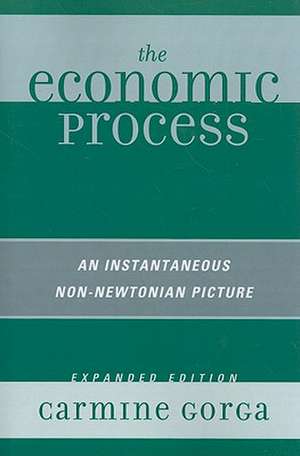
The Economic Process: An Instantaneous Non-Newtonian Picture
Autor Carmine Gorgaen Limba Engleză Paperback – 14 dec 2009
Preț: 409.81 lei
Preț vechi: 628.54 lei
-35%
Puncte Express: 615
Carte tipărită la comandă
Livrare economică 07-21 decembrie
Livrare prin curier în România Termenul estimat este afișat lângă disponibilitate.
Transport gratuit pentru acest produs Plată online sau ramburs, în funcție de opțiunile comenzii.
Retur gratuit în 14 zile Comandă securizată și suport în română.
Specificații
ISBN-13: 9780761849537
ISBN-10: 076184953X
Pagini: 410
Dimensiuni: 155 x 232 x 30 mm
Greutate: 0.64 kg
Ediția:Expanded
Editura: Bloomsbury Publishing
Colecția University Press of America
Locul publicării:New York, United States
ISBN-10: 076184953X
Pagini: 410
Dimensiuni: 155 x 232 x 30 mm
Greutate: 0.64 kg
Ediția:Expanded
Editura: Bloomsbury Publishing
Colecția University Press of America
Locul publicării:New York, United States
V-ar putea interesa
-
 Environmental Economics: A Very Short IntroductionStephen Smith-20%Preț: 56.97 lei70.82 lei
 -
 Sustainability AnalysisS. Shmelev-15%Preț: 670.74 lei789.11 lei
 -
 BoomerangMichael Lewis-31%Preț: 64.31 lei93.00 lei
 -
 -18%Preț: 1253.07 lei1528.14 lei
 -
 Environmental Finance and DevelopmentSanja Tišma-18%Preț: 1307.32 lei1594.29 lei
 -
 -18%Preț: 1297.28 lei1582.05 lei
 -
 The Instant EconomistTimothy Taylor-19%Preț: 63.94 lei78.87 lei
 -
 Ending Dirty Energy PolicyJoseph P. TomainPreț: 249.64 lei
 -
 Make It in America, Updated EditionAndrew LiverisPreț: 105.44 lei
 -
 Wall Street and the Financial CrisisSenate Subcommittee on InvestigationsPreț: 208.84 lei
 -
 -27%Preț: 76.96 lei105.54 lei
 -
 -18%Preț: 1118.04 lei1363.46 lei
Cuprins
Part 1 List of Illustrations
Part 2 A Synopsis
Part 3 Acknowledgments
Part 4 Preface
Part 5 The Need to Transform Economic Theory... Into "Simple" and "Obvious" Economics
Part 6 Overall Analysis of Keynes' Model:
Chapter 7 Keynes' Thought as the Apex of Classical Economics; Toward Concordian Economics; Lack of Homogeneity in Keynes' Model; Simplicism- and Forced Doublespeak- of Keynes' Model; Lack of True Equivalence in Keynes' Model; Neither Classical nor Mainstream, but R
Part 8 Analysis of the Component Elements of Keynes' Model:
Chapter 9 The Dissection of Keynes' Model and the Dissolution of the S-I Nexus; The History of the Word "Saving"; Beyond Adam Smith's Conception of Saving; Beyond Keynes' "Definition" of Investment; The Definition of Saving, Hoarding, and Investment; The Real Savin
Part 10 Analysis of the Economic Process:
Chapter 11 The Economic Process as a Whole; Simplistic Descriptions of the Economic Process; The Production Process; The Consumption Process; The Distribution Process; Economic Growth: The Normal Outcome of the Unfolding of the Economic Process; Inflation: The Outco
Part 12 Foundations of Economics:
Chapter 13 Toward Econometrics: Closing the Gap between Macro and Micro Economics
Part 14 Consciousness and Conscience of Economics:
Chapter 15 Poverty and the Economic Process; The Elimination of Absolute Poverty Through the Right to Create All the Wealth One Needs
Part 16 Epilogue: Come to Concord
Part 17 Footnotes
Part 18 Index
Part 2 A Synopsis
Part 3 Acknowledgments
Part 4 Preface
Part 5 The Need to Transform Economic Theory... Into "Simple" and "Obvious" Economics
Part 6 Overall Analysis of Keynes' Model:
Chapter 7 Keynes' Thought as the Apex of Classical Economics; Toward Concordian Economics; Lack of Homogeneity in Keynes' Model; Simplicism- and Forced Doublespeak- of Keynes' Model; Lack of True Equivalence in Keynes' Model; Neither Classical nor Mainstream, but R
Part 8 Analysis of the Component Elements of Keynes' Model:
Chapter 9 The Dissection of Keynes' Model and the Dissolution of the S-I Nexus; The History of the Word "Saving"; Beyond Adam Smith's Conception of Saving; Beyond Keynes' "Definition" of Investment; The Definition of Saving, Hoarding, and Investment; The Real Savin
Part 10 Analysis of the Economic Process:
Chapter 11 The Economic Process as a Whole; Simplistic Descriptions of the Economic Process; The Production Process; The Consumption Process; The Distribution Process; Economic Growth: The Normal Outcome of the Unfolding of the Economic Process; Inflation: The Outco
Part 12 Foundations of Economics:
Chapter 13 Toward Econometrics: Closing the Gap between Macro and Micro Economics
Part 14 Consciousness and Conscience of Economics:
Chapter 15 Poverty and the Economic Process; The Elimination of Absolute Poverty Through the Right to Create All the Wealth One Needs
Part 16 Epilogue: Come to Concord
Part 17 Footnotes
Part 18 Index
Recenzii
Carmine Gorga does put his finger on an economic reality often neglected by economists.
The writing style of the book is similar to the writing styles of Veblen, Schumpeter, Keynes, and von Hayek. This means that the reader is going to have to think carefully about the fundamental nature of capitalism as a complex system evolving through time...G's framework of analysis is a reinterpretation of Keyne's syllogistic...with the actual results...I would give the book a 5 star rating.
Carmine Gorga, of the Gloucester Community Development, who studied with Nobel laureates in his discipline, is a practitioner of creative economics. . . . he has the answers to universal poverty and the anxieties of the affluent. The blueprint for theelimination of poverty among the masses of the planned. A manual for a healthy mind, in a healthy body, in a healthy society.
The writing style of the book is similar to the writing styles of Veblen, Schumpeter, Keynes, and von Hayek. This means that the reader is going to have to think carefully about the fundamental nature of capitalism as a complex system evolving through time...G's framework of analysis is a reinterpretation of Keyne's syllogistic...with the actual results...I would give the book a 5 star rating.
Carmine Gorga, of the Gloucester Community Development, who studied with Nobel laureates in his discipline, is a practitioner of creative economics. . . . he has the answers to universal poverty and the anxieties of the affluent. The blueprint for theelimination of poverty among the masses of the planned. A manual for a healthy mind, in a healthy body, in a healthy society.