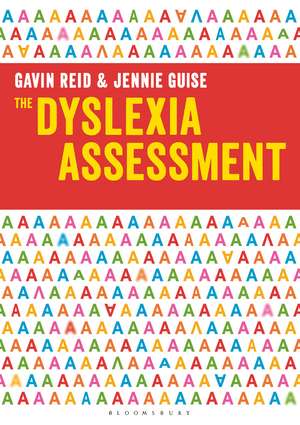
The Dyslexia Assessment: A complete assessment tool for investigating reading, writing and spelling difficulties
Autor Dr. Gavin Reid, Jennie Guiseen Limba Engleză Paperback – 5 oct 2017
Găsim în The Dyslexia Assessment un instrument de lucru esențial pentru specialiștii care activează în domeniul educației, de la nivel preșcolar până la cel universitar. Această lucrare dezvoltă competențe practice de diagnosticare și intervenție pentru dificultățile de literație, oferind un cadru metodologic riguros pentru investigarea problemelor de citire, scriere și ortografie. Considerăm că valoarea principală a volumului rezidă în capacitatea sa de a clarifica ambiguitățile din jurul procesului de evaluare, oferind instrumente concrete precum chestionare și fișe de monitorizare ce pot fi fotocopiate sau descărcate.
Spre deosebire de alte lucrări care se concentrează strict pe aspectele cognitive, Dr. Gavin Reid și Dr. Jennie Guise propun o abordare holistică. Descoperim aici o atenție deosebită acordată factorilor emoționali și sociali care influențează procesul de învățare, precum și strategii specifice pentru evaluarea cursanților care prezintă condiții suprapuse sau pentru care engleza este o limbă secundară. Ca și Assessment for Dyslexia and Learning Differences, volumul acoperă spectrul larg al dificultăților de învățare, dar se diferențiază printr-o metodologie mult mai aplicată, axată pe utilizarea imediată a instrumentelor de testare în sala de clasă.
Această publicație de la Bloomsbury Publishing completează armonios opera autorului Dr. Gavin Reid. Dacă în 100 Ideas for Secondary Teachers: Supporting Students with Dyslexia accentul era pus pe strategii rapide de predare, iar în Effective Learning pe motivarea elevului, lucrarea de față servește drept fundament tehnic, oferind rigoarea necesară pentru o diagnoză corectă înainte de implementarea oricărei strategii de suport.
Preț: 205.04 lei
Preț vechi: 361.42 lei
-43%
Carte disponibilă
Livrare economică 09-23 noiembrie
Specificații
ISBN-10: 1472945085
Pagini: 176
Dimensiuni: 210 x 294 x 12 mm
Greutate: 0.48 kg
Editura: Bloomsbury Publishing
Colecția Bloomsbury Education
Locul publicării:London, United Kingdom
V-ar putea interesa
-
 Visual Aspects of DyslexiaJohn Stein-29%Preț: 602.50 lei845.28 lei
 -
 Reading by the ColorsHelen IrlenPreț: 129.53 lei
 -
 Preț: 391.31 lei
 -
 Dyslexia, Dyscalculia and Mathematics: A practical guideAnne HendersonPreț: 369.63 lei
 -
 International Case Studies of DyslexiaPeggy L. AndersonPreț: 478.11 lei
 -
 Key Perspectives on Dyslexia: An essential text for educatorsDavid ArmstrongPreț: 398.40 lei
 -
 International Case Studies of DyslexiaPeggy L. Anderson-18%Preț: 1370.31 lei1671.11 lei
 -
 Dyslexia & LiteracyReid-23%Preț: 461.57 lei599.44 lei
 -
 Sound Bytes ReadingKathy FosterPreț: 225.12 lei
 -
 Dyslexia and Modern Foreign LanguagesElke Schneider-18%Preț: 1010.62 lei1232.47 lei
 -
 -42%Preț: 76.67 lei131.14 lei
 -
 The Dyscalculia AssessmentJane Emerson-42%Preț: 215.96 lei374.47 lei
 -
 -42%Preț: 76.13 lei130.98 lei
 -
 Dyslexia & Creativity: Investigations from Differing PerspectivesNeil Alexander-Passe-27%Preț: 1549.01 lei2110.39 lei
 -
 Dyslexia and DramaHelen EadonPreț: 258.67 lei
 -
 -25%Preț: 203.70 lei272.99 lei
 -
 -20%Preț: 122.42 lei153.92 lei
 -
 Preț: 392.00 lei
 -
 Preț: 141.20 lei
 -
 Introduction to DyslexiaLindsay PeerPreț: 266.59 lei
 -
 Dyslexia and MathsJulie KayPreț: 255.54 lei
 -
 Dyslexia and Physical EducationMadeleine PortwoodPreț: 255.94 lei
De ce să citești această carte
Recomandăm această carte psihologilor școlari, consilierilor și cadrelor didactice specializate care au nevoie de un sistem de evaluare structurat și validat științific. Cititorul câștigă acces la un set complet de instrumente practice (formulare și checklists) care transformă procesul complex al identificării dislexiei într-o procedură clară, centrată pe nevoile individuale ale elevului și pe integrarea succesului academic cu bunăstarea emoțională.
Descriere
The book provides practical and comprehensive guidance on carrying out an assessment for dyslexia through informal and formal strategies, and interpreting and acting on results. It features assessment sheets, including questionnaires, forms and checklists that can be photocopied or downloaded from an accompanying website. The strategies explored focus on the whole learner, taking into consideration social, emotional and motivational factors, as well as the challenges of assessing learners with overlapping conditions or EAL.
This practical and invaluable guide will inform and empower all mainstream and specialist teachers, teaching assistants, SENCOs and psychologists to provide the best support possible for learners with reading, writing or spelling difficulties.
Recenzii
Anyone involved in supporting students with a specific learning disability to achieve their potential will find this book invaluable. Reid and Guise share their extensive knowledge of dyslexia in order to provide clear guidance for conducting and understanding dyslexia assessment and in developing appropriate intervention. A must read.
This book provides a comprehensive overview of the dyslexia assessment process, including why and how we assess, and what we do with the findings. Importantly, it highlights the positive approach of diagnosis, the learner's strengths, and the responsibility to support a positive education outcome for our students.
This is a well-written, very clear and accessible guide to the whole complex area of the assessment of dyslexia, which can be readily, and profitably, used by teachers and lecturers in early years settings, schools and colleges.
This is a useful resource to inform and empower teachers, and to clarify any of the ambiguities and uncertainties that exist around the dyslexia assessment.
This practical and invaluable guide will inform and empower all mainstream and specialist teachers, teaching assistants, SENCOs and psychologists to provide the best support possible for learners with reading, writing or spelling difficulties.