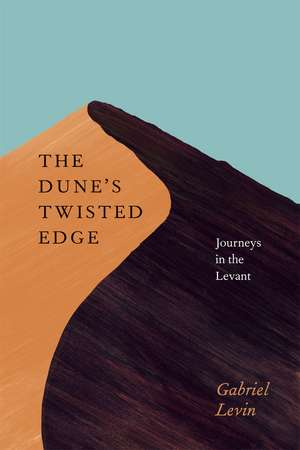
The Dune's Twisted Edge: Journeys in the Levant
Autor Gabriel Levinen Limba Engleză Hardback – 30 noi 2012
Găsim în această carte o invitație de a redescoperi Levantul nu prin prisma conflictelor geopolitice, ci ca pe un spațiu al confluențelor culturale și al memoriei literare. The Dune's Twisted Edge ne propune o călătorie erudită, organizată sub forma a șase eseuri care funcționează ca o hartă a imaginației suprapusă peste relieful arid al Orientului Mijlociu. Reținem abordarea distinctivă a lui Gabriel Levin, care refuză simplificările, alegând în schimb să exploreze 'poetica Semilunii Roditoare' prin intersectarea observației directe cu fantomele trecutului.
Structura volumului ne poartă de la Tunelul lui Ezechia până în deșertul Wadi Rumm, într-o progresie care amintește de rătăcirile poeților beduini. Fiecare capitol este o stratificare de experiențe: autorul descoperă un palat omeyyad lângă Ierihon sau inscripții nabateene în nisipurile Iordaniei, în timp ce invocă prezențe literare neașteptate, precum Herman Melville sau poetul de avangardă Frank O’Hara. Această metodă transformă lectura dintr-un simplu jurnal de călătorie într-un ghid de teren pentru spirit, unde peisajul este citit ca un text străvechi.
În contextul operei sale anterioare, precum Poems from the Diwan sau traducerile din poezia lui Taha Muhammad Ali în So What, acest volum reprezintă o sinteză a preocupărilor lui Levin pentru identitățile compuse ale regiunii. Dacă în lucrările trecute se concentra pe vocea lirică individuală, aici autorul extinde cadrul către peisajul vast, demonstrând cum geografia modelează limbajul și credința. Stilul este precis, dar evocator, beneficiind de cele 14 ilustrații care ancorează vizual aceste meditații despre ruină și reînnoire.
Preț: 167.79 lei
Carte disponibilă
Livrare economică 02-16 noiembrie
Livrare express 16-22 octombrie pentru 26.59 lei
Specificații
ISBN-10: 0226923673
Pagini: 216
Ilustrații: 5 halftones, 9 line drawings
Dimensiuni: 140 x 216 x 20 mm
Greutate: 0.4 kg
Ediția:New.
Editura: University of Chicago Press
Colecția University of Chicago Press
V-ar putea interesa
-
 A Stricken Field: A NovelMartha GellhornPreț: 131.78 lei
 -
 Preț: 170.93 lei
 -
 Goodbye Cinema, Hello Cinephilia: Film Culture in TransitionJonathan RosenbaumPreț: 267.92 lei
 -
 Backflash: A Parker NovelRichard StarkPreț: 105.42 lei
 -
 The Handle: A Parker NovelRichard StarkPreț: 94.85 lei
 -
 The Rare Coin Score: A Parker NovelRichard StarkPreț: 94.51 lei
 -
 Preț: 207.61 lei
 -
 The Development of a Russian Legal ConsciousnessRichard S. WortmanPreț: 306.47 lei
 -
 Helter SkelterVincent BugliosiPreț: 123.99 lei
 -
 I'll Go to Bed at NoonGerard WoodwardPreț: 170.98 lei
 -
 The History of LoveNicole KraussPreț: 93.91 lei
 -
 Pediatric PsychopharmacologyDaniel F. Connor-5%Preț: 396.14 lei416.98 lei
 -
 Brief Coaching for Lasting SolutionsInsoo Kim BergPreț: 233.07 lei
 -
 The Klamath Knot – Explorations of Myth & EvolutionDavid Rains WallacePreț: 181.71 lei
 -
 MuckDror BursteinPreț: 161.05 lei
 -
 Lucy's DanceDeb VanassePreț: 70.14 lei
 -
 So WhatTaha Muhammad Ali-20%Preț: 74.69 lei92.88 lei
 -
 CompulsionMeyer LevinPreț: 109.20 lei
De ce să citești această carte
Recomandăm această carte cititorilor care caută mai mult decât un ghid turistic convențional. Este o lectură esențială pentru pasionații de istorie culturală și literatură care doresc să înțeleagă Orientul Apropiat prin ochii unui poet stabilit în Ierusalim. Câștigați o perspectivă profundă asupra modului în care arheologia, poezia pre-islamică și peisajul deșertic se împletesc pentru a forma identitatea complexă a Levantului.
Despre autor
Gabriel Levin este un poet și traducător distins, stabilit în Ierusalim, a cărui operă este profund ancorată în peisajul și cultura Orientului Mijlociu. Autor al mai multor volume de poezie, printre care 'To These Dark Steps', Levin s-a remarcat și prin activitatea sa de traducător, aducând în limba engleză voci fundamentale ale literaturii ebraice și palestiniene. Experiența sa în medierea între culturi și limbi diferite este evidentă în The Dune's Twisted Edge, unde sensibilitatea sa poetică se îmbină cu rigoarea cercetării istorice pentru a explora legătura dintre teritoriu și cuvânt.
Descriere scurtă
Notă biografică
Cuprins
Notes