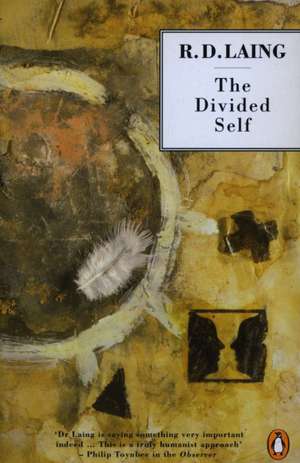
The Divided Self
Autor R D Laingen Limba Engleză Paperback – 30 aug 1965
În The Divided Self, remarcăm o schimbare de paradigmă în psihiatrie, unde R D Laing propune o metodologie ancorată în fenomenologia existențială pentru a face inteligibil procesul alienării mentale. Structura materialului este organizată riguros: prima parte stabilește bazele teoretice pentru o „știință a persoanelor”, a doua parte explorează distincția dintre sinele întrupat și cel neîntrupat în condiția schizoidă, iar ultima parte validează aceste concepte prin studii de caz detaliate ale pacienților cronici. Descoperim aici o analiză profundă a modului în care individul, sub presiunea insecurității ontologice, își construiește un „sine fals” pentru a face față lumii exterioare, proces care duce inevitabil la dezintegrarea personalității reale. Această lucrare completează perspectiva oferită de Embodied Selves and Divided Minds, adăugând o dimensiune clinică și umanistă care lipsește adesea din abordările pur cognitive ale identității. În timp ce Michelle Maiese se concentrează pe metafizica identității personale, R D Laing coboară în realitatea brută a experienței subiective a pacientului. În contextul operei sale, The Divided Self reprezintă piatra de temelie pentru lucrările ulterioare, precum The Politics of the Family sau The Politics of Experience. Dacă în volumele următoare autorul atacă moralitatea convențională și structurile sociale, aici el pune diagnosticul fundamental asupra scindării interne a eului. Ritmul textului este dens, dar accesibil, transformând jargonul clinic într-o explorare filosofică a condiției umane în fața nebuniei.
Preț: 101.69 lei
Carte disponibilă
Livrare economică 13-27 noiembrie
Specificații
ISBN-10: 0140135375
Pagini: 224
Dimensiuni: 129 x 198 x 15 mm
Greutate: 0.17 kg
Ediția:Revised edition
Editura: Penguin Publishing Group
Locul publicării:United Kingdom
V-ar putea interesa
-
 Search For The Real Self: Unmasking The Personality Disorders Of Our AgeJames F. Masterson M.D.-17%Preț: 66.09 lei80.10 lei
 -
 Politics of Experience and The Bird of ParadiseR. D. Laing-5%Preț: 87.28 lei91.87 lei
 -
 The Social Construction of RealityPeter L. Berger-19%Preț: 63.79 lei78.73 lei
 -
 Madness ExplainedRichard P BentallPreț: 123.75 lei
 -
 What is Madness?Darian Leader-19%Preț: 64.60 lei79.27 lei
 -
 The Divided SelfR. D. Laing-31%Preț: 63.58 lei92.56 lei
 -
 Nowhere GirlCarla CicconePreț: 122.34 lei
 -
 Against IdentityAlexander DouglasPreț: 143.72 lei
 -
 Preț: 110.15 lei
 -
 -26%Preț: 90.18 lei122.48 lei
 -
 Life With LacanCatherine MillotPreț: 77.49 lei
 -
 We Are Not NumbersAhmed AlnaouqPreț: 110.16 lei
 -
 Are You Mad At Me?Meg JosephsonPreț: 108.04 leiRecomandat
 -
 The uncharted selfTalal AlaliPreț: 99.33 lei
 -
 When Nothing Feels RealNathan DunnePreț: 122.22 lei
 -
 The Unrealizable: Towards a Politics of OntologyGiorgio AgambenPreț: 159.80 lei
 -
 How to be RealStephen FroshPreț: 130.86 lei
 -
 A Shadow of MyselfPeter FlammPreț: 105.67 lei
 -
 The Divided Mind: Uncovering psychiatry's dark past and reimagining its futureProfessor Edward Bullmore-28%Preț: 105.56 lei146.82 lei
De ce să citești această carte
Recomandăm această ediție revizuită oricărui cititor interesat de psihologie, filosofie sau sociologie. The Divided Self nu este doar un tratat despre schizofrenie, ci o lecție despre empatie și înțelegerea „celuilalt”. Veți câștiga o perspectivă unică asupra modului în care mintea umană se fragmentează pentru a supraviețui, oferind instrumente teoretice esențiale pentru a descifra mecanismele complexe ale alienării în societatea modernă.
Despre autor
R D Laing (1927–1989) a fost un psihiatru scoțian de renume, figură centrală a mișcării antipsihiatrice, deși el însuși a respins această etichetă. Activitatea sa la Tavistock Institute of Human Relations a influențat radical modul în care este percepută boala mentală. Prin lucrări precum Self and Others și Knots, Laing a explorat interacțiunile umane și „nodurile” psihologice, punând sub semnul întrebării tratamentele medicale tradiționale și subliniind importanța contextului familial și social în dezvoltarea tulburărilor psihotice.
Descriere scurtă
Cuprins
Preface to the Pelican Edition
Part One
1. The existential-phenomenological foundations for a science of persons
2. The existential-phenomenological foundations for the understanding of psychosis
3. Ontological insecurity
Part Two
4. The embodied and unembodied self
5. The inner self in the schizoid condition
6. The false-self system
7. Self-consciousness
8. The case of Peter
Part Three
9. Psychotic developments
10. The self and the false self in a schizophrenic
11. The ghost of the weed garden: a study of a chronic schizophrenic
References
Index
Recenzii
—Philip toynbee in the Observer
"It is a study that makes all other works I have read on schizophrenia seem fragmentary. . . . The author brings, through his vision and perception, that particular touch of genius which causes one to say Yes, I have always known that, why have I never thought of it before?'"
—Journal of Analytical Psychology
Notă biografică
R.D. Laing died in 1989. Anthony Clare, writing in the Guardian, said of him: "His major achievement was that he dragged the isolated and neglected inner world of the severely psychotic individual out of the back ward of the large gloomy mental hospital and on to the front pages of influential newspapers, journals and literary magazines . . . Everyone in contemporary psychiatry owes something to R.D. Laing."