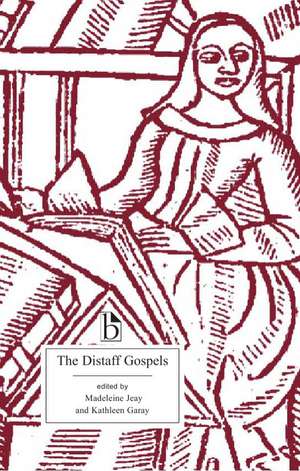
The Distaff Gospels: A First Modern English Edition of Les Évangiles des Quenouilles
Editat de Madeleine Jeay, Kathleen Garayen Limba Engleză Paperback – 2006
This edition includes a facing-page translation (the first in English since 1510) of the two Old French manuscripts of the text. The critical introduction discusses the literary context, textual history, and cultural significance of The Distaff Gospels, while the rich selection of appendices includes translations of the names of the women storytellers and excerpts from works by Giovanni Boccaccio, Jean de Meun, François Villon, and Christine de Pizan.
Preț: 235.72 lei
Preț vechi: 302.76 lei
-22%
Puncte Express: 354
Carte disponibilă
Livrare economică 30 octombrie-13 noiembrie
Livrare prin curier în România Termenul estimat este afișat lângă disponibilitate.
Transport gratuit de la 400.00 lei Plată online sau ramburs, în funcție de opțiunile comenzii.
Retur gratuit în 14 zile Comandă securizată și suport în română.
Specificații
ISBN-13: 9781551115603
ISBN-10: 1551115603
Pagini: 325
Dimensiuni: 140 x 216 x 384 mm
Greutate: 0.42 kg
Editura: BROADVIEW PR
Colecția Broadview Press
Locul publicării:Peterborough, Canada
ISBN-10: 1551115603
Pagini: 325
Dimensiuni: 140 x 216 x 384 mm
Greutate: 0.42 kg
Editura: BROADVIEW PR
Colecția Broadview Press
Locul publicării:Peterborough, Canada
V-ar putea interesa
-
 -18%Preț: 100.54 lei122.42 lei
 -
 Closet Queens: Some 20th Century British PoliticiansMichael Bloch-27%Preț: 67.83 lei92.32 lei
 -
 Russian History through the Senses: From 1700 to the PresentProfessor Matthew P. Romaniello-26%Preț: 195.96 lei265.67 lei
 -
 -35%Preț: 193.68 lei299.20 lei
 -
 The Royal Navy Officer's Jutland Pocket-Manual 1916Brian LaveryPreț: 64.44 lei
 -
 N F S Grundtvig: An Introduction to his Life & WorkA. M. AllchinPreț: 279.33 lei
Recenzii
The Distaff Gospels (Les Évangiles des Quenouilles), a fascinating fifteenth-century collection of more than 250 popular beliefs, constitutes a kind of encyclopedia of late medieval women’s wisdom. The women’s beliefs and experiences are recounted within the narrative frame of traditional gatherings where women meet with their spindles and distaffs to spin. They share advice on such important matters as how to control errant husbands, how to predict the gender of future offspring, how to cure common diseases, and ways to deal with evil spirits, providing a rare look into the intimate lives of medieval peasant women.
This edition includes a facing-page translation (the first in English since 1510) of the two Old French manuscripts of the text. The critical introduction discusses the literary context, textual history, and cultural significance of The Distaff Gospels, while the rich selection of appendices includes translations of the names of the women storytellers and excerpts from works by Giovanni Boccaccio, Jean de Meun, François Villon, and Christine de Pizan.
“This first English modern translation of The Distaff Gospels gracefully renders the somewhat recondite late medieval French of the original into elegant and faithful yet contemporary prose. The editors’ introduction frames well and cogently the issues germane to the production of this text, including transgendered expression, the culture of the ‘World Upside Down’ in which women may have their say, archeological information about practices of midwifery in the era, and the folkloric aspect and popular content of short narrative. The book is simultaneously inter-disciplinary, an inventive reconstruction, and a scholarly edition, and succeeds admirably at all three.” — Catharine Randall, Fordham University
This edition includes a facing-page translation (the first in English since 1510) of the two Old French manuscripts of the text. The critical introduction discusses the literary context, textual history, and cultural significance of The Distaff Gospels, while the rich selection of appendices includes translations of the names of the women storytellers and excerpts from works by Giovanni Boccaccio, Jean de Meun, François Villon, and Christine de Pizan.
“This first English modern translation of The Distaff Gospels gracefully renders the somewhat recondite late medieval French of the original into elegant and faithful yet contemporary prose. The editors’ introduction frames well and cogently the issues germane to the production of this text, including transgendered expression, the culture of the ‘World Upside Down’ in which women may have their say, archeological information about practices of midwifery in the era, and the folkloric aspect and popular content of short narrative. The book is simultaneously inter-disciplinary, an inventive reconstruction, and a scholarly edition, and succeeds admirably at all three.” — Catharine Randall, Fordham University
Cuprins
Acknowledgements
Introduction
A Note on the Text
Illustrations
The Distaff Gospels (Paris Manuscript: BnF 2151)
The Distaff Gospels (Chantilly Manuscript: Musée Condé)
The Distaff Gospels: Translations of the Spinsters’ Names
Appendix A: From Giovanni Boccaccio, The Decameron (ca. 1351)
Appendix B: From Guillaume de Lorris and Jean de Meung, The Romance of the Rose (late 13th century)
Appendix C: From The Fifteen Joys of Marriage (anon., early 15th century)
Appendix D: From François Villon, Testament (mid 15th century)
Appendix E: From Christine de Pizan, Ballad 26 and The Book of the Three Virtues (early 15th century)
Appendix F: From Bartholomaeus Anglicus (Bartholomew the Englishman), On the Properties of Things (mid 13th century)
Select Bibliography
Index
Introduction
A Note on the Text
Illustrations
The Distaff Gospels (Paris Manuscript: BnF 2151)
The Distaff Gospels (Chantilly Manuscript: Musée Condé)
The Distaff Gospels: Translations of the Spinsters’ Names
Appendix A: From Giovanni Boccaccio, The Decameron (ca. 1351)
Appendix B: From Guillaume de Lorris and Jean de Meung, The Romance of the Rose (late 13th century)
Appendix C: From The Fifteen Joys of Marriage (anon., early 15th century)
Appendix D: From François Villon, Testament (mid 15th century)
Appendix E: From Christine de Pizan, Ballad 26 and The Book of the Three Virtues (early 15th century)
Appendix F: From Bartholomaeus Anglicus (Bartholomew the Englishman), On the Properties of Things (mid 13th century)
Select Bibliography
Index