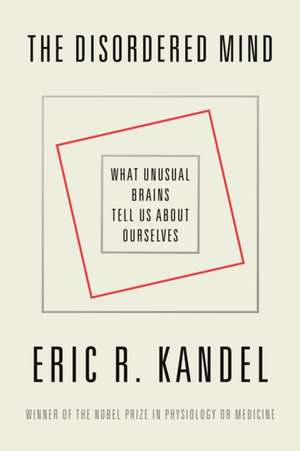
The Disordered Mind
Autor Eric R Kandelen Limba Engleză Paperback – 13 aug 2019
Analizăm această lucrare fundamentală pornind de la datele furnizate de laureatul Premiului Nobel, Eric R Kandel, a cărui carieră a fost dedicată înțelegerii mecanismelor biologice ale memoriei. În The Disordered Mind, autorul propune o perspectivă inversată asupra neuroștiinței: el nu studiază doar creierul sănătos pentru a înțelege boala, ci folosește tulburările psihice și neurologice ca ferestre către funcționarea normală a minții umane. Remarcăm modul în care Kandel demonstrează că studiul autismului ne poate învăța despre instinctele sociale, în timp ce cercetarea depresiei oferă date esențiale despre integritatea sinelui și emoții. Cartea acoperă o arie tematică similară cu The Physics of the Mind and Brain Disorders de Ioan Opris, însă, în timp ce Opris se concentrează pe principiile fizicii aplicate circuitelor cerebrale, Kandel adoptă o abordare mai biologică și umanistă, integrând perspective din psihologia cognitivă și moleculară. Această lucrare reprezintă o evoluție firească față de In Search of Memory, unde autorul a stabilit bazele biologiei minții, și față de Essays on Art and Science, continuând să exploreze cum procesele biologice dau naștere creativității și conștiinței. Structura textului este clară, adresându-se atât specialiștilor, cât și cititorilor interesați de fundamentele biologice ale comportamentului, fără a recurge la simplificări excesive. Credem că valoarea adăugată a acestei ediții constă în capacitatea autorului de a sintetiza decenii de cercetare de vârf într-o narațiune coerentă despre ceea ce ne face umani.
Preț: 123.80 lei
Carte disponibilă
Livrare economică 17 noiembrie-01 decembrie
Livrare express 03-07 noiembrie pentru 56.45 lei
Specificații
ISBN-10: 0374538441
Pagini: 304
Dimensiuni: 154 x 230 x 20 mm
Greutate: 0.64 kg
Editura: Farrar, Straus and Giroux
V-ar putea interesa
-
 The Mind and the BrainJeffrey M SchwartzPreț: 115.65 lei
 -
 The Private Life of the BrainBaroness Susan Greenfield-18%Preț: 65.06 lei79.13 lei
 -
 EmotionalLeonard Mlodinow-19%Preț: 63.69 lei78.82 lei
 -
 The Balanced BrainCamilla NordPreț: 78.17 lei
 -
 The Brain: A Very Short IntroductionMichael O'Shea-31%Preț: 49.06 lei71.12 lei
 -
 -16%Preț: 124.00 lei147.72 lei
 -
 Brain: An Owner's GuideElizabeth R. Ricker-17%Preț: 90.27 lei108.77 lei
 -
 ConnectomeSebastian SeungPreț: 93.83 lei
 -
 ConnectionsKarl Deisseroth-29%Preț: 61.08 lei85.65 lei
 -
 Phantoms in the BrainV. S. Ramachandran-5%Preț: 112.96 lei118.91 lei
 -
 -17%Preț: 60.97 lei73.02 lei
 -
 -48%Preț: 46.26 lei89.10 lei
 -
 -26%Preț: 90.81 lei122.07 lei
 -
 Preț: 122.07 lei
 -
 The Brain in MinutesRita Carter-25%Preț: 71.21 lei94.83 lei
 -
 One Hand ClappingNikolay KukushkinPreț: 159.17 lei
 -
 The Brain at RestJoseph JebelliPreț: 75.26 lei
 -
 Our Brains, Our SelvesMasud HusainPreț: 145.03 lei
 -
 Man Who Lost His HeadAnastasija RopaPreț: 115.84 lei
De ce să citești această carte
O recomandăm celor care doresc să înțeleagă bazele biologice ale conștiinței prin prisma neuroștiinței moderne. Cititorul va câștiga o perspectivă profundă asupra modului în care afecțiuni precum schizofrenia sau adicția nu sunt doar patologii, ci chei către înțelegerea voinței și a percepției. Este o lectură esențială pentru studenții la medicină și psihologie, oferind rigoarea unui premiu Nobel într-un limbaj accesibil.
Descriere scurtă
Eric R. Kandel, the winner of the Nobel Prize in Physiology or Medicine for his foundational research into memory storage in the brain, is one of the pioneers of modern brain science. His work continues to shape our understanding of how learning and memory work and to break down age-old barriers between the sciences and the arts.
In his seminal new book, The Disordered Mind, Kandel draws on a lifetime of pathbreaking research and the work of many other leading neuroscientists to take us on an unusual tour of the brain. He confronts one of the most difficult questions we face: How does our mind, our individual sense of self, emerge from the physical matter of the brain? The brain's 86 billion neurons communicate with one another through very precise connections. But sometimes those connections are disrupted. The brain processes that give rise to our mind can become disordered, resulting in diseases such as autism, depression, schizophrenia, Parkinson's, addiction, and post-traumatic stress disorder. While these disruptions bring great suffering, they can also reveal the mysteries of how the brain produces our most fundamental experiences and capabilities-the very nature of what it means to be human. Studies of autism illuminate the neurological foundations of our social instincts; research into depression offers important insights on emotions and the integrity of the self; and paradigm-shifting work on addiction has led to a new understanding of the relationship between pleasure and willpower.
By studying disruptions to typical brain functioning and exploring their potential treatments, we will deepen our understanding of thought, feeling, behavior, memory, and creativity. Only then can we grapple with the big question of how billions of neurons generate consciousness itself.