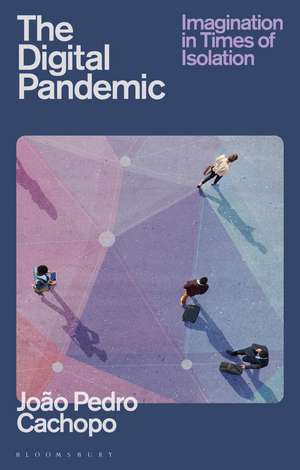
The Digital Pandemic: Imagination in Times of Isolation
Autor João Pedro Cachopoen Limba Engleză Paperback – 16 iun 2022
Arguing that the pandemic has ushered in a civilizational digital shock, João Pedro Cachopo charts new channels of relatedness and communication between people through digital technologies for the foreseeable future. The transformation of human experience that began in 2020 creates a break in our sociality that Cachopo pinpoints through key themes of love, travel, study, community and art.
In contrast to the growing philosophical literature on the pandemic, this bold theoretical work does not prophesy the fall of capitalism or the end of personal freedom and relationships. Instead, this book carefully investigates the advanced technology that is increasingly inextricable from our lives, using an alternative approach that avoids pessimism, while remaining alert to the risks and threats of the digital age. It opens up the possibility of fostering global solidarity and consciousness beyond physical borders in the 21st century.
| Toate formatele și edițiile | Preț | Express |
|---|---|---|
| Paperback (1) | 108.80 lei 3-5 săpt. | +32.49 lei 7-13 zile |
| Bloomsbury Publishing – 16 iun 2022 | 108.80 lei 3-5 săpt. | +32.49 lei 7-13 zile |
| Hardback (1) | 361.34 lei 6-8 săpt. | |
| Bloomsbury Publishing – 16 iun 2022 | 361.34 lei 6-8 săpt. |
Preț: 108.80 lei
Preț vechi: 132.39 lei
-18%
Puncte Express: 163
Preț estimativ în valută:
19.23€ • 23.07$ • 16.72£
19.23€ • 23.07$ • 16.72£
Carte disponibilă
Livrare economică 20 februarie-06 martie
Livrare express 06-12 februarie pentru 42.48 lei
Specificații
ISBN-13: 9781350284296
ISBN-10: 1350284297
Pagini: 128
Dimensiuni: 138 x 214 x 10 mm
Greutate: 0.45 kg
Editura: Bloomsbury Publishing
Colecția Bloomsbury Academic
Locul publicării:London, United Kingdom
ISBN-10: 1350284297
Pagini: 128
Dimensiuni: 138 x 214 x 10 mm
Greutate: 0.45 kg
Editura: Bloomsbury Publishing
Colecția Bloomsbury Academic
Locul publicării:London, United Kingdom
Cuprins
Prologue: The Pandemic Is Not the Event
1. The Role of Philosophy in Times of Uncertainty
2. Questions, Hypotheses, Suspicions
3. Topology of the Imagination
4. Apocalypse Remediated
5. The Disruption of the Senses
Love
Travel
Study
Community
Art
Epilogue: Our World After the Pandemic
Index
1. The Role of Philosophy in Times of Uncertainty
2. Questions, Hypotheses, Suspicions
3. Topology of the Imagination
4. Apocalypse Remediated
5. The Disruption of the Senses
Love
Travel
Study
Community
Art
Epilogue: Our World After the Pandemic
Index
Recenzii
A marvellous meditation on the spatial and temporal reorientation brought to light by the pandemic. Covering isolation in the home, and the shock of a new daily existence that produces distinct aesthetic experiences, Cachopo explores the digital pandemic through globalization, inequality, biopolitics, technology and disaster capitalism.
From Agamben to Zizek, anyone interested in a sober, witty, and productive critique of the ways in which the pandemic has influenced our ways of loving, studying, traveling, coexisting, and creating should read this book.
Among countless books and articles on the COVID-19 crisis, The Digital Pandemic stands out. It is a compelling meditation on the isolation that we have experienced. Philosophically sophisticated and yet thoroughly readable, the book offers fresh insight into the physical separation and digital proximity of life during this unpredictable pandemic.
Speaking to the urgency of our times, this is a short, incisive book that manages to slow down. Cachopo's analysis moves the critical literature on the pandemic along by highlighting how digital media reshapes the conditions of human imagination.
From Agamben to Zizek, anyone interested in a sober, witty, and productive critique of the ways in which the pandemic has influenced our ways of loving, studying, traveling, coexisting, and creating should read this book.
Among countless books and articles on the COVID-19 crisis, The Digital Pandemic stands out. It is a compelling meditation on the isolation that we have experienced. Philosophically sophisticated and yet thoroughly readable, the book offers fresh insight into the physical separation and digital proximity of life during this unpredictable pandemic.
Speaking to the urgency of our times, this is a short, incisive book that manages to slow down. Cachopo's analysis moves the critical literature on the pandemic along by highlighting how digital media reshapes the conditions of human imagination.