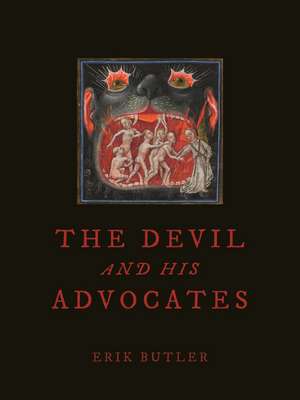
The Devil and His Advocates
Autor Erik Butleren Limba Engleză Hardback – 15 mar 2021
În volumul The Devil and His Advocates, apărut la REAKTION BOOKS, explorăm o perspectivă care răstoarnă imaginea populară a lui Satan ca antagonist absolut. Această ediție propune o reevaluare a figurii diavolului nu ca inamic al divinității, ci ca un funcționar cosmic a cărui sarcină, încă de la prima apariție în Cartea lui Iov, este de a pune la încercare integritatea umană. Suntem de părere că forța acestui studiu constă în refuzul de a accepta scuza „diavolul m-a pus să o fac”, demonstrând prin exemple riguroase că Satan doar facilitează impulsurile pe care oamenii le posedă deja. Lucrarea completează perspectiva oferită de Satan in the Bible, God's Minister of Justice de Henry Ansgar Kelly, adăugând o dimensiune culturală vastă care depășește exegeza biblică pură. În timp ce Kelly se concentrează pe statutul juridic al lui Satan în textele sacre, Erik Butler extinde analiza către arte, muzică și literatură, urmărind metamorfozele personajului în viziunea lui Dante, Milton sau Goethe. În contextul operei sale, The Devil and His Advocates se aliniază preocupării autorului pentru figurile marginale și miturile culturii europene, amintind de abordarea din Metamorphoses of the Vampire in Literature and Film. Dacă în lucrări precum Atlas of Poetic Zoology Butler investiga minunile lumii naturale, aici el cartografiază geografia morală a răului, păstrând același ton erudit și spirit critic. Putem afirma că volumul este o sinteză magistrală care transformă o temă teologică aridă într-o istorie culturală vibrantă a responsabilității umane.
Preț: 169.73 lei
Preț vechi: 203.34 lei
-17%
Carte disponibilă
Livrare economică 30 octombrie-06 noiembrie
Livrare express 16-22 octombrie pentru 68.78 lei
Specificații
ISBN-10: 178914373X
Pagini: 272
Ilustrații: 29 halftones
Dimensiuni: 164 x 218 x 32 mm
Greutate: 0.51 kg
Editura: REAKTION BOOKS
V-ar putea interesa
-
 -21%Preț: 153.01 lei194.69 lei
 -
 In the SwarmByung-Chul HanPreț: 75.81 lei
 -
 The Agony of ErosByung-Chul HanPreț: 77.52 lei
 -
 Felt Time: The Science of How We Experience TimeMarc Wittmann-17%Preț: 102.18 lei122.75 lei
 -
 Preț: 353.61 lei
 -
 An Everyday ManWilliam WickhamPreț: 42.92 lei
 -
 Two Dogs Recognizing and Dealing with Our Two Conflicting NaturesD. W. FothergillPreț: 113.20 lei
 -
 J'Ai Cherche La Mort J'Ai Trouve La VieGerard BoyerPreț: 148.35 lei
 -
 Klassieke Astrologie Basisboek Hellenistische periodeJohan LigteneigenPreț: 421.99 lei
 -
 Dharma Training Course Year OneTriratna Buddhist CommunityPreț: 187.95 lei
 -
 IdentitiesEmelrennPreț: 159.20 lei
 -
 The Peaceful TimesDaria ShermanPreț: 258.09 lei
 -
 Hideous GnosisNicola MasciandaroPreț: 92.24 lei
 -
 Religion in a NutshellBradley W. RaschPreț: 82.51 lei
 -
 Devotional Field BookU S Marine CorpsPreț: 44.19 lei
 -
 Transcendence and FulfillmentBenjamin W. FarleyPreț: 222.65 lei
 -
 Mary, Help of Christians and the Fourteen Saints Invoked as Holy HelpersRev Bonaventure HammerPreț: 77.43 lei
 -
 Jawshan Al-KabirAngel JibrailPreț: 64.25 lei
 -
 Preț: 216.41 lei
 -
 What God Is NotDonald AshePreț: 85.87 lei
 -
 Equanimity: The Spirit WithinSamuel BartoliPreț: 119.54 lei
 -
 Kodex der Energiemedizin: Werde glücklich, dann bist Du gesund!Matthias KaiserPreț: 272.96 lei
De ce să citești această carte
Această carte este esențială pentru cititorii interesați de istoria ideilor și de modul în care figurile religioase au modelat cultura occidentală. Veți câștiga o înțelegere nuanțată a responsabilității morale, învățând să distingeți între mitul popular al demonului ispititor și rolul său biblic de „avocat” al testării umane. Este o lectură densă, dar accesibilă, care oferă instrumentele necesare pentru a decoda simbolismul satanic în artă și literatură.
Despre autor
Erik Butler este un cercetător și scriitor prolific, specializat în istoria culturii europene și în cinematografie. Expertiza sa vastă se reflectă în diversitatea subiectelor abordate, de la evoluția literaturii europene în The Bellum Grammaticale and the Rise of European Literature, până la analize de nișă despre creaturi mitologice. Stilul său se remarcă prin capacitatea de a face conexiuni între discipline aparent disparate, precum teologia, folclorul și teoria filmului, oferind cititorilor o perspectivă academică riguroasă, dar marcată de o curiozitate intelectuală captivantă.