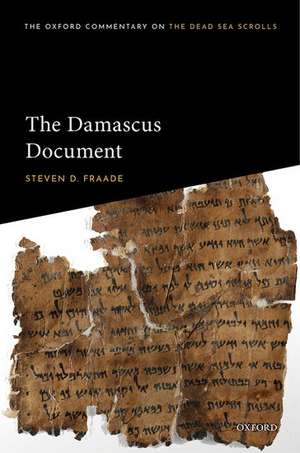
The Damascus Document: Oxford Commentary on the Dead Sea Scrolls
Autor Steven D. Fraadeen Limba Engleză Hardback – 19 noi 2021

Preț: 601.46 lei
Preț vechi: 895.29 lei
-33%
Puncte Express: 902
Carte disponibilă
Livrare economică 29 octombrie-04 noiembrie
Livrare prin curier în România Termenul estimat este afișat lângă disponibilitate.
Transport gratuit pentru acest produs Plată online sau ramburs, în funcție de opțiunile comenzii.
Retur gratuit în 14 zile Comandă securizată și suport în română.
Specificații
ISBN-13: 9780198734338
ISBN-10: 0198734336
Pagini: 206
Dimensiuni: 163 x 240 x 20 mm
Greutate: 0.49 kg
Editura: OUP OXFORD
Colecția OUP Oxford
Seria Oxford Commentary on the Dead Sea Scrolls
Locul publicării:Oxford, United Kingdom
ISBN-10: 0198734336
Pagini: 206
Dimensiuni: 163 x 240 x 20 mm
Greutate: 0.49 kg
Editura: OUP OXFORD
Colecția OUP Oxford
Seria Oxford Commentary on the Dead Sea Scrolls
Locul publicării:Oxford, United Kingdom
Recenzii
What sets this commentary apart is its philosophical sophistication, adopting a broadly Gadamerian approach to the question of what a "work" is.
Scholars in a variety of fields should salute the publication of Steven Fraade's new commentary on the Damascus Document.
A most pleasing volume that demonstrates clarity, erudition and discernment throughout.
The Damascus Document, the second volume in the series, Oxford Commentary on the Dead Sea Scrolls (OCDSS), is such a work that will be helpful to both new readers and experts...Fraade's balanced and succinct style of commentary is congruous with the mission of the Oxford Commentary on the Dead Sea Scrolls series- "to provide scholarship of the highest level that is accessible to non-specialists." The commentary is a product of and testament to the author's meticulous use of the comparative method and will surely contribute to conversations between scholars of Scrolls and specialists in cognate fields.
These brief observations underscore the scholarly value of this commentary. The author deserves commendation for having concisely assembled a substantial body of documentation pertaining to the various manuscripts of the Damascus Document.
Fraade's learned commentary bridges these fissures and, in doing so, demonstrates the creative and intellectual scale of ambition and learrting of the ancient authors of this text. The volume will become a standard point of reference for scholars and students of the Damascus Document, Second Temple Judaism and the history of Jewish law.
These few remarks underline the interest in reading this commentary. We will be grateful to the author for having gathered in a few condensed pages a rich documentation concerning the various copies of the Damascus Document regulating family life, according to the law of Moses correctly interpreted, in the various Essene camps distributed in towns and villages, a composition parallel to the Rule of the Community for singles of Qumran.
Fraade's presentation of the Damascus Document provides a thorough introduction to the content and historical context of the document.... this commentary will prove highly valuable to both non-specialists and scholars alike. This handy volume represents yet another significant step in making the Dead Sea Scrolls accessible to a wider readership.
Scholars in a variety of fields should salute the publication of Steven Fraade's new commentary on the Damascus Document.
A most pleasing volume that demonstrates clarity, erudition and discernment throughout.
The Damascus Document, the second volume in the series, Oxford Commentary on the Dead Sea Scrolls (OCDSS), is such a work that will be helpful to both new readers and experts...Fraade's balanced and succinct style of commentary is congruous with the mission of the Oxford Commentary on the Dead Sea Scrolls series- "to provide scholarship of the highest level that is accessible to non-specialists." The commentary is a product of and testament to the author's meticulous use of the comparative method and will surely contribute to conversations between scholars of Scrolls and specialists in cognate fields.
These brief observations underscore the scholarly value of this commentary. The author deserves commendation for having concisely assembled a substantial body of documentation pertaining to the various manuscripts of the Damascus Document.
Fraade's learned commentary bridges these fissures and, in doing so, demonstrates the creative and intellectual scale of ambition and learrting of the ancient authors of this text. The volume will become a standard point of reference for scholars and students of the Damascus Document, Second Temple Judaism and the history of Jewish law.
These few remarks underline the interest in reading this commentary. We will be grateful to the author for having gathered in a few condensed pages a rich documentation concerning the various copies of the Damascus Document regulating family life, according to the law of Moses correctly interpreted, in the various Essene camps distributed in towns and villages, a composition parallel to the Rule of the Community for singles of Qumran.
Fraade's presentation of the Damascus Document provides a thorough introduction to the content and historical context of the document.... this commentary will prove highly valuable to both non-specialists and scholars alike. This handy volume represents yet another significant step in making the Dead Sea Scrolls accessible to a wider readership.
Notă biografică
Steven D. Fraade is the Mark Taper Professor of the History of Judaism at Yale University in the Department of Religious Studies and the Program in Judaic Studies. He has held a John Simon Guggenheim Memorial Foundation Fellowship and was awarded a National Jewish Book Award for Scholarship for From Tradition to Commentary. Fraade has published widely in the history of ancient Judaism, rabbinic literature, multilingualism in antiquity, scriptural translation and interpretation, ancient Jewish legal rhetoric, and the Dead Sea Scrolls. He is the author Enosh and His Generation: Pre-Israelite Hero and History in Post-Biblical Interpretation (1984), From Tradition to Commentary: Torah and its Interpretation in the Midrash Sifre to Deuteronomy (1991), and Legal Fictions: Studies of Law and Narrative in the Discursive Worlds of Ancient Jewish Sectarians and Sages (2011). He is the co-editor of Rabbinic Perspectives: Rabbinic Literature and the Dead Sea Scrolls (2006).